Agnico Eagle Mines (AEM): Supplier landscape, strategic posture, and what the market needs to know
Agnico Eagle Mines operates as a global gold producer that monetizes through exploration, development and the sale of refined gold from operating mines in Canada, Sweden and Finland; revenue derives from mineral production and hedged/spot metal sales while the balance sheet supports disciplined capital allocation to M&A and development. With roughly $105 billion market capitalization, robust margins and a recurring dividend, Agnico Eagle leverages scale to extract cost efficiencies from suppliers and contractors and to internalize critical project risk where it is value-accretive.
If you are evaluating supplier exposure or vendor partnership with Agnico Eagle, this note synthesizes the supplier-related signals uncovered in recent filings and market notices, and translates them into operational and investment implications. For a deeper look at supplier coverage and supplier-risk scoring, visit https://nullexposure.com/.
Why supplier relationships matter for a major gold producer
Agnico Eagle is a capital-intensive operator: mining projects require specialized heavy equipment, engineering contractors, and long lead-time inputs. Scale grants Agnico Eagle negotiating leverage with global suppliers, while the geographic footprint across Canada, Sweden and Finland reduces single-site concentration risk for material inputs. The company’s strong profitability metrics — including a 37.5% profit margin and nearly $12 billion in trailing revenue — reinforce a buyer posture that secures favorable contracting terms and the capacity to self-fund strategic acquisitions.
Bold takeaway: Agnico Eagle’s size and margins convert supplier relationships into discretionary tools for cost control and project timing, rather than fixed points of operational vulnerability. Learn more about supplier intelligence for mining companies at https://nullexposure.com/.
The hard facts on supplier-related signals (constraints and company-level posture)
The consolidated intelligence feed returned no explicit supplier constraints tied to Agnico Eagle in this review. That absence itself is a signal: there are no flagged contractual bottlenecks, supplier disputes, or embargoed input lines in the available notices.
Company-level signals to incorporate into supplier-risk analysis:
- Contracting posture: Large buyer with cash flow to finance capital projects and acquisitions; this translates into the ability to demand performance and to pick reliable suppliers.
- Concentration: Multi-jurisdictional operations lower the systemic single-supplier risk; however, specialized mining equipment and construction contractors are still critical single points for project schedules.
- Criticality: Suppliers of mining services and tailings/processing technology are operationally critical; Agnico’s financial strength reduces counterparty credit risk for its suppliers.
- Maturity: Established producer with repeated project cycles and a history of M&A — supplier relationships are likely to be long-running and performance-oriented.
Specific supplier relationships identified in public notices
Below are every supplier-related relationship uncovered in the intelligence set, with a concise, plain-English summary and the public source.
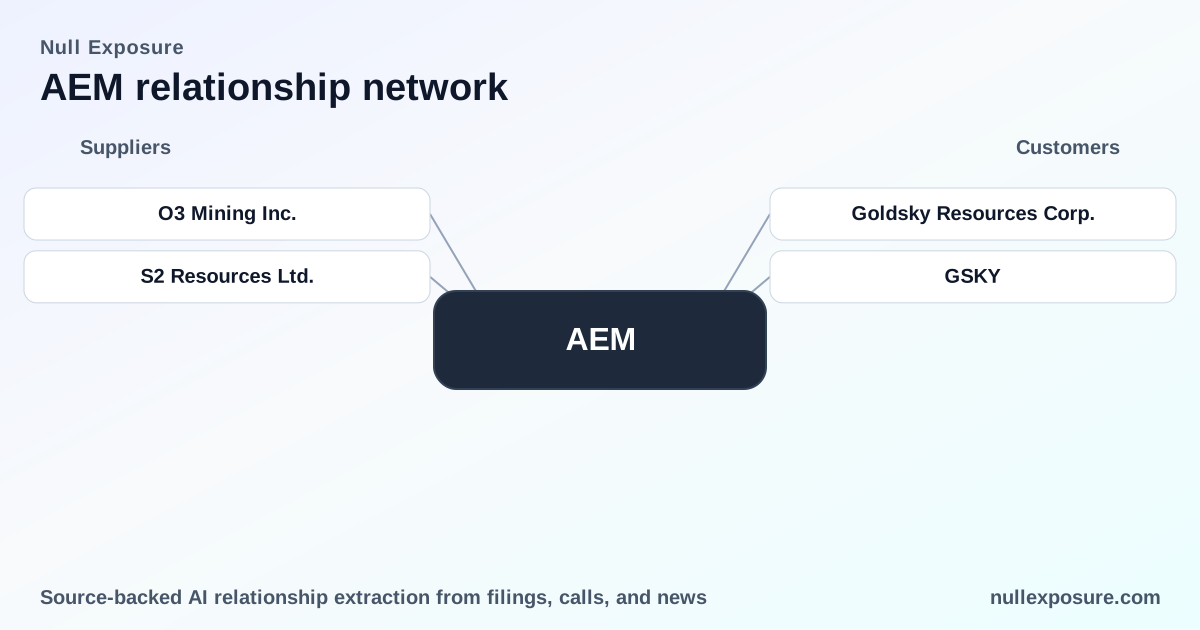
O3 Mining Inc. — The Marban deposit reserve declaration is tied to the March 2025 acquisition of O3 Mining, which brought Marban into Agnico’s portfolio; this is the first formal mineral reserve statement for Marban since that acquisition, signaling integration of acquired ore bodies into reserve reporting (Markets FT announcement, FY2026).
Source: Markets FT corporate announcement (published via FT Markets, referenced in notices seen March 2026).
S2 Resources Ltd. — Agnico Eagle’s exploration program will assess the Fosterville tenement that it acquired from S2 Resources on December 22, 2025, indicating early-stage exploration and evaluation activity on newly transferred ground (Markets FT announcement, FY2026).
Source: Markets FT corporate announcement (published via FT Markets, referenced in notices seen March 2026).
What those relationships imply for procurement and operations
Both entries are acquisition-driven rather than vendor-supplier disputes: they describe asset transfers and subsequent reserve or exploration activity rather than supplier failures or vendor concentration events. That nuance matters for investors and operators:
- Acquisitions expand Agnico’s vendor footprint and can increase demand for specialist contractors during ramp-up and evaluation phases. Expect short-term purchasing spikes in drilling, geotech, and engineering services tied to newly acquired assets.
- The Marban reserve declaration is a near-term validation event that accelerates development planning and procurement decisions; validated reserves convert optionality into scheduled capital and supplier contracts.
- The Fosterville tenement assessment is exploratory; procurement demand will be phased and episodic, focused initially on survey and drilling services rather than long-term plant vendors.
Bold takeaway: These relationships highlight Agnico Eagle’s use of acquisitions to source reserves and then onboard suppliers to drive conversion — not supplier-led operational disruption.
For an expanded supplier-risk brief tailored to mining procurement, explore our modeling tools at https://nullexposure.com/.
Investment implications and a concise risk checklist
From an investment perspective, the notices reinforce a growth-through-acquisition posture that shifts risk from pure exploration to integration and execution:
- Positive: Reserve additions convert into predictable capital expenditure and future production, which underpins mid-cycle cash flow assumptions used by analysts (Agnico’s analyst consensus skews bullish: multiple buy/strong-buy ratings).
- Procurement risk: Short, execution-sensitive supplier contracts for site development and commissioning become critical to realize forecasted production; timeline slippage or contractor underperformance would impair near-term throughput.
- Financial buffer: Strong margins, a solid EBITDA base, and institutional ownership above 73% provide financial resiliency to manage supplier disputes or to switch vendors if necessary.
Risk checklist for investors and operators:
- Confirm contractor track records and contract terms on newly acquired sites.
- Monitor capex pacing and vendor payment cadence for signs of integration stress.
- Track reserve-to-production conversion timelines against public guidance.
Conclusion — what investors should do next
Agnico Eagle’s recent notices reflect a deliberate acquisition-and-validate strategy: the company acquires assets, carries out reserve declarations or exploratory assessments, and then layers supplier contracts to convert those assets into production. There are no supplier constraints flagged in the readout, and Agnico’s size and margins give it the commercial leverage to manage supplier risk proactively.
For investors and procurement teams wanting a structured supplier-risk profile or proactive alerts on supplier-level developments, visit https://nullexposure.com/ for tailored coverage and ongoing monitoring.
Bold closing: Agnico Eagle’s supplier relationships are executional levers for growth, not immediate sources of fragility — focus diligence on contractor selection and execution timelines as acquisitions move into development.