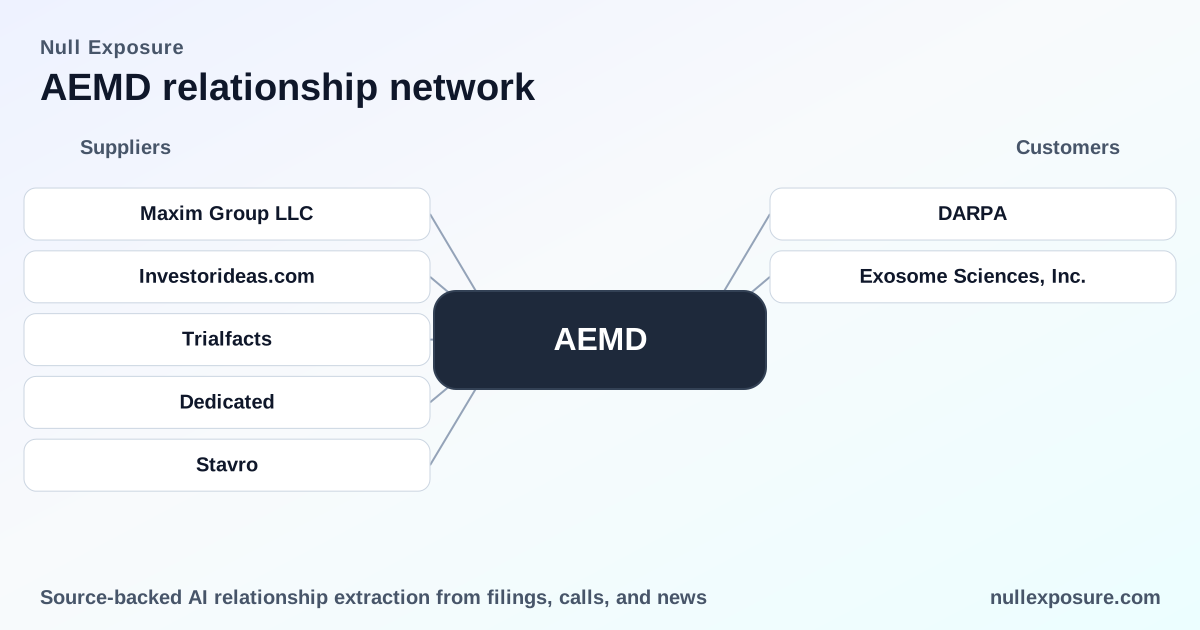
AEMD supplier map: what investors should know about Aethlon Medical’s external relationships
Aethlon Medical develops the Hemopurifier, a medical device intended to remove disease-associated particles from blood; the company currently monetizes chiefly through product development milestones, limited commercial activity, and serial capital raises that finance R&D and trials. With trailing revenue under $1 million, a market capitalization in the low single-digit millions, and repeated use of placement agents for equity financing, Aethlon’s supplier and services posture is as important to investors as its clinical pipeline—because outside partners carry operational, regulatory and cash‑consumption implications. For a distilled supplier view and risk checklist, see Null Exposure for full supplier intelligence: https://nullexposure.com/.
Business model and operating constraints that shape supplier risk
- Contracting posture — long‑term commitments. Aethlon discloses multiple multi‑year agreements for facilities and manufacturing capacity (terms cited at 55–63 months), which signals fixed obligations that reduce near‑term flexibility but provide continuity for development and GMP manufacturing.
- IP and licensing dependency. The company relies on third‑party licenses for specific Hemopurifier applications; loss or challenge to licensed IP would be material to R&D progress.
- Concentrated single‑sourced components. Management discloses that the Hemopurifier contains three critical components with limited suppliers, an intrinsic concentration risk that elevates supplier importance and potential production bottlenecks.
- Service intensity and outsourcing. Aethlon uses multiple service providers (audit firms, placement agents, CROs, patient‑recruitment vendors), and procures some inputs through distributors, reflecting an operating model that outsources noncore functions at scale.
- Manufacturing footprint and regulatory gating. Historically the Hemopurifier was made with a California contract manufacturer under cGMP and registered with the FDA; Aethlon is actively qualifying alternative suppliers for key components under FDA supplements—this indicates dependency on regulated manufacturing partners and regulatory approval for supplier changes.
- Active supplier relationships. Vendor management and cybersecurity programs are in place; most supplier relationships are described as active rather than exploratory.
Who Aethlon is working with — relationship snapshots and sources Aethlon’s public reporting and press coverage identify a small set of external partners that matter today. Below are concise, plain‑English summaries for every relationship surfaced in the results.
-
Maxim Group LLC — Maxim has acted as Aethlon’s exclusive placement agent for recent equity offerings, and the company paid a cash fee equivalent to 6.5% of gross proceeds plus expense reimbursement on at least one placement. This positions Maxim as the primary capital‑markets intermediary used to fund ongoing development. According to StockTitan and company disclosures in FY2025, Maxim served as exclusive/sole placement agent for private placements in 2025–2026 (press reports, March 2026) and was paid placement fees and expense reimbursements.
-
Investorideas.com — InvestorIdeas hosted at least two paid press releases that featured Aethlon content; these are paid promotional placements rather than independent news coverage. InvestorIdeas’ paid releases were published in FY2025, and the releases are disclosed as paid content in press pickups (InvestorIdeas/Newsfile, 2025–2026).
-
Trialfacts — Trialfacts has been contracted by Aethlon to support clinical trial recruitment, and management reported an uptick in interested participants since engaging Trialfacts, indicating measurable operational impact on enrollment activity. This engagement was referenced in an earnings call transcript covering FY2026 (InsiderMonkey / Q3 FY2026 call coverage).
-
Dedicated — Dedicated (a recruitment/clinical enrollment vendor) is named alongside Trialfacts as a contracted group that helped increase interest among potential study participants, suggesting Aethlon is using multiple third‑party recruiters in active trials. The relationship and its effect on recruitment were noted in the company’s FY2026 earnings discussion (InsiderMonkey transcript).
-
Stavro — Under a Material Transfer Agreement, Stavro is evaluating compatibility of the Hemopurifier with its simplified blood treatment platform (SLAMB system), a collaboration that could broaden settings for use (e.g., oncology units and infusion centers) if technical compatibility is confirmed. This collaboration and the MTA were reported in FY2026 press coverage and investor forum notices (Intellectia.ai and company earnings commentary).
How these relationships drive value — and where they create risk
- Capital formation via placement agents (Maxim) is fundamental to Aethlon’s ability to continue trials and vendor payments; placement fees are a recurring cash burden but enable short‑term runway extension. Investor impact: dilution and recurring financing costs are an explicit part of the investment calculus.
- Paid media (InvestorIdeas) increases visibility but provides no operational capability; investors should treat paid placements as promotional spend rather than independent validation.
- Clinical recruitment vendors (Trialfacts, Dedicated) materially shorten enrollment timelines when effective; improved recruitment reduces trial duration and cash burn from prolonged studies. Conversely, failure to enroll would be a programmatic and financial setback.
- Technical collaboration (Stavro) addresses a strategic aim: reducing reliance on dialysis infrastructure by enabling use in infusion‑center settings. Successful integration could lower deployment barriers and broaden the commercial pathway, but it depends on MTA results and regulatory acceptance.
Operational maturity and concentration profile Aethlon’s supplier picture fits an R&D‑stage medical device company with concentrated supply and service reliance: manufacturing is outsourced to cGMP contract manufacturers, several components are single‑sourced, and licensing underpins product features. These characteristics produce a high operational leverage where a small number of supplier relationships have outsized impact on regulatory timelines and commercial scale‑up.
Key investment takeaways
- Supplier dependency is high: three critical components with limited suppliers, a single active contract manufacturer historically, and ongoing efforts to qualify alternatives elevate supply‑chain and regulatory transition risk.
- Financing reliance is explicit: repeated use of placement agents and paid PR demonstrates a capital‑consumptive model financed by equity raises rather than product revenue today.
- Clinical and product partnerships matter: recruitment vendors materially affect enrollment velocity, and technology MTAs (e.g., Stavro) could materially affect the go‑to‑market pathway if compatibility tests are positive.
If you need a deeper supplier risk scorecard or a custom diligence brief on any single partner listed above, Null Exposure provides targeted supplier intelligence and monitoring—start your review at the homepage: https://nullexposure.com/.
Conclusion and next steps Aethlon’s operational viability rests on three pillars: continued financing, successful clinical enrollment, and the ability to secure alternative component suppliers or obtain regulatory approvals to change suppliers. Investors should track placement activity, CRO/recruitment performance metrics, and MTA/compatibility outcomes as the proximate drivers of value. For supplier‑level monitoring and live updates on AEMD partner activity, visit Null Exposure and request the Aethlon supplier brief: https://nullexposure.com/.