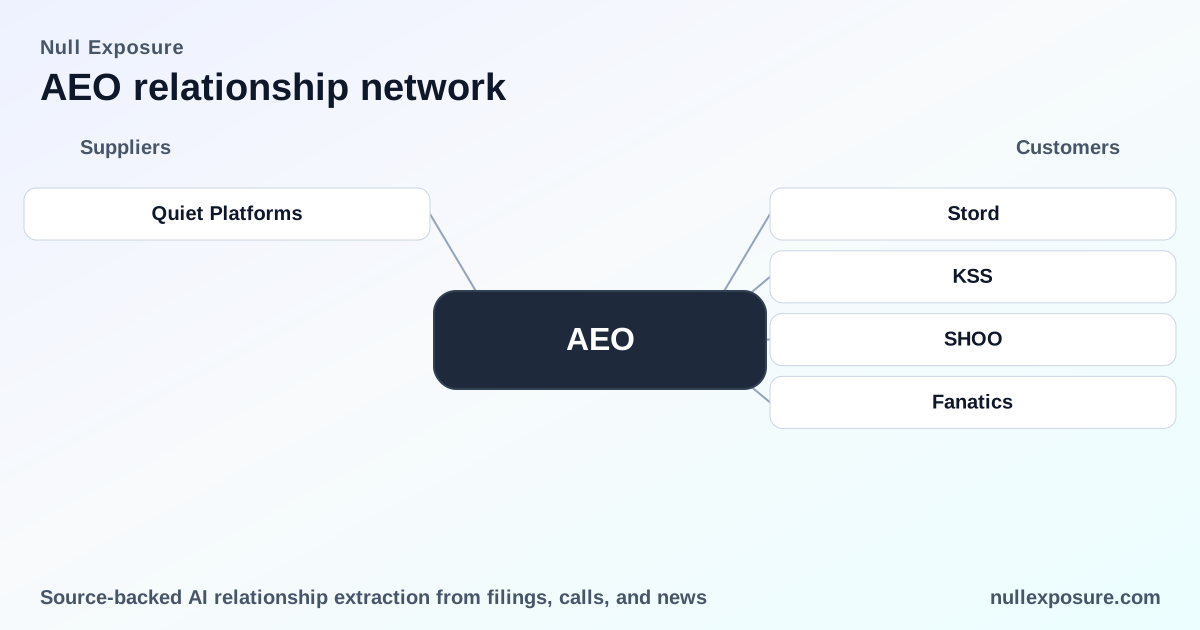
American Eagle Outfitters (AEO): supplier posture, logistics shifts, and what investors should price in
American Eagle Outfitters is a specialty apparel retailer that monetizes through retail and e‑commerce sales of its American Eagle and Aerie brands, relying on third‑party manufacturing and outsourced logistics to convert designs into shelf and online inventory. The company captures margin through product gross profit and operating leverage across store and digital channels, while liquidity for operations is supported by a senior secured, asset‑based credit facility. Investors evaluating supplier relationships should focus on AEO’s geographic sourcing concentration (Asia), its reliance on third‑party factories and logistics partners, and the operational impact of recent logistics exits and restructuring.
For a consolidated view of supplier risk and relationship mapping, visit https://nullexposure.com/.
Quiet Platforms: a discrete logistics separation with operational consequences
Quiet Platforms was referenced in AEO’s FY2026 material event filing as part of an adjustment tied to the company’s exit from a third‑party logistics business, alongside store impairments and corporate restructuring. This indicates AEO is terminating or substantially changing a logistics relationship that previously supported distribution operations (8‑K filed March 2026: https://www.stocktitan.net/sec-filings/AEO/8-k-american-eagle-outfitters-inc-reports-material-event-85ed08bc2641.html).
The exit from Quiet Platforms is a focused operational shift: it reduces one external logistics channel and triggers restructuring costs, but creates flexibility to re‑allocate volumes to other providers or insource selected capabilities.
How AEO sources and structures supplier relationships
AEO’s supplier model combines in‑house product design with a network of third‑party manufacturers and regionally contracted distribution services. Key operating signals from company disclosures:
- Asia‑centric sourcing: AEO sources merchandise primarily from vendors in Asia and reports purchasing substantially all merchandise from non‑North American suppliers during Fiscal 2024, while avoiding single‑factory concentration by sourcing less than 10% from any one factory. This is a deliberate concentration strategy: high geographic concentration for cost and capability, paired with vendor diversification to limit single‑point factory risk (company filings, Fiscal 2024).
- Buyer and design role: AEO designs products and acts as the buyer for finished goods; production is executed by third‑party factories, underscoring dependency on contract manufacturers for core product supply (company filings).
- Regional logistics providers: The company contracts third‑party distribution centers (for example, a partner in Mexico serves stores and e‑commerce in that region), indicating outsourced regional logistics as the company’s standard operating model (company filings).
These characteristics produce a supplier posture that is operationally mature and transactionally extensive, but geographically concentrated, creating a tradeoff between cost efficiency and regional disruption risk.
Contracting posture and financial backstop
AEO operates with a long‑term borrowing facility that provides an important financing buffer for supplier payments and inventory buildup: an amended and restated Credit Agreement entered in June 2022 offers senior secured asset‑based revolving credit up to $700 million, expiring June 24, 2027. This facility underpins working capital and gives the company negotiating leverage with suppliers during routine purchasing cycles, while the 2027 maturity introduces a refinance timeline investors must monitor (company filing, Credit Agreement June 2022).
Relationship inventory: what we found
- Quiet Platforms — logistics partner: AEO recorded adjustments tied to the company’s exit from the Quiet Platforms third‑party logistics business, with the related accounting and restructuring impacts disclosed in an 8‑K filed in March 2026 (8‑K filing, March 9, 2026: https://www.stocktitan.net/sec-filings/AEO/8-k-american-eagle-outfitters-inc-reports-material-event-85ed08bc2641.html).
This single recorded supplier relationship in the FY2026 public reporting highlights a targeted logistics change rather than a wholesale supplier network disruption.
For deeper supplier mapping and exposure analytics, see https://nullexposure.com/.
Investment implications — what matters to owners and operators
- Operational risk vs. cost efficiency: Asia sourcing concentrates factory and transport risk (port congestion, tariffs, labor). AEO mitigates single‑factory risk by keeping exposure to any one factory under 10%, but regional shocks in Asia still translate to inventory and margin pressure (company filings, Fiscal 2024).
- Logistics transition costs: The Quiet Platforms exit generated restructuring and impairment costs; investors should expect one‑time charges and potential near‑term service disruptions while volumes re‑route to alternate providers or regional DCs in Mexico and elsewhere (8‑K, March 2026).
- Liquidity and supplier leverage: The $700 million Credit Facility provides short‑to‑medium term liquidity cushion and supports vendor payments; the facility’s June 2027 maturity is a refinancing milestone that affects supplier negotiation stance and working capital strategy (Credit Agreement, June 2022).
- Business model resilience: With FY‑TTM revenue of roughly $5.5 billion and gross profit of about $2.0 billion, AEO has scale to absorb transition costs, but margins (operating margin ~10.2%) leave limited room for sustained supply‑chain inflation without price or productivity offsets (company financials, FY‑TTM).
- Corporate restructuring signal: The logistics exit plus store impairments and corporate restructuring indicate management is actively reshaping cost structure and distribution strategy; investors should treat this as a deliberate operational reset with short‑term expense and longer‑term efficiency objectives.
Tactical checklist for analysts and operators
- Verify whether displaced Quiet Platforms volumes have been redistributed to in‑region DCs (Mexico) or to new third‑party logistics providers; quantify transitional fulfillment costs.
- Model the impact of Asia sourcing shocks on inventory lead times and markdown risk given AEO’s product turnover and gross margin profile.
- Monitor the Credit Facility refinancing process ahead of June 2027 and its implications for working capital and vendor payment terms.
- Track restructuring charge cadence in quarterly filings to separate one‑time costs from ongoing operating improvements.
For a structured supplier risk scorecard and to subscribe to ongoing monitoring of AEO’s partner network, visit https://nullexposure.com/.
Bottom line
AEO runs a classic design‑and‑buy retail model that outsources production and logistics, concentrating sourcing in Asia while limiting single‑factory exposure. The exit from the Quiet Platforms logistics relationship signals a near‑term operational disruption and restructuring expense, but management retains a financial backstop via its credit facility and operational alternatives such as regional distribution centers. Investors should weigh geographic concentration risk and logistics transition costs against AEO’s scale and operating margin buffer when forecasting near‑term earnings and long‑term supply resilience.
To review supplier relationships holistically or commission a tailored exposure assessment, go to https://nullexposure.com/.