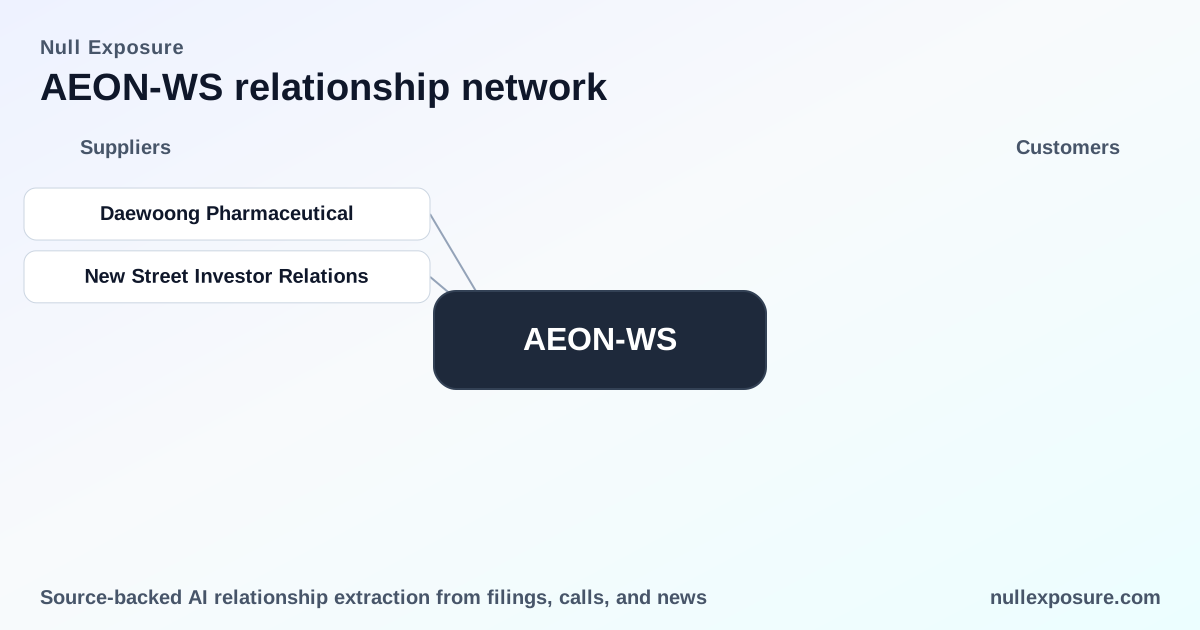
AEON-WS supplier relationships — what investors need to know
Aeon Biopharma operates as a clinical-stage biopharmaceutical company that advances biologic candidates through development and seeks value from regulatory progress, manufacturing partnerships, and commercial or licensing arrangements. The company monetizes by progressing proprietary assets (such as ABP-450) toward approval and relying on external manufacturing and partner engagement to convert clinical progress into revenue and licensing opportunities. For an at-a-glance supplier and investor view, visit https://nullexposure.com/ for broader supplier intelligence and relational context.
Why supplier mapping matters for investors
Manufacturing and investor relations providers are not peripheral for small biotechs; they are central to timelines, regulatory risk, and commercialization economics. A single qualified contract manufacturer or a small set of partners can determine the speed to market and the credibility of regulatory filings, while investor relations firms shape market access to capital and messaging during critical financings.
From the disclosed relationships here, two operational signals stand out: one external manufacturer that supports a development-stage product and one investor-relations contact used in public announcements. These are not high-volume supplier networks — they are targeted, strategic relationships whose disruptions would be material to near-term development timelines.
Supplier and service relationships (explicit records)
Below I summarize each relationship instance reported in public releases, with source attribution.
-
Daewoong Pharmaceutical — news release on 2026-03-09 (first closing of PIPE investment)
- Aeon states that ABP-450 is manufactured by Daewoong Pharmaceutical in compliance with cGMP in a facility approved by the U.S. FDA, Health Canada, and EMA; this confirms a qualified manufacturing arrangement supporting the asset’s regulatory filings and potential commercialization. Source: StockTitan news release dated 2026-03-09 (https://www.stocktitan.net/news/AEON/aeon-biopharma-announces-first-closing-of-pipe-investment-and-ykjtut542zfp.html).
-
Daewoong Pharmaceutical — quarterly results summary on 2026-03-09 (Q3 2025 results)
- The company reiterated that ABP-450 is produced by Daewoong in an approved cGMP facility, reinforcing consistency across communications that manufacturing is outsourced to a regulatorily approved partner. Source: StockTitan news post on Aeon Biopharma third-quarter 2025 results (https://www.stocktitan.net/news/AEON/aeon-biopharma-reports-third-quarter-2025-results-including-positive-3y9d8yr742y1.html).
-
New Street Investor Relations — investor contact listed in PIPE announcement
- Aeon provided Laurence Watts at New Street Investor Relations as the investor contact for the PIPE announcement, signaling engagement of an external IR advisor to manage financing communications and investor outreach. Source: StockTitan news release dated 2026-03-09 (https://www.stocktitan.net/news/AEON/aeon-biopharma-announces-first-closing-of-pipe-investment-and-ykjtut542zfp.html).
What these relationships imply for AEON-WS’s operating model
- Contracting posture: Aeon relies on third-party manufacturing rather than in-house production; this is a common capital-light approach for clinical-stage biotech that reduces fixed costs but increases dependency on vendor capacity, quality compliance, and contract terms.
- Concentration: The disclosures point to a concentrated manufacturing relationship (Daewoong) for ABP-450, which increases single-point-of-failure risk; conversely, investor relations engagement is a low-operational-risk outsourcing decision but high in messaging importance.
- Criticality: Manufacturing for a clinical/registrational product is mission-critical; Daewoong’s cGMP approvals (FDA, Health Canada, EMA) materially de-risk the manufacturing quality dimension, though they do not eliminate supply-chain, capacity, or contractual execution risk.
- Maturity and regulatory posture: The cited approvals indicate a manufacturing partner operating at a mature regulatory standard — a positive signal for regulatory dossier acceptance and inspection readiness.
- Commercial leverage: Reliance on an established contract manufacturer can accelerate time-to-market and attractiveness to potential licensees, but it also concentrates negotiating leverage with the manufacturer if no backup suppliers are disclosed.
Risk and value drivers investors should watch
- Single-manufacturer dependency: If Daewoong is the sole disclosed manufacturer for ABP-450, any production, capacity, or contract dispute could delay filings or launches — investors should look for diversification or backup capacity commitments in future disclosures.
- Regulatory alignment: The presence of approvals from FDA, Health Canada, and EMA for the manufacturing site is a strong positive, reducing quality-related regulatory risk for the specific product made there.
- Capital and messaging: Use of New Street Investor Relations in the PIPE announcement shows active external support for capital markets engagement; effective IR is a multiplier when converting clinical milestones into financing — poor messaging execution would directly affect stock liquidity and fundraising costs.
For continuous monitoring of supplier relationships and impact analysis, see https://nullexposure.com/ for structured supplier profiles and tracking.
Operational constraints and visibility
The current record set contains no explicit contractual constraints, exclusivity clauses, or supply agreements disclosed in the provided texts. This absence is itself an investor signal: publicly available relationship details are limited to manufacturing compliance statements and an IR contact, leaving key commercial terms, capacity commitments, pricing, and exclusivity unreported. Treat this as a company-level visibility gap rather than evidence of favorable or unfavorable contractual terms.
How to use this assessment in investment decisions
- For short-term event-driven investors: watch announcements on manufacturing scale-up, regulatory filings, and any additional supplier disclosures; these will materially influence timelines.
- For longer-term holders: prioritize confirmation of multi-site manufacturing strategies or contract terms that mitigate concentration risk before assuming low operational risk.
- For credit-oriented or partnership investors: assess counterparties’ balance sheets and capacity (Daewoong) and any contractual protections Aeon has secured (e.g., capacity reservation, penalties, or technology transfer provisions) — these are not present in the public snippets and should be requested in diligence.
Before acting on position sizing or funding decisions, review Aeon’s full press releases and filings and seek contractual disclosure where possible. For a deeper supplier-focused diligence framework and tailored relationship maps, start your research at https://nullexposure.com/.
Bottom line
Aeon Biopharma’s supplier footprint as disclosed is compact but strategically important: Daewoong provides regulated manufacturing capacity for ABP-450 and an external IR firm supports market-facing communications. The regulatory approvals attached to the manufacturing site are a material positive, but concentration and limited public contractual detail create execution risk that investors must monitor through subsequent disclosures and diligence.
For ongoing updates and a more systematic view of supplier concentration and risk exposure, visit https://nullexposure.com/ and sign up for supplier-monitoring alerts.