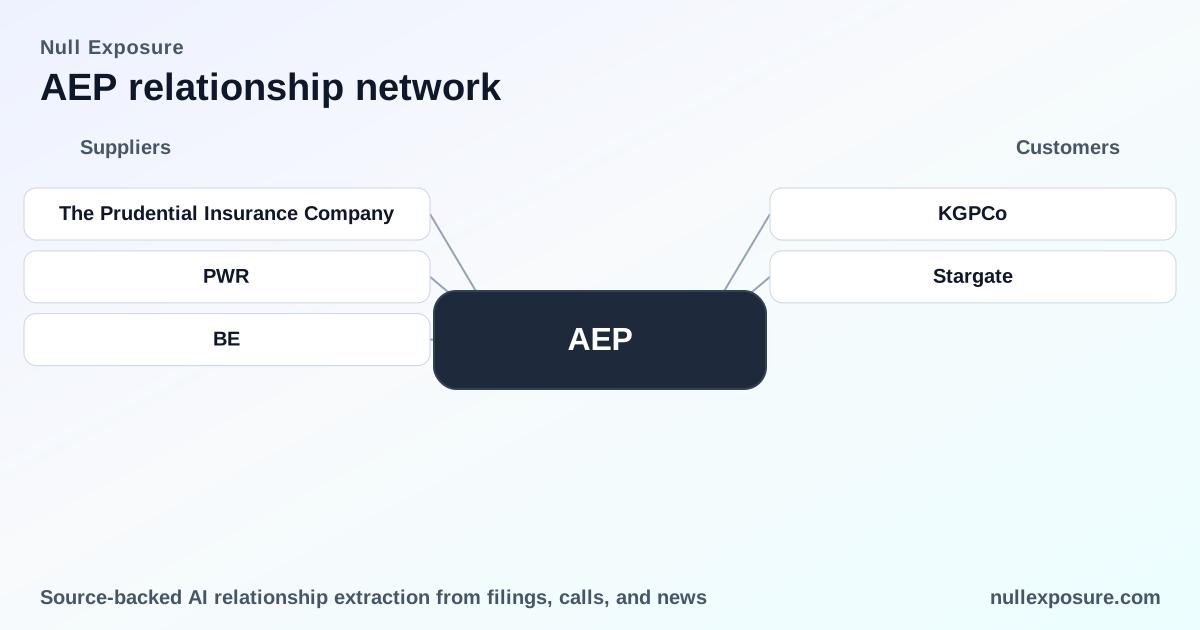
AEP supplier relationships: what investors and operators need to know
Thesis — American Electric Power (AEP) is a regulated investor-owned utility that monetizes a geographically diversified grid and generation portfolio through rate-based capital recovery and merchant/unregulated projects. Revenue and returns come from regulated electricity delivery and incremental earnings from large, strategic capital projects and generation contracts, supported by multi-year procurement and transmission partnerships that underpin both reliability and growth.
If you want a concise, sourced view of who AEP is contracting with and why it matters for operations and credit, read on — and for ongoing supplier intelligence, visit https://nullexposure.com/ for more coverage.
Supplier relationships — the partners in the filings and calls
Below are the relationships called out in AEP’s recent filings and public remarks. Each entry is a plain-English synopsis with the original source noted.
The Prudential Insurance Company (from AEP FY2025 10‑K)
AEP holds trust-owned life insurance (TOLI) under its OPEB plan trusts that is underwritten by The Prudential Insurance Company, which indicates use of life-insurance assets to support post-employment benefit liabilities. According to AEP’s FY2025 10‑K filing, the Prudential contract is part of AEP’s employee benefits funding strategy (FY2025 10‑K, filed 2026).
Quanta Services — market coverage noting strategic partnership (news, March 2026)
Market coverage reiterated a long-term partnership between AEP and Quanta Services to accelerate buildout of AEP’s 765 kV transmission network, highlighting execution as a near-term catalyst for operational expansion. A Finviz news post referencing TD Cowen’s commentary described this partnership (Finviz, March 9, 2026).
Quanta Services — AEP management discussion on the partnership (Q4 2025 earnings call)
In the Q4 2025 earnings call, AEP management confirmed that it entered a long-term strategic partnership with Quanta Services to strengthen capabilities for 765 kV transmission infrastructure buildout, framing Quanta as a key delivery partner for high-voltage transmission projects (AEP Q4 2025 earnings call, March 2026).
Bloom Energy — large-scale equipment purchase announced on earnings call (Q4 2025 earnings call)
AEP announced plans to purchase $2.65 billion of fuel cells that will be part of a generation facility expected near Cheyenne, Wyoming, indicating a material procurement and vendor relationship with fuel cell suppliers such as Bloom Energy referenced in the call (AEP Q4 2025 earnings call, March 2026).
What the constraints and procurement signals tell investors about AEP’s operating model
AEP’s supplier footprint is shaped by procurement choices and multi-decade arrangements. Filings and extracted constraints produce a coherent company-level picture:
-
Contracting posture — long-term bias. AEP’s disclosure shows a heavy reliance on long-term agreements for critical generation and power participation rights (examples include power agreements and plant-secured obligations extending to the late 2020s and 2040), which underscores predictability of supply and rate-base recovery inherent in regulated utilities.
-
Tactical use of short-term and spot markets. The company mixes spot and short-term purchases alongside long-term contracts for fuel and commodity inputs, signaling active merchant-style procurement where volatility management is required.
-
Buyer-centric relationships and centralized service functions. AEP regularly acts as the primary buyer for generation and capacity and runs a service company subsidiary that supplies administrative and technical services to affiliates at cost, indicating centralized procurement and internal service provisioning rather than purely outsourced operations.
-
Material capital exposure and concentration. The $2.65 billion procurement commitment by an unregulated subsidiary (reported in filings) signals large-ticket vendor risk and execution reliance on suppliers for new generation projects; this elevates counterparty and project-delivery risk relative to routine O&M contracts.
-
Maturity and stage. Many contracts reflected in filings are multi-year and active, reinforcing a mature supplier base oriented around long‑dated delivery and regulatory recovery rather than transient vendor relationships.
These are company-level signals derived from AEP’s public disclosures and extracted constraint evidence in FY2025–2026 filings and commentary.
Investment and operational implications — focus areas for diligence
-
Execution risk matters. Large, long-term capital procurements (e.g., the multi-billion-dollar fuel cell purchase) create concentrated exposure: project delays, supplier performance shortfalls, or cost overruns would have immediate operational and financial implications given the size and strategic nature of the assets.
-
Counterparty and credit assessment is essential. For partners like Quanta Services, which is tasked with accelerating high-voltage buildouts, investors should evaluate contractor backlog, balance-sheet strength, and subcontracting models because delivery on transmission timelines directly impacts rate cases and return profiles.
-
Regulatory sensitivity is embedded. AEP’s monetization depends on rate-base treatment and regulatory approval for cost recovery; supplier costs that become contentious in rate proceedings can affect allowed returns and cash flow timing.
-
Diversified procurement reduces spot exposure but does not eliminate vendor risk. The mix of long-term contracts and spot purchases lowers commodity risk but concentrates risk on specialized equipment and EPC providers for major projects.
If you want a detailed view of AEP’s supplier exposures and how they affect credit and operational risk, explore additional analysis at https://nullexposure.com/.
Practical advice for investors and operators
- Prioritize review of contractor performance clauses, liquidated damages, and acceptance testing for the $2.65 billion generation procurement and for transmission build contracts with Quanta.
- Monitor regulatory filings for cost recovery language tied to these projects; successful rate-case wins will materially affect value realization.
- Track counterparty credit metrics and execution milestones quarterly — for AEP, supplier delivery is a direct lever on near-term execution and long-term regulated earnings.
For continuous supplier monitoring and bespoke due diligence on utilities and their partners, visit https://nullexposure.com/ for subscriptions and deeper research tools.
Conclusion — AEP’s supplier relationships are strategic, long-dated, and capital‑intensive. That structure creates steadiness through regulated recovery but concentrates execution risk in a handful of large contracts and contractors; investors and operators should focus diligence on execution, counterparty strength, and regulatory recovery mechanics when assessing AEP’s forward profit trajectory and operational resilience.