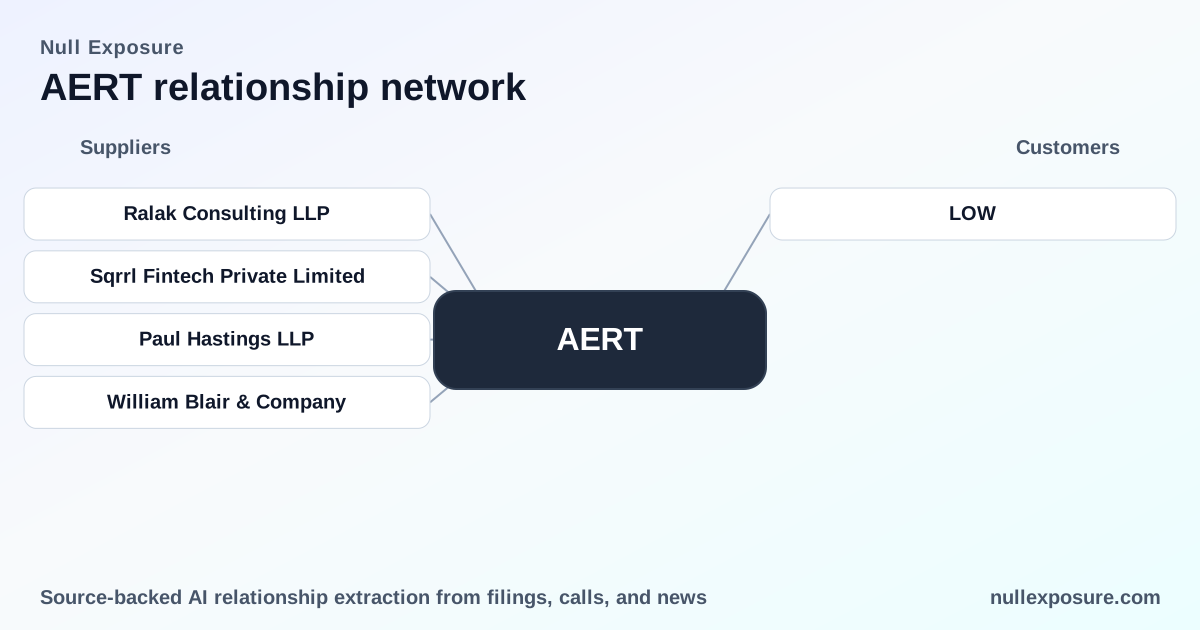
AERT supplier map: what investors need to know about counterparty exposure and contracting posture
Aeries Technology Inc. (AERT) monetizes by selling data analytics and cloud-enabled software services to enterprise clients, layering implementation and professional services on top of recurring cloud-based revenue. The company operates as a solutions integrator that leverages third‑party software, hosted infrastructure and external consulting to deliver productized AI and machine‑learning offerings, generating revenue through subscription and services contracts and driving margin through scale in cloud operations and professional services delivery.
Explore a summarized supplier intelligence view and practical investor takeaways on exposure and contracting risks at https://nullexposure.com/.
Why supplier relationships matter for AERT investors
AERT is a small-cap technology and consulting business with roughly $69 million in trailing revenue and a market capitalization around $17.8 million. That profile makes supplier arrangements disproportionately important for both continuity of service and cash flow. Key business model drivers include reliance on hosted SaaS ecosystems, outsourced implementation partners, and significant cost‑sharing arrangements that reduce fixed overhead but concentrate contractual exposure.
- Contracting posture: The company documents multi‑year cost‑sharing and facility agreements with automatic renewals, indicating a tilt toward long‑term, lock‑in style arrangements for core operational services. This reduces the risk of abrupt service interruptions but increases concentration risk if a counterparty underperforms.
- Concentration and spend: Public filings flag aggregate cost‑sharing commitments in the high hundreds of millions (reported $297–$303 million across named affiliates), signaling material third‑party spend relative to the company’s revenue base. Large spend bands create single‑point supplier risk for a small-cap operator.
- Operational criticality: AERT explicitly relies on third‑party software, hardware and hosted SaaS to deliver its solutions, so supplier operational performance is mission‑critical to service delivery and revenue recognition.
- Maturity and renewals: Facilities and cost‑sharing agreements run on 36‑month terms with automatic renewal, presenting predictable tenure but limited contractual flexibility for rapid supplier substitution.
These firm‑level signals come directly from AERT’s regulatory filings and inform capital allocation and counterparty monitoring strategies. Learn more about supplier risk intelligence at https://nullexposure.com/.
Detailed supplier relationships disclosed by AERT
The company’s public documents and related reporting list a small set of named counterparties. Each relationship below is summarized in plain language with sources.
Ralak Consulting LLP
AERT engaged Ralak Consulting LLP to provide consulting and implementation services covering business restructuring, risk management, feasibility studies and M&A support under an agreement dated April 1, 2022. This is a professional services relationship used for strategic and transformation programs. (Source: AERT FY2025 Form 10‑K disclosure.)
Sqrrl Fintech Private Limited
AERT recorded interest expense on loans borrowed from Sqrrl Fintech Private Limited to meet working capital requirements, indicating that Sqrrl has acted as a short‑to‑medium term financier for operating liquidity. This is a credit relationship rather than a vendor‑service arrangement. (Source: AERT FY2025 Form 10‑K disclosure.)
Paul Hastings LLP
On a prior transaction dated in FY2017, Paul Hastings LLP acted as legal counsel for AERT in a corporate transaction, reflecting use of outside law firms for deal execution. This relationship is legal advisory and tied to historical M&A activity reported in contemporaneous news. (Source: AccessWire report on AERT transaction, FY2017.)
William Blair & Company
William Blair & Company served as AERT’s financial advisor on the same FY2017 transaction, evidencing the company’s use of external investment banking expertise for strategic exits or M&A work. This is an advisory relationship documented in press reporting. (Source: AccessWire report on AERT transaction, FY2017.)
What the constraints reveal about supplier risk and operational posture
AERT’s public constraints and evidentiary excerpts provide forward‑looking signals about contract terms and exposure rather than granular vendor SLAs.
- Long‑term contracting is embedded in the operating model. The 36‑month cost‑sharing facility agreements with automatic renewals demonstrate the company commits to multi‑year bilateral arrangements for office management, IT and operations services, reducing churn but locking in counterparties for extended periods (evidence from FY2025 and FY2024 filings).
- Material spend concentration exists at the company level. The filings reference aggregate amounts of $297 million and $303 million across the named cost‑sharing affiliates, which places AERT in a position where large counterparty commitments are meaningful relative to its revenue base.
- Third‑party service dependence is explicit. AERT states reliance on external software, hardware and hosted SaaS providers to deliver its platform, signaling operational criticality of suppliers for uptime and product functionality.
- Role clarity: service provider posture. Filings identify many third parties as service providers, indicating a supplier universe composed primarily of vendors delivering discrete services rather than equity or JV partners.
These constraints should be read as company‑level structural signals: AERT runs with long-term, high‑value cost-sharing arrangements and outsources critical elements of its delivery stack. Investors should treat counterparty performance and contract renewal dynamics as primary monitoring metrics.
If you want a deeper vendor risk breakdown or to track supplier concentration trends for AERT over time, start with our supplier intelligence hub at https://nullexposure.com/.
Investment implications — risks and opportunities
- Risk: counterparty concentration relative to scale. Large cost‑sharing commitments can amplify operational disruption or negotiation leverage if counterparties change terms; this is a key downside for a company with negative EPS and modest cash flow margins.
- Risk: liquidity and funding dependency. Use of private loans for working capital (e.g., from Sqrrl) increases refinancing and interest rate sensitivity on a small balance sheet.
- Opportunity: defensible delivery model if suppliers perform. Long‑term arrangements and integrated third‑party platforms create stickiness for enterprise customers when uptime and integrations are reliable, enabling AERT to focus resources on product development.
- Monitoring priority: contract expiry calendars, renewal terms, counterparty financial health, and the extent to which services are replaceable within short notice should inform valuation adjustments and covenant stress testing.
Practical next steps for investors and operators
- Obtain the full FY2025 10‑K and extract the cost‑sharing schedules and collateral terms to model downside scenarios against revenue and EBITDA.
- Track interest expense and debt rollovers associated with cash‑providers such as Sqrrl to assess liquidity runway and refinancing risk.
- Confirm legal and advisory pedigree for past transactions (William Blair and Paul Hastings) as context for potential future M&A or strategic exits.
For an immediate, structured review of these supplier relationships and contract exposure across your portfolio, visit https://nullexposure.com/ to request supplier intelligence and monitoring tools.
Bottom line
AERT operates with a lean balance sheet and outsources core operational and technical functions under multi‑year, high‑value agreements, which produces both operational leverage and concentrated counterparty risk. Investors should prioritize monitoring contract renewal clauses, counterparty performance, and working capital funding sources to properly value downside scenarios and upside stability. For ongoing supplier surveillance and tailored reports, see https://nullexposure.com/.