Aeries Technology (AERTW): supplier footprint, contractor posture and what it means for investors
Aeries Technology is a U.S.-headquartered professional services and consulting firm that generates revenue by delivering implementation and advisory engagements to corporate clients; the company monetizes through project fees, implementation contracts and recurring engagements tied to software/hardware integrations and hosted services. Revenue trailing twelve months is $69.2M with gross profit of $17.235M, operating margin of 4.42% and a negative net margin, signaling a services-first business with thin operating leverage. The company’s filings also disclose reliance on third‑party software, hardware and hosted SaaS, which shapes supplier risk and contracting behavior. Learn more about supplier signals at https://nullexposure.com/.
How Aeries runs its supplier relationships — the operating skeleton investors should value
Aeries operates as a service integrator and consulting partner: the core deliverable is professional time and project outcomes rather than proprietary product licensing. That orientation produces several predictable supplier characteristics:
- Contracting posture: Predominantly short- to medium-term engagement contracts supplemented by ongoing SaaS and hosted service subscriptions. Company disclosures reference hosted SaaS applications and third‑party hardware and software as essential inputs.
- Concentration and criticality: Supplier concentration is a primary investor lens. Professional services firms typically engage many boutique consultants and a small set of software/cloud providers; when critical platform components are third‑party hosted, outages or supplier changes can be material to delivery cadence and revenue recognition.
- Maturity and stage: Supplier relationships are operationally active, spanning consultants, cyber and training providers to implementation partners. The filing language emphasizes active engagement with external consultants and security firms to sustain service delivery and governance.
- Role of suppliers: Suppliers act largely as service providers and platform vendors rather than equity partners—Aeries depends on their availability, SLAs and pricing rather than on co‑development.
These signals translate into predictable investor considerations: margin sensitivity to vendor cost changes, revenue risk from delivery disruptions, and governance exposure where key security or hosting providers are involved.
The disclosed suppliers — one-by-one, with source context
Aeries’ public filings list identifiable external providers where contract terms or roles are disclosed. Below is each disclosed relationship from the provider search results and what it means:
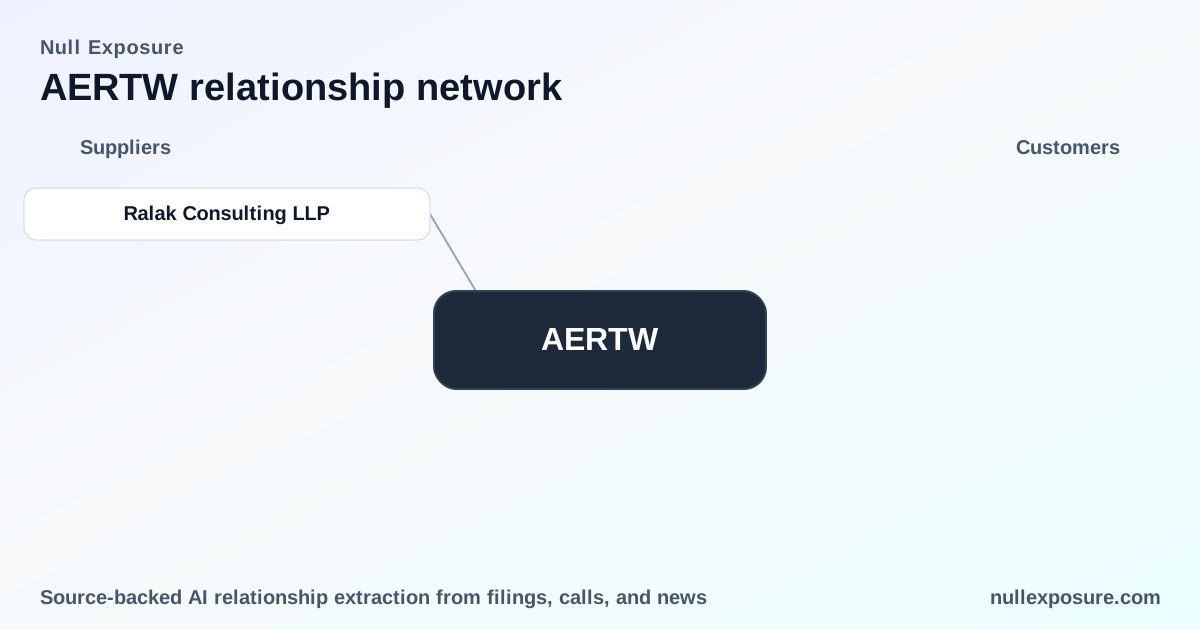
- Ralak Consulting LLP: Aeries engaged Ralak Consulting LLP under an agreement dated April 1, 2022, for consulting services covering implementation, business restructuring, risk management, feasibility studies and mergers & acquisitions. According to the company’s FY2025 10‑K, these are fee‑for‑service consulting engagements used to supplement in‑house capabilities (Aeries FY2025 10‑K, disclosed in the FY2025 filing).
Source: Aeries Technology FY2025 10‑K filing (consulting agreement; referenced in FY2025 disclosures).
This is the full set of named suppliers returned by the supplier search results. The company otherwise references a broader set of third‑party service and hosting providers in its general disclosures without naming additional firms.
What the constraints tell investors about corporate supplier risk
Aeries’ extracted constraints—subscription contracting, service‑provider role and active relationship stage—should be read as company‑level operational signals rather than relationship‑specific facts, because the constraint excerpts reference third‑party hosted SaaS and a range of external advisers without naming individual vendors.
- Subscription orientation: The disclosure that Aeries “relies on software and hardware from various third parties, as well as hosted SaaS applications” signals recurring cost structures and renewal risk; budget volatility from price increases at cloud or SaaS providers will flow directly into gross margins.
- Supplier role: Suppliers are framed as service providers and external consultants used to augment internal capability, which implies flexibility but also operational dependency when key skills or hosted platforms are not replicated internally.
- Active stage: The company’s language about ongoing engagement with cybersecurity assessors, training providers and consultants indicates relationships are operational and current—this raises the importance of monitoring contractual SLAs, incident response clauses and continuity plans.
Together these constraints indicate a supplier ecosystem that is integral to delivery, commercially subscription‑influenced, and operationally active—factors that increase the importance of vendor management for investors focused on earnings quality and operational resilience.
Investment implications and risk checklist
For investors evaluating the supplier posture of Aeries, the operational reality maps to a focused set of diligence priorities:
- Revenue and margin sensitivity: Because Aeries sells time and project outcomes, supplier cost inflation (SaaS or contractor rates) and delivery interruptions compress margins quickly. Monitor future gross profit trends relative to headcount and subcontractor spend.
- Single‑point vendor risks: Named consulting partners such as Ralak are replaceable in principle, but when combined with unnamed hosted providers, there is potential for critical dependency. Investors should demand disclosure around top vendors, concentration by spend and key SLAs.
- Cyber and continuity exposure: The company explicitly engages external firms for cybersecurity oversight and governance; contractual rights for incident response, liability caps and insurance coverage matter materially to downside risk.
- Contract maturity and renewal: A subscription orientation entails renewal exposure—understand renewal cadence for hosted services and whether pricing is fixed, CPI‑linked or subject to vendor repricing.
Practical next steps for a focused diligence program:
- Request top‑5 supplier spend and contract term summaries.
- Review SLA, continuity and indemnity clauses for hosting and security providers.
- Confirm subcontractor usage on client‑facing projects and any pass‑through liabilities.
- Track gross margin trajectory alongside subcontractor and SaaS cost lines.
If you want deeper supplier mapping or a tailored vendor risk memo for Aeries, start with a vendor concentration review available at https://nullexposure.com/.
Final takeaway and action for operators and investors
Aeries Technology runs a classic services‑led model with material dependence on third‑party software, hardware and consulting partners. That structure delivers growth by scaling billable hours and partnerships, but it also concentrates risk around vendor pricing, continuity and cybersecurity governance. Key questions for investment due diligence are vendor concentration, contract terms for hosted services, and the company’s ability to insource or reprice supplier costs without damaging client delivery.
For investors who need repeated supplier intelligence and contract‑level signals to underwrite operational risk, explore additional resources at https://nullexposure.com/. Conduct supplier‑level diligence now to quantify margin resilience and operational continuity before the next earnings cycle.