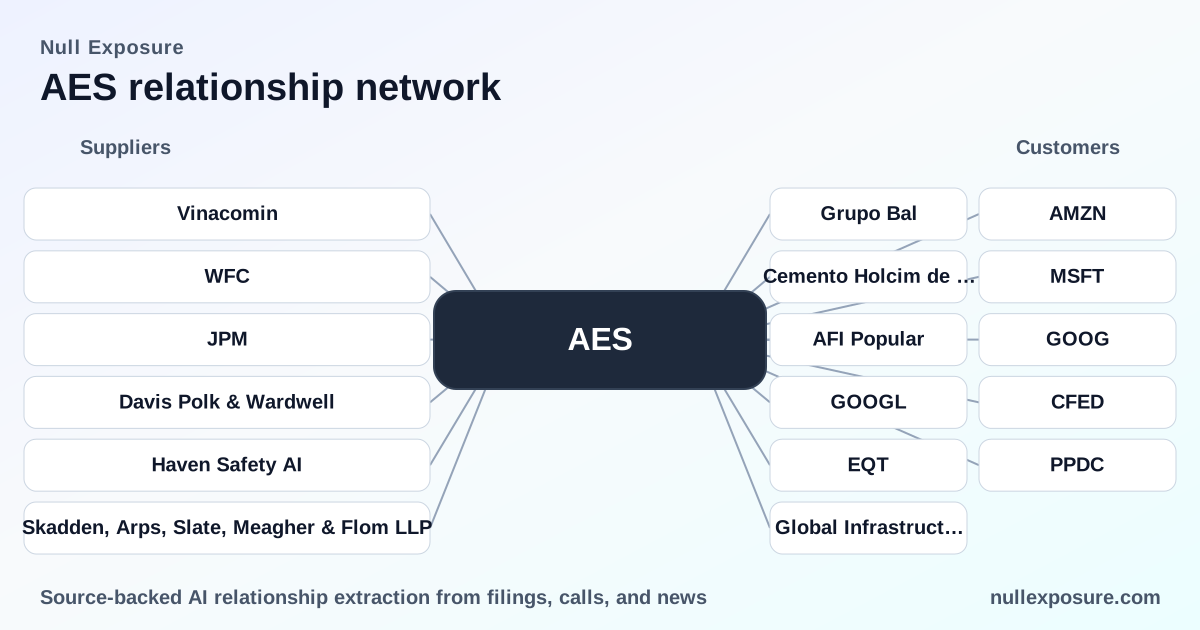
AES supplier map: advisors, fuel counterparties and service partners that matter to investors
Thesis — The AES Corporation operates large-scale generation businesses and monetizes through a mix of long-term power purchase agreements (PPAs), merchant market sales, and contracted services across thermal and renewable assets; its cash flow profile is therefore driven by contract tenure, fuel supply arrangements, and periodic capital markets transactions that re-price debt and ownership. For investors and operators, the critical angles are contract duration, supplier concentration, and the network of financial and legal advisors that signal active transaction activity. For a quick vendor-risk check and transaction watchlist, visit https://nullexposure.com/.
How AES contracts and spends shape operational risk
AES runs a hybrid contracting posture: predominantly long-term PPAs and fuel agreements supplemented by short-term market sales. According to AES’s 2024 Form 10‑K, the company discloses multiple long-term PPAs and fuel supply contracts that align with the term of its generation assets, and it also sells power on short-term markets where fuel is procured on a matching short-term basis. This mix delivers cash-flow stability from contracted capacity while preserving optionality (and exposure) from merchant sales.
AES reports substantial purchase and obligation lines where electricity, fuel and other purchase contracts run into the hundreds of millions or billions, indicating high counterparty spend and operational dependency on suppliers—this is a company-level signal that procurement counterparty risk is material by dollar exposure even if AES characterizes customer/fuel concentration as limited geographically. The company also uses supplier financing arrangements to optimize working capital, a buyer posture that introduces intermediary-credit exposure on payable financing. All are documented in AES’s 2024 filings.
Key operating-model takeaways:
- Contract tenure is a primary risk mitigant: long-term PPAs lock in revenue but create dependency on suppliers that match those contract terms.
- Large absolute spend: electricity and fuel obligations are reported at multi‑hundred‑million to multi‑billion scales, elevating counterparty and liquidity risk if contracts are disrupted.
- Hybrid counterparty roles: AES acts as buyer (supplier financing), seller (power deliveries), and service consumer (third‑party operations and maintenance), so vendor performance impacts both input cost and output reliability.
Mapping every supplier and advisor relationship in the public record
Below are the relationships surfaced in AES supplier-relationship monitoring, each with a concise investor-oriented summary and source reference.
Vinacomin
AES’s BOT company has a coal supply agreement with Vinacomin that runs alongside a PPA with EVN and is contracted through 2040, indicating a long‑dated fuel linkage for at least one thermal asset. This is disclosed in AES’s 2024 Form 10‑K (FY2024).
Wells Fargo Securities LLC
Wells Fargo Securities is acting as a financial advisor to AES in recent transactions reported in March 2026, signaling active capital-markets or sale processes where external advisory support was engaged. The advisory role was reported in an 8‑K and published via StockTitan on March 9, 2026.
J.P. Morgan Securities LLC
J.P. Morgan Securities is identified as the lead financial advisor to AES in the same March 2026 transaction disclosures, implying JPMorgan is steering strategic sale or financing workstreams for the company. This is reported in March 2026 news items and SEC disclosure summaries available online.
Davis Polk & Wardwell
Davis Polk & Wardwell served as legal advisor to AES on certain debt matters disclosed in March 2026 filings, which indicates engagement of a top-tier law firm to structure or document financing arrangements. The engagement is noted in company 8‑K materials published in March 2026.
Skadden, Arps, Slate, Meagher & Flom LLP
Skadden acted as lead transaction counsel to AES in the March 2026 transaction narrative, showing that AES used established M&A counsel for the deal execution and documentation. This legal role is disclosed via the same March 2026 SEC reporting.
Haven Safety AI
AES co‑founded or partnered to launch Haven Safety AI, a safety‑intelligence platform developed with AI Fund, intended to accelerate incident-to-corrective-action workflows for field crews and safety teams; AES highlighted this operational partnership publicly in March 2026. The partnership was covered in a press release captured by RecordNet in March 2026.
What these relationships tell investors about strategy and near-term risk
The roster of relationships combines large fuel counterparties, top-tier financial and legal advisors, and technology partners—that mix signals three strategic vectors:
- Transaction activity: engagement of J.P. Morgan, Wells Fargo and elite law firms in March 2026 is consistent with a material financing or asset-sale process, which will influence leverage, capital return capacity and near-term cash flows.
- Operational continuity: a long-term coal supply contract with Vinacomin (through 2040) and sizable fuel obligations reported in the 10‑K highlight fuel dependency for thermal assets, an operational risk that investors should monitor as fuel markets and regulatory frameworks evolve.
- Operational improvement and safety investment: the Haven Safety AI partnership is a direct investment in field safety and analytics, reducing workforce risk and potential operational disruptions—a positive signal for reliability and insurance/litigation exposure.
Bottom-line risk signals: AES’s contracting profile is heavily weighted toward long-term commitments (stability) but with very large spend bands that create concentrated dollar exposure; supplier financing and short-term market sales introduce liquidity and market-price sensitivity. For active monitoring and vendor-risk scoring, see https://nullexposure.com/.
Practical watchlist and recommended investor actions
- Monitor filings for transaction updates and advisor confirmations (8‑K / press releases) to gauge deal size and timing—advisors named in March 2026 are primary trackers.
- Track PPA and fuel‑supply expiry dates—examples in the 2024 Form 10‑K include a Panama thermal PPA expiring August 2028 and coal supply through 2040 with Vinacomin—these expiries are inflection points for re-contracting risk.
- Review supplier financing exposure and the structure of payables: supplier financing arrangements can reduce working capital but raise counterparty/intermediary credit dependence.
- Assess operational partners like Haven Safety AI for their potential to reduce incident-driven downtime, insurance costs and reputational risk.
For a vendor-risk deep dive or to set up continuous monitoring on AES counterparties and advisors, go to https://nullexposure.com/.
Final takeaway
AES operates with a blended business model that uses long-term contracts for revenue stability and active capital‑markets engagements to manage balance-sheet outcomes. The named financial and legal advisors suggest imminent or recent material transactions; the coal supply and other large purchase obligations indicate significant supplier dollar exposure. Investors should prioritize monitoring advisor-led filings, PPA/fuel expiries, and supplier-financing disclosures to understand near-term cash-flow and counterparty risk. For tailored alerts and supplier relationship intelligence on AES, visit https://nullexposure.com/.