Atlas Energy Solutions (AESI): Supplier and competitor relationships that shape execution risk
Atlas Energy Solutions monetizes by selling proppant and logistics services to Permian Basin oil and gas operators and by leasing power-generation equipment to distributed, behind‑the‑meter customers through subsidiaries such as Galt Power Solutions. Revenue streams combine commodity-exposed product sales (proppant and logistics) with capital‑intensive, lease-financed power assets, creating a hybrid industrial and equipment‑leasing business model that demands both operational scale in the basin and access to structured finance. For a focused provider view, visit the NullExposure homepage for supplier-risk intelligence: https://nullexposure.com/.
How Atlas makes money and why suppliers matter
Atlas sells bulk proppant and related logistics into fracture stimulation programs in the Permian Basin and has expanded into providing and leasing power generation capacity to industrial customers. The business is capital intensive and supplier-dependent: proppant supply and in-basin logistics determine unit economics on the commodity side, while large equipment vendors and lease financiers enable the power-leasing strategy. Atlas reported about $1.095 billion in trailing revenue and $179.6 million of EBITDA, underscoring a mid‑market energy services company balancing cyclical commodity exposure with long‑term lease contracts (company FY2024 filings and financial summary).
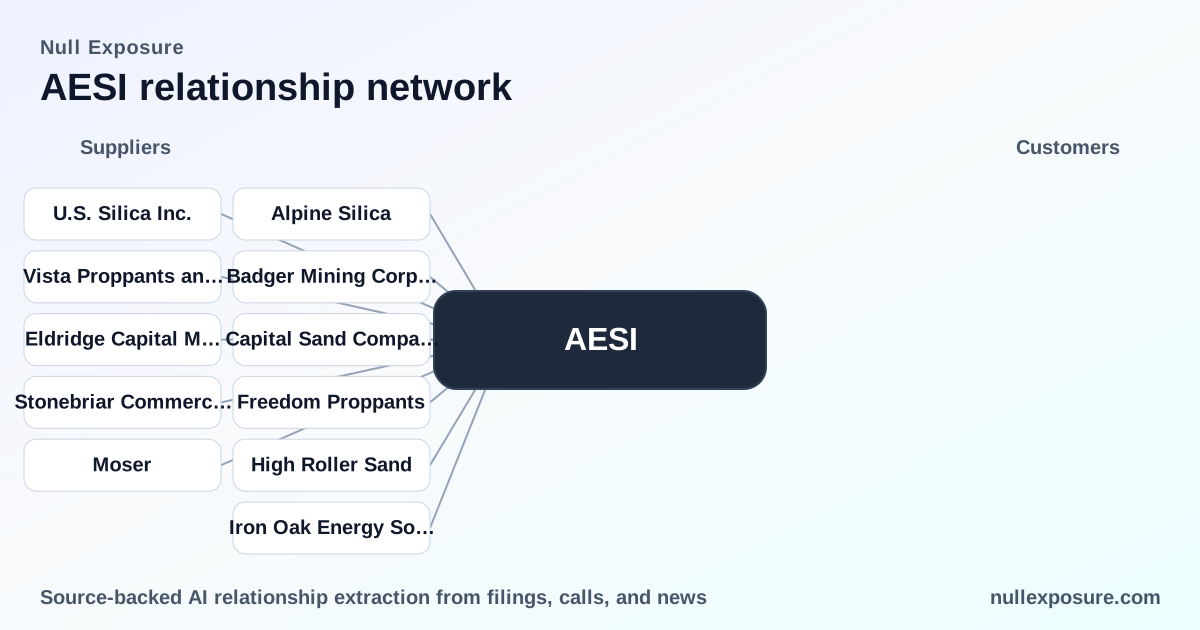
Who Atlas competes and transacts with — the full relationship list
Below are every relationship returned in the supplier-scope results, with concise, plain-English descriptions and source references.
-
Alpine Silica — Atlas lists Alpine Silica as one of several regional and national proppant providers that compete for in‑basin volume and logistics business. According to Atlas’s FY2024 10‑K, Alpine Silica is named among peer suppliers and competitors in proppant markets.
Source: Atlas FY2024 10‑K. -
Badger Mining Corporation — Badger Mining is cited by Atlas as a competitor in proppant and mined materials, competing on supply footprint and proximity to Permian demand centers. This competitive mention is included in the company’s FY2024 10‑K competitor disclosure.
Source: Atlas FY2024 10‑K. -
Capital Sand Company — Capital Sand Company appears on Atlas’s competitor list for in‑basin sand and logistics services, a factor in pricing and customer retention dynamics. See Atlas’s FY2024 10‑K competitor discussion.
Source: Atlas FY2024 10‑K. -
Freedom Proppants — Freedom Proppants is another named regional rival that competes for contract volumes and spot sales in the Permian, per Atlas’s regulatory filing.
Source: Atlas FY2024 10‑K. -
High Roller Sand — High Roller Sand is listed as a competitor in Atlas’s proppant market overview, reflecting a fragmented supplier base with multiple small to mid‑sized in‑basin providers.
Source: Atlas FY2024 10‑K. -
Iron Oak Energy Solutions — Iron Oak is cited alongside other in‑basin competitors; Atlas acknowledges Iron Oak as a peer in the market for sand and logistics services that influence pricing and utilization rates.
Source: Atlas FY2024 10‑K. -
U.S. Silica Inc. — U.S. Silica, a larger national player, is named by Atlas as a competitor, representing scale and product-diversification risks to Atlas’s market share in commodity proppant.
Source: Atlas FY2024 10‑K. -
Vista Proppants and Logistics — Vista Proppants and Logistics is mentioned as a competing provider of proppant and transportation services, part of the competitive set Atlas identifies in regulatory disclosures.
Source: Atlas FY2024 10‑K. -
Eldridge Capital Management — Eldridge closed a $375 million lease facility to finance Atlas’s expansion of behind‑the‑meter power generation assets, providing immediate capital for fleet deployment and reflecting third‑party appetite to finance Atlas’s leasing strategy. This arrangement was reported in March 2026.
Source: ConnectMoney report and investor commentary (March 2026). -
Stonebriar Commercial Finance LLC — Atlas’s subsidiary Galt Power Solutions entered a master lease and interim funding arrangement with Stonebriar that reserved roughly 240 megawatts of equipment and provided up to $385 million in advances, with Atlas guaranteeing obligations on an unsecured basis; terms permit early or end‑of‑term termination at defined prices. The transaction was disclosed in a Dec 26, 2025 press release.
Source: Company press release reported by The Globe and Mail (Dec 26, 2025). -
Moser — Atlas incorporated approximately 190 MW of newly acquired Moser assets into its megawatt portfolio, expanding its power-generation footprint and underwriting additional leasing capacity. This consolidation of Moser assets was noted in investor coverage in late 2025.
Source: SahmCapital analysis (Nov 28, 2025).
What the documented constraints reveal about Atlas’s operating model
The company disclosures and constraint evidence provide direct signals about Atlas’s contracting posture, concentration, criticality, and procurement maturity:
-
Contracting posture — a mix of long‑term and capital leases. Atlas discloses long‑term mineral leases (Monahans Lease) and explicit purchase commitments for equipment, indicating that the firm uses formal long‑term arrangements to secure raw material access and equipment capacity. The Monahans Lease includes a minimum royalty of $1.0 million per lease year following the IPO, reflecting fixed-cost obligations in the cost base.
-
Government interaction and land rights. Atlas entered a pooling agreement with the Texas General Land Office (GLO) on March 1, 2024, creating a pooled unit across fee and leased lands at Kermit — a direct, government counterparty that affects mineral access and revenue allocation.
-
Concentration and critical supplier risk. Atlas states its power generation business depends on a sole key supplier for unique equipment; this is a critical single‑source dependency that, if disrupted, would materially impair operations and competitive position.
-
Buyer and commodity exposure. The company is a buyer of natural gas and records commodity price risk, making input cost volatility a direct margin pressure point.
-
Service‑provider maturity in cybersecurity. Atlas relies on external cybersecurity assessors and third‑party vendors for monitoring and annual penetration testing, indicating mature outsourcing of security functions rather than purely in‑house capability.
-
Procurement scale and spend bands. Recent capital purchases include a logistics equipment order (
$32.8 million with a 40% downpayment) and dredge equipment ($9.8 million with 25% downpayment), placing capital procurement in the $1M–$100M range and demonstrating tiered supplier engagement and staged payment terms.
(These constraints are company‑level signals drawn from Atlas filings and disclosures.)
For deeper supplier risk maps and contract detail, visit https://nullexposure.com/ for tailored reports.
Investment implications — risk-adjusted framing
Atlas blends a commodity-sensitive proppant business and a lease-financed power generation platform. Competitive pressure from multiple local and national sand suppliers keeps pricing disciplined on the proppant side. On the upside, secured lease financing from firms such as Eldridge and Stonebriar supports rapid fleet scale‑up without immediate equity dilution, but the unsecured corporate guarantees and sole‑supplier dependency for critical equipment create concentrated execution risk. Financial multiples (EV/EBITDA ~12.4; EV/Revenue ~2.0) reflect mid‑market valuation for a capital-intensive operator with growth-capital agreements in place.
If you are evaluating counterparty exposure in detail, NullExposure delivers supplier-level diligence and contract summaries to quantify these risks: https://nullexposure.com/.
Bottom line
Atlas operates at the intersection of industrial commodity supply and equipment leasing finance. The company’s success depends on controlling logistics and proppant costs while executing a capital-intensive power leasing roll‑out backed by outside financiers. Key investor focus areas are the single-supplier exposure for power equipment, the financial encumbrances created by lease guarantees, and competitive pricing pressure from multiple in‑basin proppant providers. For real‑time supplier risk dashboards and actionable relationship intelligence, visit https://nullexposure.com/.