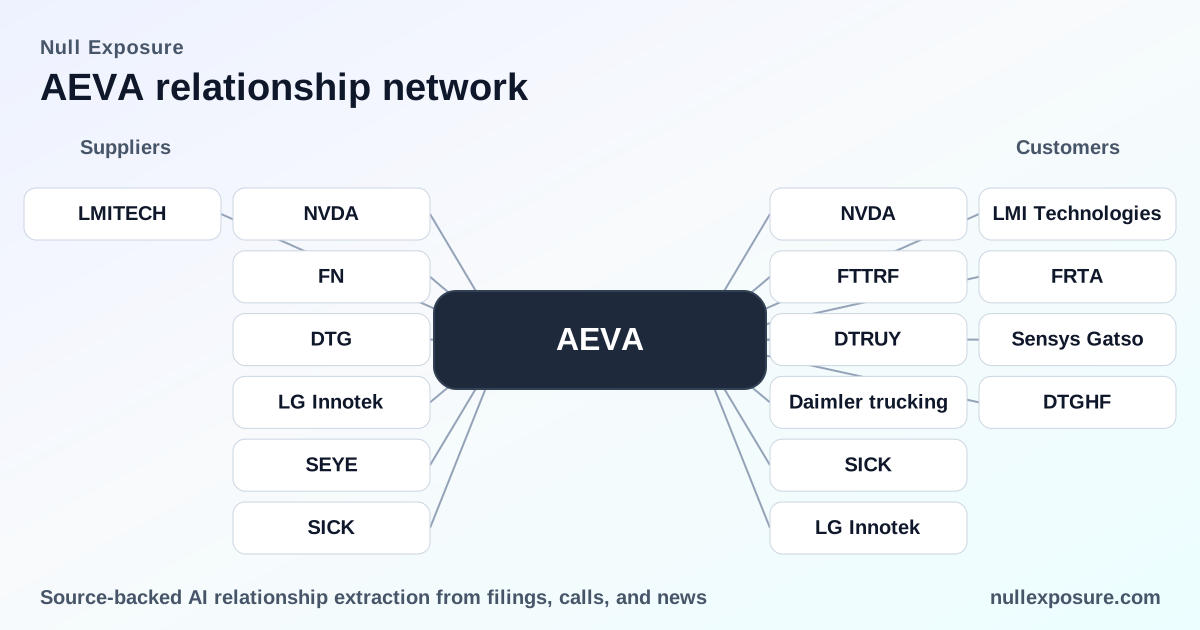
Aeva Technologies (AEVA): Commercialization through partnerships and third‑party manufacturing
Aeva designs and sells FMCW 4D LiDAR-on-chip systems and captures value by licensing and selling sensor hardware to automotive OEMs, industrial automation companies and smart‑infrastructure customers while funding development through collaborative agreements and manufacturing partnerships. The company is transitioning from in‑house assembly to an outsourced manufacturing model, monetizing through product sales and development contracts as it moves into volume production (Revenue TTM $18.1M; Market Cap ~$934M). For a consolidated view of supplier and partner exposures, visit https://nullexposure.com/.
How Aeva makes money and what its operating model implies
Aeva’s revenue model is straightforward: product sales of its FMCW 4D LiDAR systems and jointly developed products with strategic partners. Commercial validation comes through OEM production wins and platform selections; economic leverage will depend on manufacturing scale and unit margins as volumes increase. The company reports negative EBITDA (-$122.2M) and negative EPS (-$2.55) while trading at high multiples (Price/Sales ~51.7), signaling a growth‑at‑risk valuation that requires successful volume conversion.
Several company‑level signals drive operational risk and opportunity:
- Long‑term contracting posture: Aeva documents development agreements and MOUs with third‑party manufacturers and customers, indicating multi‑year collaboration and program commitments rather than one‑off orders.
- Outsourced manufacturing transition: Management is shifting from in‑house assembly to exclusive reliance on third‑party manufacturers, which accelerates scale but transfers execution risk to partners.
- Global production footprint: Aeva plans to leverage global manufacturing plants for final assembly and test, which supports OEM timelines but increases geopolitical and logistics exposure.
- Concentration and criticality: Financials show customer concentration (five customers = 68% of receivables at 12/31/2024) and supplier concentration (one vendor = 40% of accounts payable at 12/31/2024), and Aeva acknowledges single‑source components for key subsystems—a critical supply chain dependency.
- Relationship roles: The company uses third parties as manufacturers, distributors and service providers—roles that are active now and are ramping as production scales.
For deeper supplier and partner mapping, see https://nullexposure.com/.
Relationships that define AEVA’s commercial runway
NVIDIA — DRIVE Hyperion platform selection
Aeva’s FMCW 4D LiDAR technology was selected for NVIDIA’s DRIVE Hyperion autonomous vehicle reference platform, establishing Aeva as a sensor supplier in a major autonomous vehicle ecosystem and validating its automotive performance claim. This was reported across news outlets during March 2026, including StockTwits and Trefis coverage (March 2026).
Source: StockTwits news coverage and a Trefis report noting the DRIVE Hyperion selection (March 2026).
Fabrinet — production capacity upgrade
Aeva upgraded a high‑precision production line at Fabrinet to accommodate expected volume growth ahead of 2026 demand, signaling that Fabrinet is a core manufacturing partner for scaling automotive‑grade production. The Globe and Mail press release covered this capacity move and its timing in early 2026.
Source: Globe and Mail reporting on Fabrinet capacity upgrades tied to Aeva’s production needs (FY2025/early 2026).
Daimler Truck — exclusive long‑range LiDAR supplier for production trucks
Aeva stated on its FY2025 Q4 earnings call that it is the exclusive long‑range LiDAR supplier and primary detection sensor for Daimler Truck’s autonomous production trucks, positioning Aeva as a production‑tier partner for heavy‑vehicle autonomy deployment.
Source: Aeva Q4 2025 earnings call (2025Q4).
LG Innotek — strategic joint development funding
Aeva has a strategic collaboration with LG Innotek that includes a commitment of up to $50 million for joint product development, which both underwrites development and aligns a component‑level partner with Aeva’s product roadmap and physical‑AI objectives.
Source: Intellectia.ai reporting on the LG Innotek collaboration and the $50M commitment (FY2026 announcement).
Sensys Gatso — smart‑infrastructure customer win
Management referenced Sensys Gatso among wins in smart infrastructure on the FY2025 Q4 earnings call, establishing Aeva’s addressable market beyond automotive into traffic and public‑safety sensing for cities and infrastructure operators.
Source: Aeva Q4 2025 earnings call (2025Q4).
SICK AG — initial shipments and ramp timing
Shipments to early customers such as SICK began in late 2025 and are on track to ramp during the current year, indicating that Aeva’s sensor hardware has moved from prototype to production shipping with industrial automation partners.
Source: Aeva Q4 2025 earnings call noting late‑2025 shipments to SICK (2025Q4).
LMI Technologies — factory automation deployment
Aeva listed LMI Technologies as a manufacturing and factory automation customer win on the FY2025 Q4 earnings call, corroborating that Aeva’s sensors are being positioned in machine‑vision and automation applications alongside conventional lidar players.
Source: Aeva Q4 2025 earnings call (2025Q4).
What the relationship map means for investors and operators
The partner list shows a deliberate go‑to‑market through strategic platform validations (NVIDIA), OEM production programs (Daimler Truck), contract manufacturing scale (Fabrinet), and funded component partnerships (LG Innotek). That combination is positive evidence of commercial traction, but it also concentrates execution risk in third‑party manufacturing and a small set of customers and vendors.
Key operational constraints that shape valuation and execution:
- Contracting and program risk: Long‑term development agreements create multi‑year revenue visibility when they convert to production, but they also lock Aeva into program timelines and acceptance testing controlled by OEMs and platform integrators.
- Supply chain criticality: Single‑source components and vendor concentration create potential bottlenecks as volumes ramp; this is a company‑level constraint that requires active supplier diversification.
- Manufacturing dependency: Reliance on contract manufacturers (evidenced by Fabrinet capacity upgrades and the company’s stated outsourcing strategy) accelerates scale but transfers yield and quality risk to partners.
- Financial leverage to execution: Given negative EBITDA and the current low revenue base, operational milestones (production yield, on‑time shipments, OEM installs) are the primary drivers of upside or downside.
Mid‑article action: if you need a structured supplier risk report, check https://nullexposure.com/ for tailored analysis.
Near‑term monitoring and investment checklist
- Production ramp metrics and yield reports from Fabrinet or other contract manufacturers.
- OEM qualification milestones and volume purchase agreements (timing and committed quantities).
- Supplier concentration changes and any announcements on second‑source components.
- Revenue and margin progression versus guidance in the next two quarters.
Bottom line and recommended focus
Aeva has assembled validation partners that de‑risk commercial acceptance, but the stock remains an execution play: production ramps, supplier diversification and conversion of development contracts into recurring product revenue will determine value realization. Suppliers and operators should prioritize capacity assurance and contract clarity; investors should focus on quarterly shipment metrics and margin inflection.
For a full supplier exposure package and ongoing monitoring of AEVA relationships, visit https://nullexposure.com/.