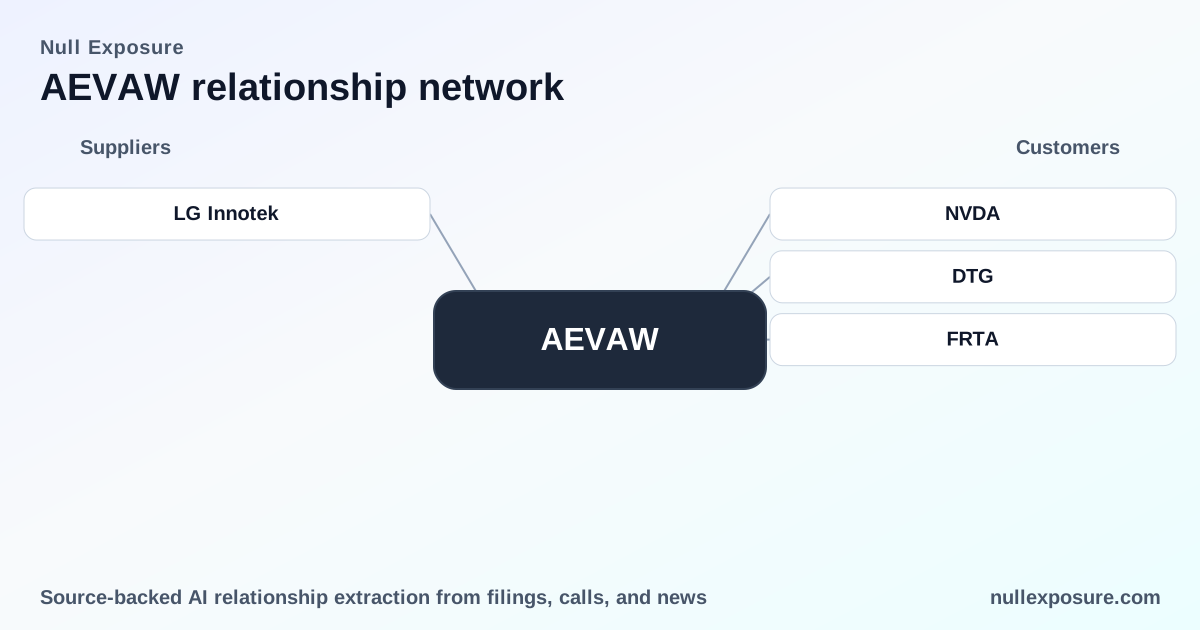
AEVAW (Aeva Technologies Warrants) — Supplier relationships and operational constraints investors should know
Aeva Technologies designs and sells 4D LiDAR sensing systems and perception software, monetizing through product sales and strategic partnerships that extend its sensor technology into automotive and broader physical-AI markets. The company leverages third-party manufacturing and strategic collaborators to scale production and distribution while retaining R&D and systems integration capabilities, a model that compresses capital intensity but concentrates execution risk in supplier relationships and contract terms. For a deeper look at supplier intelligence and counterparty analysis, visit https://nullexposure.com/.
Why the supplier layer matters for Aeva’s commercial trajectory
Aeva’s core product — a 4D LiDAR system and LiDAR-on-chip — is hardware-intensive and requires manufacturing scale and global distribution to reach automotive-grade volumes. Supplier choices therefore determine unit economics, time-to-market, and the company’s ability to serve non-automotive industrial customers at scale. Observed disclosures show Aeva is transitioning to a third-party manufacturing model and actively pursuing strategic collaborations to broaden addressable markets.
Explore supplier mapping and counterparty risk tools at https://nullexposure.com/ to track these dynamics.
The single named supplier relationship: LG Innotek
Aeva disclosed a strategic collaboration with LG Innotek to accelerate distribution of 4D LiDAR into a range of physical-AI applications beyond automotive. According to Aeva’s 2025 Q4 earnings call, the collaboration aims to leverage LG Innotek’s global scale to commercialize Aeva’s 4D LiDAR for non-automotive uses where LG Innotek already has market presence. This relationship is presented as strategic rather than a simple supplier contract, indicating commercialization and go-to-market alignment rather than only component sourcing (Aeva 2025 Q4 earnings call, March 2026).
What the company-level constraints reveal about operating posture
Aeva’s disclosures and financial statements provide clear company-level signals about how supplier relationships are structured and what that implies for investors:
-
Short-term contracting posture: Weighted-average remaining lease terms were 1.2 years as of December 31, 2024, indicating short-duration obligations and a flexible, near-term vendor footprint rather than long-term captive facilities. This implies the company can pivot manufacturers but also faces renewal and continuity risk on short notice (company filings, FY2024 financials).
-
Global manufacturing footprint: Aeva intends to utilize third-party production counterparties and global manufacturing plants to supply its 4D LiDAR systems and LiDAR-on-chip. Globalized production supports scale and customer proximity but increases supply-chain complexity and geopolitical exposure (company filing and corporate disclosures).
-
Outsourced manufacturing role: Multiple statements confirm Aeva’s reliance on third-party manufacturers to develop and produce products for customer development programs and eventual automotive-grade production. Aeva positions itself as a product developer and integrator, outsourcing volume manufacturing — a capital-efficient model that shifts production and quality risk to partners (company filings).
-
Third-party service provider dependence: The company explicitly manages cybersecurity and operational risks from third-party service providers and asks service providers to report incidents compromising company data. Dependence on external service providers creates an operational surface that requires rigorous contract and governance controls (company filings).
-
Active and ramping supplier relationships: Financial disclosures and operational commentary indicate active third-party arrangements and a transition phase from in-house assembly to exclusive reliance on third-party manufacturing. This is a ramping commercial phase where supplier performance directly drives revenue recognition and margins (company filings and FY2024–FY2025 commentary).
What these signals mean for investors and operators
The combination of strategic partnerships (e.g., LG Innotek), outsourced manufacturing, and short-term contractual commitments creates a distinct risk/reward profile:
-
Upside: Outsourcing manufacturing accelerates scale with lower capital expenditure and allows Aeva to capitalize on partner distribution networks and manufacturing expertise. Strategic partners can open new verticals quickly, improving revenue diversification beyond automotive.
-
Downside: Short contract tenors and heavy reliance on third-party manufacturers concentrate execution risk. Supplier disruptions, quality control failure, or a partner changing strategic priorities would have immediate operational and financial consequences. Cybersecurity and service-provider governance failures present added downside to product integrity and customer trust.
Key investor priorities include:
- Contractual clarity on manufacturing capacity guarantees, lead times, and quality metrics.
- Backup supplier strategies and inventory buffers to mitigate short-term lease and supplier churn risk.
- Governance and cyber controls for service providers to protect IP and sensor data integrity.
Relationship-by-relationship summaries (complete listing)
- LG Innotek — Aeva formed a strategic collaboration to deploy 4D LiDAR across a broad range of physical-AI applications leveraging LG Innotek’s global scale; the partnership is positioned as a commercial acceleration step rather than simple component sourcing (Aeva 2025 Q4 earnings call, March 2026).
Investment implications and risk-adjusted posture
Aeva’s model is capital-efficient but execution-dependent. The company’s financial profile (negative EBITDA, limited revenue base in reported periods) and a high beta reflect that supplier performance and partner commercialization will be principal drivers of valuation recovery. Investors should price in execution risk driven by supplier transitions even while recognizing the leverage that a successful rollout via partners like LG Innotek provides to revenue growth and market reach.
- Monitor manufacturer qualification timelines and ramp metrics: sample yields, test pass rates, and yield improvements will be the earliest objective indicators of scaling success.
- Treat short lease terms as both flexibility and a potential discontinuity risk; verify contract renewal terms and capacity commitments in diligence.
Final takeaways and next steps
Aeva’s strategy is to scale quickly through partnerships and outsourced manufacturing, trading capital intensity for partner execution risk. The LG Innotek collaboration is the most visible supplier tie; it demonstrates a clear push into non-automotive physical-AI markets using a partner with global manufacturing footprint (Aeva 2025 Q4 earnings call, March 2026). Investors should weigh the commercial upside of partner-enabled distribution against short-term contract exposures and the operational complexity of a globally sourced supply chain.
For ongoing supplier monitoring and targeted counterparty diligence, visit https://nullexposure.com/ to see how supplier signals and contractual constraints translate into investable risk assessments.
Conclude diligence by focusing on supplier SLAs, capacity commitments, and cybersecurity governance to convert Aeva’s partner-driven scale into reliable revenue and margin improvements. For continuous updates and supplier intelligence, return to https://nullexposure.com/.