AEXA: Sponsor-led SPAC whose underwriter relationships define early liquidity and control
American Exceptionalism Acquisition Corp. A (AEXA) is a sponsor-led SPAC that monetizes through a classic blank-check structure: the sponsor raises IPO proceeds held in trust, sells Class A shares to public investors, and extracts value through founder shares and transaction fees when a business combination closes. Value for investors and counterparties depends less on operating cashflow today and more on distribution, underwriting, and governance relationships that determine liquidity, lock-ups, and the path to a merger. For deeper supplier and counterparty intelligence on AEXA, visit https://nullexposure.com/.
How AEXA operates and why supplier relationships matter for returns
AEXA’s economics are typical of a SPAC: the company raises capital in an IPO, lists on the New York Stock Exchange, and intends to acquire a high-growth target in tech or consumer sectors. The sponsor team profits from founder shares and transaction-related economics at close, while public holders obtain pro rata claims on the trust until a business combination is executed or funds returned. In this model, the identity and posture of the underwriter and exchange are primary determinants of distribution success, aftermarket stability, and the sponsor’s execution window.
- Concentration of distribution amplifies counterparty leverage: a sole book-runner shapes pricing, lock-ups, and over-allotment mechanics.
- Listing venue matters for visibility and institutional access; NYSE listing signals a certain profile of investor attention and compliance regime.
- Lock-up and underwriting options constrain insider liquidity and influence timing of secondary sales and sponsor monetization.
If you are evaluating AEXA as an investor or as a potential counterparty, these relationships control near-term liquidity and the SPAC’s ability to deliver a successful deal. Learn more about supplier relationships and exposures at https://nullexposure.com/.
Supplier and counterparty inventory you need to know
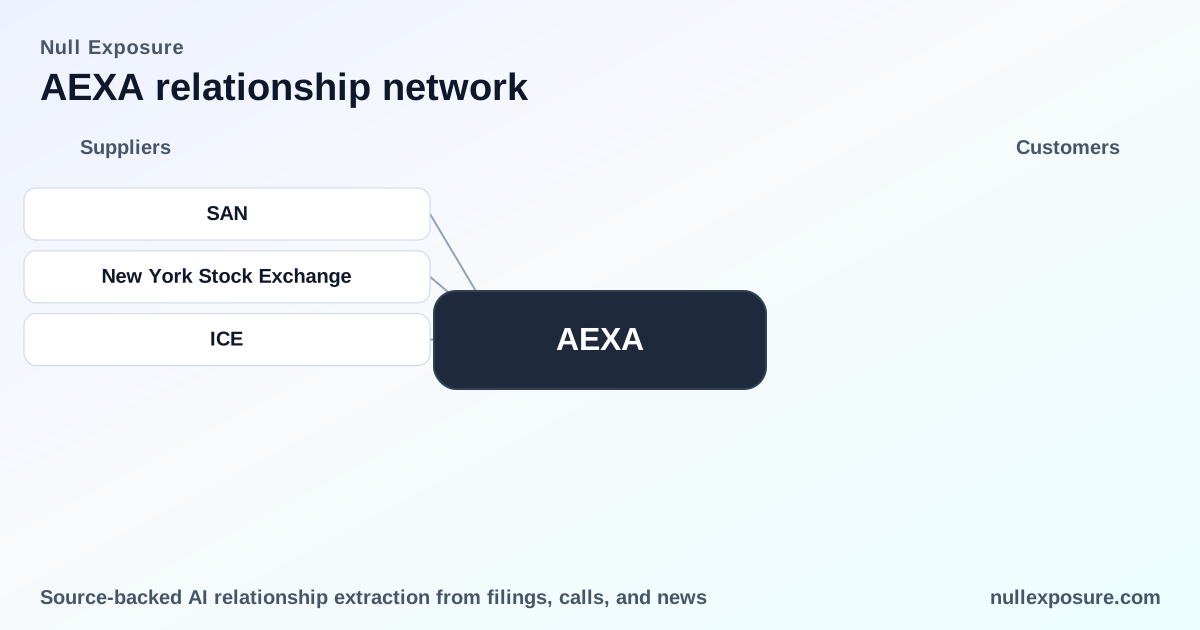
Below are every counterpart referenced in public coverage of AEXA’s formation and IPO, with concise plain-English summaries and source references.
Santander
Santander served as the sole book-running manager for AEXA’s upsized IPO, which gives Santander primary control over allocation, stabilization and underwriting economics. Multiple press reports noted Santander’s underwriting role and that it holds a 45‑day option to buy up to 4.5 million additional shares to cover over‑allotments. (Sources: MLQ.ai coverage of the IPO; StockTitan reporting, both March 2026)
Santander US Capital Markets LLC
Santander US Capital Markets LLC is referenced in the prospectus lock-up language: AEXA, its sponsor and directors agreed not to sell shares for 180 days after the prospectus date without the prior written consent of Santander US Capital Markets LLC, subject to specified exceptions for private placement or over-allotment shares. This creates a formal underwriter-enforced restriction on insider liquidity during the SPAC’s initial post-IPO window. (Source: MarketScreener report on prospectus lock-up terms, March 2026)
New York Stock Exchange (NYSE)
AEXA’s Class A ordinary shares began trading on the New York Stock Exchange under the ticker AEXA on September 26, 2025, placing the SPAC on a primary U.S. exchange with attendant listing standards and institutional access. The NYSE listing anchors market liquidity and compliance obligations for the vehicle. (Sources: MLQ.ai and StockTitan reports on listing, September 2025 and March 2026)
What the relationship map implies for counterparties and investors
These three relationships collectively shape AEXA’s early operating reality.
- Contracting posture: The underwriting arrangement reflects a high degree of control by Santander and its U.S. capital markets affiliate, enforced via a 180‑day lock-up and an over‑allotment option. That contracting posture constrains sponsor and director liquidity and gives the underwriter gatekeeping power over secondary distributions.
- Concentration risk: Santander’s role as sole book-runner concentrates distribution risk and negotiation leverage with one counterparty rather than a syndicate, increasing dependency on a single channel to the market.
- Criticality of counterparties: The NYSE listing is critical to market access and secondary liquidity; underwriter consent provisions create a second critical dependency for share-side flexibility.
- Maturity and business model: AEXA reports no operating revenues and typical zero operating metrics for a SPAC pre-combination; the entity is an early-stage capital vehicle focused on deal sourcing and sponsor monetization, not standalone product economics.
Together these signals present a clear operating profile: AEXA is an early-stage SPAC with concentrated underwriting exposure and explicit lock-up constraints that will influence liquidity and sponsor behavior through the initial post-IPO period.
Risk and opportunity snapshot for investors and operators
- Risk — Underwriter concentration and lock-up: Santander’s sole book-runner role and the 180‑day lock-up mean insider selling and certain secondary transactions require underwriter consent; this can compress liquidity or delay sponsor monetization, which affects the stock’s supply-demand dynamics. (MarketScreener; StockTitan)
- Opportunity — Visibility via NYSE listing: The NYSE listing supports institutional engagement and makes the SPAC a legitimate candidate for larger targets and PIPE investors that prefer exchange-traded vehicles. (MLQ.ai; StockTitan)
- Operational reality — No operating revenues: As a SPAC, AEXA’s short-term valuation drivers are cash in trust, sponsor incentives, and the quality of prospective targets rather than present EBITDA or revenue metrics.
For a closer read on how these supplier relationships influence execution risk and valuation, visit https://nullexposure.com/.
Final takeaways and recommended next steps
AEXA’s immediate risk profile is defined by Santander’s concentrated underwriting role and the formal lock-up enforced by Santander US Capital Markets LLC, while the NYSE listing provides necessary market access. Investors evaluating exposure to AEXA should prioritize diligence on the underwriter’s stabilization actions, over-allotment exercise likelihood, and prospective PIPE or sponsor commitments that will determine deal success.
If you want structured intelligence on AEXA’s counterparty exposure and similar supplier mappings across the SPAC universe, explore our analysis and tools at https://nullexposure.com/.
Key sources referenced in this piece include MLQ.ai and StockTitan coverage of the IPO and listing (reported March 2026 with listing activity dated September 26, 2025) and a MarketScreener summary of prospectus lock-up terms (March 2026).