AudioEye (AEYE): Supplier relationships, balance sheet moves, and what investors should price
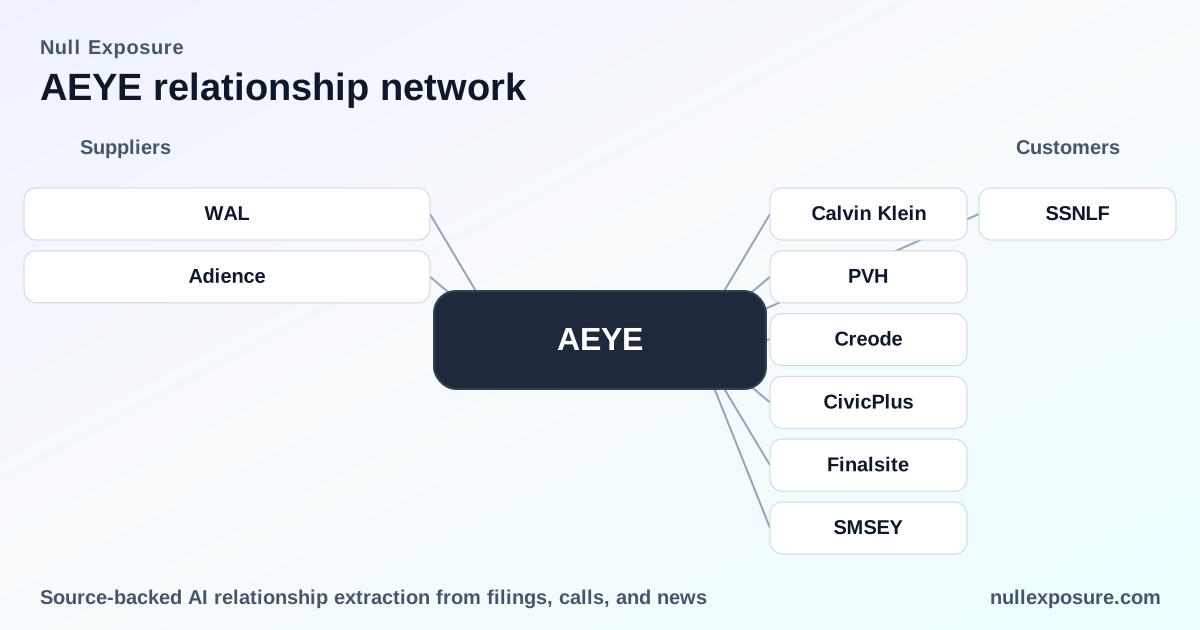
AudioEye operates a subscription-led accessibility software business that sells automated detection, remediation services, and compliance monitoring to enterprises and digital property owners. The company monetizes through recurring licenses and professional services, with a mix of SaaS-like revenue and one-time implementation fees; Revenue TTM was $40.3M with gross profit of $31.6M, while operating losses persist and cash management is a gating factor for growth. For investors evaluating vendor and counterparty risk, the two supplier relationships in the public record point to one strategic lender engagement and one market validation partner that together influence liquidity and go-to-market credibility. Visit the NullExposure hub for deeper supplier intelligence: https://nullexposure.com/
How to read supplier signals for a small-cap software vendor
AudioEye’s supplier footprint is lean, and that is meaningful. A lender refinancing and a third-party validation study give insight into the company’s contracting posture, capital runway, and commercial positioning.
- Contracting posture: AudioEye executed debt refinancing to reduce interest expense, which signals an active approach to managing financing cost and balance-sheet flexibility rather than relying solely on equity raises.
- Commercial maturity and criticality: The company sells functionality that is material to customer compliance (web accessibility), so vendor performance and product efficacy directly affect renewal and upsell rates.
- Concentration and governance: Ownership is concentrated—insiders hold ~35.5% and institutions ~36.7% of shares—which influences negotiation leverage with service providers and lenders and can shape strategic decisions quickly.
- Financial constraints: AudioEye is still loss-making (Diluted EPS TTM: -$0.29; Profit Margin: -7.63%), so supplier relationships that reduce cash outflow or accelerate demand are disproportionately valuable.
These are company-level signals: there are no explicit contractual constraints disclosed in the relationship records provided, which itself is a signal of relative operational flexibility.
Explore supplier profiles and impact analysis at NullExposure: https://nullexposure.com/
Supplier relationship: Western Alliance Bank — refinancing the debt facility
AudioEye refinanced its debt facility with Western Alliance Bank in Q1 2025 to reduce interest expense and strengthen its balance sheet. According to the Q4 2025 earnings call transcript reported by InsiderMonkey (published March 2026), management highlighted the refinancing as a key step that “strengthened our balance sheet and reduce[d] our interest expense, positioning us for continued growth with greater financial flexibility.” This is a financier relationship rather than a product-supplier tie, and it materially affects cash interest burden and runway.
Source: InsiderMonkey, Q4 2025 earnings call transcript (reported March 9, 2026).
Supplier relationship: Adience — independent validation of detection performance
A third-party study from Adience, a B2B market research agency, showed AudioEye’s automated accessibility technology detects 89–253% more WCAG issues than competitor products, according to a PR Newswire release in March 2026. This external validation is an important commercial asset for sales and marketing: it strengthens AudioEye’s competitive positioning in procurement cycles centered on compliance and risk mitigation.
Source: PR Newswire release announcing Adience study findings (March 2026).
What these relationships imply for investors
The two relationships combine to alter the risk-reward profile in clear ways:
- Liquidity and financing risk lowered. The Western Alliance refinancing materially reduces interest expense and therefore improves near-term cash flow dynamics; that reduces downside risk tied to short-term liquidity for a company with negative EPS.
- Commercial differentiation improved. The Adience study is a marketing lever that can accelerate enterprise wins and reduce sales friction in regulated or compliance-driven procurement processes.
- Operational concentration remains. AudioEye’s small scale (market cap ~$73.9M; Revenue TTM $40.3M) and ongoing operating losses mean that supplier and lender terms disproportionately influence the company’s ability to invest in product development and sales. Supplier decisions are therefore strategically significant.
- Valuation context. Analysts show constructive sentiment (analyst target price $16.70 with mostly buy/strong-buy ratings) while the stock trades below its 52-week high; the firm’s forward PE is listed at 6.61 but trailing PE is not meaningful given negative earnings, so investors must balance growth expectations against execution risk.
Strategic takeaways and risk checklist
Investors and operators should weigh these points when modeling downside and upside scenarios:
- Positive cash-flow impact from refinancing should be quantified in interest-savings assumptions and used to extend runway rather than assume immediate R&D or sales acceleration.
- Validate the Adience findings in procurement contexts—ask management how the study is being used in contract renewals, proof-of-concept conversions, and RFP wins. Independent validation helps reduce sales cycle friction but does not guarantee conversion.
- Monitor ownership and governance dynamics—high insider ownership can accelerate decisive action but can also concentrate risk if management priorities diverge from minority investor interests.
- Watch renewal cohorts and margin cadence—AudioEye’s revenue quality (recurring vs. one-time) will determine how much value the Adience endorsement can actually convert into predictable cash flows.
For a deeper supplier-risk score and counterparty mapping for AudioEye, see our platform: https://nullexposure.com/
Bottom line for investors
AudioEye’s public supplier signals are limited but meaningful: a refinancing with Western Alliance Bank reduces financing risk, and the Adience validation strengthens commercial credibility in accessibility compliance sales. These two relationships collectively lower capital risk and improve sales positioning, but they do not eliminate execution risk given the company’s modest scale and negative profitability. Investors should fold interest-savings into near-term cash models and seek proof points that the Adience study is translating into higher conversion and retention rates before assuming a sustained acceleration in growth.
If you evaluate AEYE counterparty exposure or need a tailored supplier risk brief, start here: https://nullexposure.com/