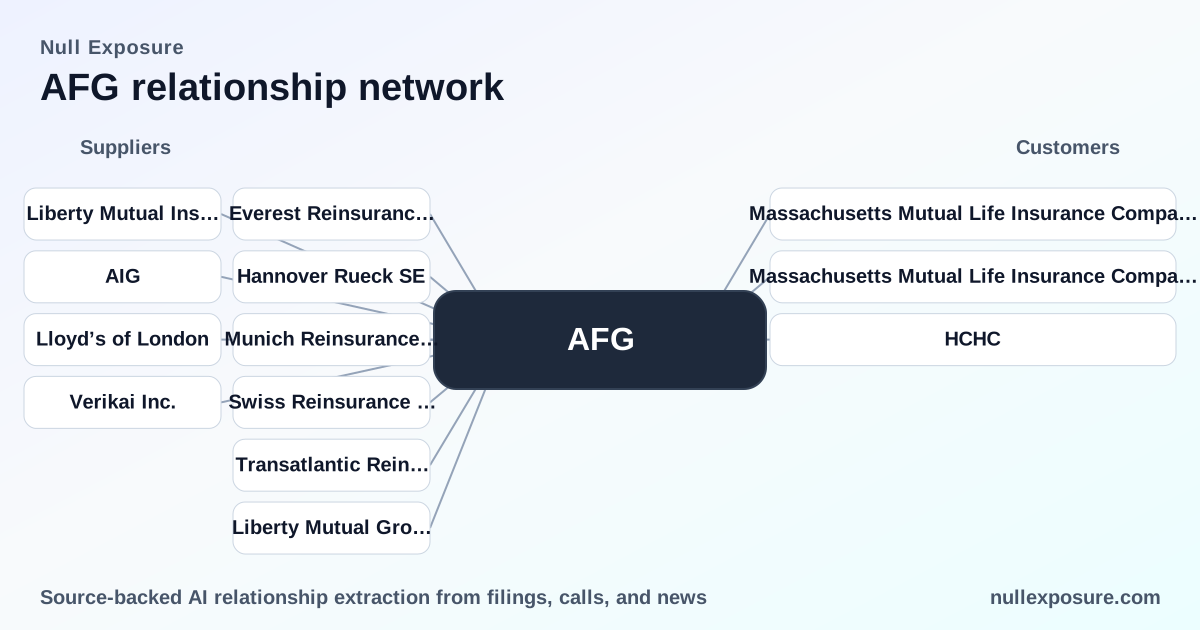
American Financial Group (AFG): supplier and reinsurance counterparties that shape underwriting economics
American Financial Group (AFG) operates as a property & casualty insurance holding company that monetizes through underwriting margins, reinsurance optimization and investment income on policyholder funds. The company cedes a material portion of property and casualty risk to third‑party reinsurers and records $5.18 billion of recoverables from reinsurers on the balance sheet, which directly affects AFG’s loss emergence and capital flexibility. For investors evaluating counterparty exposure, the combination of concentrated recoverables with conservative contracting (A‑rated counterparties and collateral arrangements) is central to both upside (capital efficiency) and downside (counterparty concentration). Learn more at https://nullexposure.com/.
How AFG structures supplier relationships and what that means for returns
AFG’s supplier posture is fundamentally risk‑transfer oriented: the company cedes substantial P&C exposures to external reinsurers while retaining distribution and underwriting control through its operating subsidiaries. The 2024 Form 10‑K shows the firm cedes to counterparties rated A or better or uses collateral constructs such as “funds withheld” to secure recoverables, which preserves capital but leaves AFG exposed to a set of large counterparties concentrated at single‑digit percentages of total recoverables.
- Contracting posture: AFG cedes risk to highly rated reinsurers and secures recoverables with collateral or funds‑withheld arrangements to minimize credit exposure implied by ceded business.
- Concentration: Several reinsurers account for between 5% and 12% of AFG’s total P&C reinsurance recoverable, introducing single‑counterparty sensitivity into loss recovery and balance‑sheet strength.
- Criticality: Reinsurance recoverables are material to the balance sheet and directly influence statutory and GAAP loss reserves and capital measures.
- Maturity: Relationships reflect long‑standing industry counterparties rather than one‑off partners, consistent with an established reinsurance program and strategic exits (e.g., Lloyd’s) that simplify the counterparty map.
If you want a counterparty breakdown and risk signal analysis tailored to institutional diligence, visit https://nullexposure.com/ for detailed supplier profiles.
The counterparties investors should track
Everest Reinsurance Company
Recoverables from Everest are listed in AFG’s 2024 10‑K as one of the reinsurers that individually represented between 5% and 12% of AFG’s total P&C reinsurance recoverable, making Everest a material recoverable counterparty for loss recovery. According to AFG’s Form 10‑K for the year ended December 31, 2024, Everest Reinsurance Company is explicitly named among these material reinsurers.
Hannover Rueck SE
Hannover Rück appears in the same disclosure: the 2024 10‑K identifies Hannover Rueck SE as one of several reinsurers representing 5–12% of the total P&C reinsurance recoverable, indicating a meaningful bilateral exposure. The 10‑K for FY2024 lists Hannover Rueck SE as a named recoverable counterparty.
Munich Reinsurance America, Inc.
Munich Reinsurance America, Inc. is similarly included among the reinsurers that accounted for 5–12% of AFG’s P&C reinsurance recoverables at year‑end 2024, establishing Munich Re as a large single‑counterparty in AFG’s reinsurance program. This fact is drawn from AFG’s FY2024 Form 10‑K.
Swiss Reinsurance America Corporation
Swiss Reinsurance America Corporation is also called out in the 2024 Form 10‑K as one of the reinsurers with recoverables between 5% and 12%, placing Swiss Re in the top tier of AFG’s ceded counterparties for loss recovery. The FY2024 10‑K contains this disclosure.
Transatlantic Reinsurance Company
Transatlantic Reinsurance Company completes the group of reinsurers disclosed in the 2024 10‑K as individually representing 5–12% of total P&C reinsurance recoverables, making Transatlantic a material counterparty for AFG’s ceded exposures. This is reported in AFG’s Form 10‑K for year ended December 31, 2024.
Liberty Mutual Group / Liberty Mutual Insurance
AFG expanded through acquisition when it agreed to buy Summit Holdings Southeast Inc. from Liberty Mutual in a 2014 transaction; contemporaneous press reported the deal was valued at roughly $250 million in cash. A 2014 Insurance Journal report and BenefitsPro coverage documented AFG’s acquisition of the Liberty Mutual unit (Summit Holdings Southeast).
American International Group (AIG)
AFG announced definitive terms to acquire Crop Risk Services (CRS) from AIG, a move reported in the market as an acquisition aimed at expanding AFG’s crop insurance franchise and putting excess capital to work. ReinsuranceNews covered the AIG‑CRS transaction commentary in 2023 that framed the deal as strategic for AFG’s crop business (FY2023 reporting context).
Lloyd’s of London
AFG exited participation in the Lloyd’s market and placed the related platform into run‑off as part of a strategic consolidation of reinsurance market footprint; this exit was publicly noted in 2020. ReinsuranceNews documented AFG’s plan to withdraw from Lloyd’s in a 2020 report.
Verikai Inc.
AFG’s operating subsidiary Great American Insurance Group announced it would leverage Verikai’s predictive risk tool and Marketplace platform to enter the medical stop‑loss segment focused on small and underserved risks; Insurance Journal covered that partnership in 2022, highlighting a tech adoption play within underwriting operations.
What the constraints and numbers imply for investment risk and upside
- Size and exposure: AFG reports $5.18 billion of recoverables from reinsurers as of December 31, 2024, including roughly $220 million on paid losses and LAE and $4.96 billion on unpaid losses and LAE, which signals large counterparty credit exposures embedded in reserve recovery. This is a balance‑sheet level fact from the FY2024 10‑K.
- Concentration risk is real: Multiple reinsurers individually representing 5–12% of recoverables create a small set of counterparties whose credit performance materially affects AFG’s loss pickup and statutory capital.
- Mitigants are structural: AFG’s practice of ceding to A‑rated or better reinsurers and using funds‑withheld or collateral reduces but does not eliminate counterparty risk; collateral arrangements transfer risk dynamics into counterparty and collateral quality.
- Operational posture: AFG functions both as a buyer of reinsurance (ceding exposures) and as an occasional service provider/assumer of business from other insurers, consistent with standard industry practices and active portfolio management.
For institutional users preparing diligence or counterparty monitoring, a focused supplier profile clarifying contract terms, collateral mechanics and concentration thresholds is the next practical step—get tailored profiles at https://nullexposure.com/.
Actionable investor checklist
- Monitor counterparty credit ratings and collateral structures for the five reinsurers named in the 2024 10‑K; downgrades or weaker collateral would have an outsized impact on recoverable realization.
- Stress test recoverables against multi‑counterparty default scenarios and delayed recoveries given $5.18 billion of reported recoverables.
- Evaluate strategic moves such as the 2014 Liberty Mutual purchase, the AIG CRS acquisition, and the Lloyd’s run‑off as evidence AFG allocates capital to growth where underwriting economics are favorable and consolidates where market participation undermines returns.
Concluding: AFG’s supplier map is shaped by a deliberate reinsurance ceding strategy that delivers capital efficiency but concentrates credit exposure across a handful of global reinsurers. Active monitoring of those counterparties, collateral arrangements and any portfolio acquisitions will materially affect underwriting returns and capital deployment. For a deeper supplier risk report and continuous monitoring, visit https://nullexposure.com/.