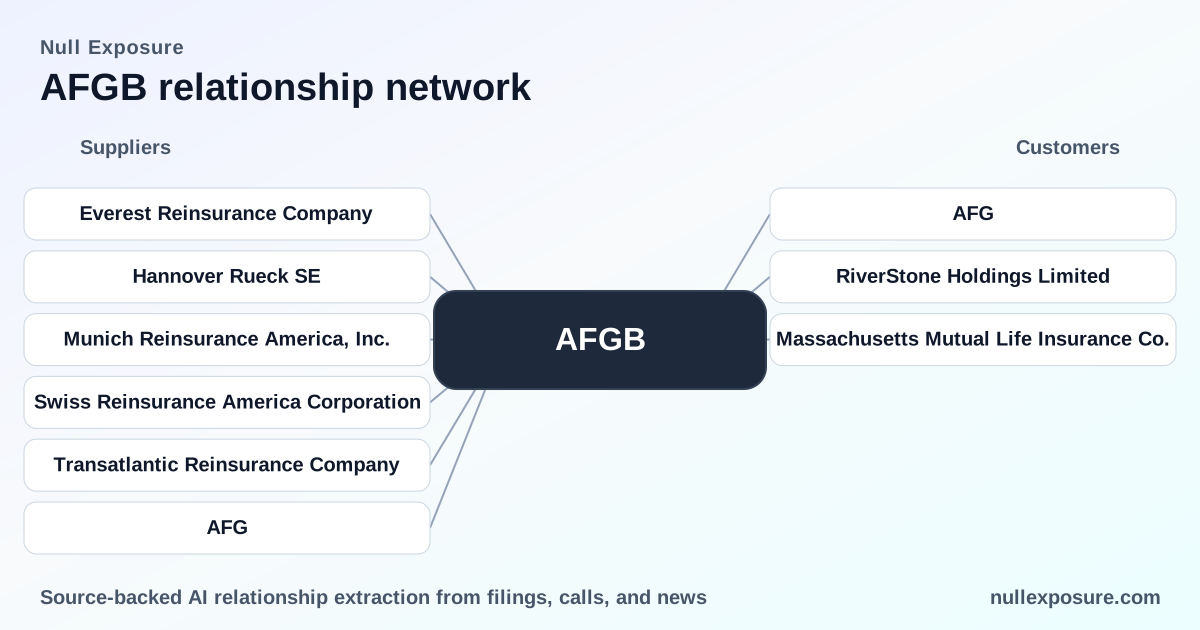
American Financial Group (AFGB) — supplier relationships and reinsurance counterparties that shape risk and capital
American Financial Group (trading as AFGB preferred stock) operates as a diversified property & casualty insurer that monetizes underwriting expertise through primary insurance and the systematic ceding of risk to global reinsurers. The company generates capital efficiency by transferring portions of large or volatile exposures, collecting premiums on retained business while offsetting volatility through reinsurance recoverables and collateral arrangements. For investors evaluating supplier exposure, the critical axis is counterparty credit and concentration among a handful of large international reinsurers that account for material recoverables.
For a broader view of supplier risk and third‑party mapping, visit https://nullexposure.com/.
How AFGB’s operating model uses supplier relationships to deliver financial outcomes
AFG’s business model pairs disciplined underwriting with an explicit reinsurance program. Reinsurance is used to diversify risk, protect capital and stabilize loss experience, and the company cedes premiums to reinsurers while retaining residual liability to policyholders. The 10‑K and related disclosures show a deliberate contracting posture:
- Long‑term liquidity and leverage management: A revolving credit facility provides up to $450 million of committed borrowing capacity through June 2028, supporting working capital and catastrophe liquidity.
- Framework contracting: Reinsurance is structured on both facultative and treaty bases, creating a blended program of long‑standing treaty arrangements and case‑by‑case facultative placements.
- Government counterparty for crop business: AFGB reinsures a portion of its multi‑peril crop insurance through the Federal Crop Insurance Corporation, typically 10–20% of MPCI gross written premiums, embedding a government risk transfer in the portfolio.
- Global footprint and service orientation: Operations and counterparties are international in scope, and AFGB treats reinsurers as service providers—ceding risk to rated counterparties or securing recoverables with funds‑withheld or collateral.
- Material reinsurance spend: Reinsurance ceded is a multi‑billion dollar line item in recent reporting, underscoring that third‑party reinsurance relationships are core to AFG’s capital and loss profile.
These attributes collectively indicate a mature, credit‑sensitive supplier posture: contracts are a mix of standard treaty frameworks and case‑specific facultative placements, counterparties are highly rated global reinsurers and a government program, and the arrangement is critical to underwriting economics rather than discretionary sourcing.
Counterparty map: the reinsurers and underwriting firms named in AFG’s filings and reporting
Below I summarize every named relationship disclosed in the provided results, with concise sourcing for each.
Everest Reinsurance Company
Recoverables from Everest constituted between 5% and 12% of AFG’s total property and casualty reinsurance recoverable at December 31, 2024, indicating Everest is a top‑tier counterparty in AFG’s reinsurance portfolio. According to AFG’s 2024 Form 10‑K, Everest is among several reinsurers with material recoverables in FY2024.
Source: American Financial Group 2024 Form 10‑K (FY2024).
Hannover Rueck SE
Hannover Rück is similarly listed as accounting for 5%–12% of AFG’s total P&C reinsurance recoverable at the end of 2024, signaling comparable exposure magnitude and placement importance. The 10‑K places Hannover Rück in the same material band as the other global reinsurers.
Source: American Financial Group 2024 Form 10‑K (FY2024).
Munich Reinsurance America, Inc.
Munich Reinsurance America is reported as one of the reinsurers with individual recoverables in the 5%–12% range of total P&C reinsurance recoverable as of December 31, 2024, making it a principal counterparty for ceded exposures.
Source: American Financial Group 2024 Form 10‑K (FY2024).
Swiss Reinsurance America Corporation
Swiss Reinsurance America Corporation shows up in the filing as another reinsurer with material recoverables (5%–12% of total P&C reinsurance recoverables), reinforcing the pattern of AFG ceding to large, globally diversified reinsurers.
Source: American Financial Group 2024 Form 10‑K (FY2024).
Transatlantic Reinsurance Company
Transatlantic Reinsurance Company is listed among reinsurers with recoverables between 5% and 12% of the stated reinsurance recoverable total at year‑end 2024, completing the set of major counterparties called out in the 10‑K.
Source: American Financial Group 2024 Form 10‑K (FY2024).
Neon Underwriting Ltd.
Neon Underwriting Ltd. (formerly Marketform) was acquired by AFG in 2008 and contributed to AFG’s Lloyd’s presence for approximately 12 years; the acquisition was reported at $75 million. A Carrier Management article (Sept. 28, 2020) recalled AFG’s acquisition history and Lloyd’s participation.
Source: Carrier Management, “AFG was only part of Lloyd's for about 12 years after it acquired Neon Underwriting Ltd. in 2008” (Sept. 28, 2020).
What these relationships mean for capital, concentration and counterparty risk
The pattern of counterparties is clear: AFG cedes substantial volumes to a compact set of globally rated reinsurers, each representing mid‑teens or single‑digit percentages of reinsurance recoverables. That structure delivers two investor‑relevant outcomes:
- Concentration risk at the counterparty level is present but managed via rating and collateral. Recoverables clustered in the 5–12% band imply meaningful exposures to a handful of firms; however, AFG discloses that reinsurance is ceded primarily to companies rated “A” or better or is secured by funds‑withheld/collateral, reducing but not eliminating credit risk.
- Operational criticality of these suppliers is high. Reinsurance is not ancillary; it is fundamental to underwriting economics and catastrophe protection, so credit events or contract friction with these reinsurers would have immediate earnings and capital effects.
For deeper mapping of counterparty networks and to stress‑test concentration scenarios, see https://nullexposure.com/.
Contracting posture, liquidity and governance implications
AFG’s disclosure that reinsurance is provided on facultative and treaty bases signals a hybrid contracting playbook—treaties for stable lines and facultative for large or bespoke risks. The presence of a $450 million revolving facility through June 2028 provides standby liquidity, while reliance on the Federal Crop Insurance Corporation for 10–20% of MPCI cessions introduces a government counterparty that alters tail‑risk dynamics. Collectively, these facts indicate mature risk governance but persistent sensitivity to reinsurer credit and collateral mechanics.
Investment implications and recommended next steps
- Position risk around reinsurance credit: AFGB’s recovery profile is concentrated among global reinsurers; monitor reinsurer solvency metrics and collateral arrangements quarterly.
- Watch liquidity and facility cadence: the $450 million revolver expiring in June 2028 is a governance and liquidity milestone that investors should track for refinancing or covenant changes.
- Consider the crop insurance overlay: government reinsurance for MPCI reduces market counterparty exposure but introduces policy and subsidy dependency into a portion of the portfolio.
For tailored supplier diligence and counterparty concentration analytics, start a focused review at https://nullexposure.com/.
Bottom line: AFG runs a deliberate, reinsurance‑intensive model that transfers material exposures to a small set of highly rated global reinsurers and a government program; that structure stabilizes underwriting but concentrates counterparty credit risk that investors must monitor.