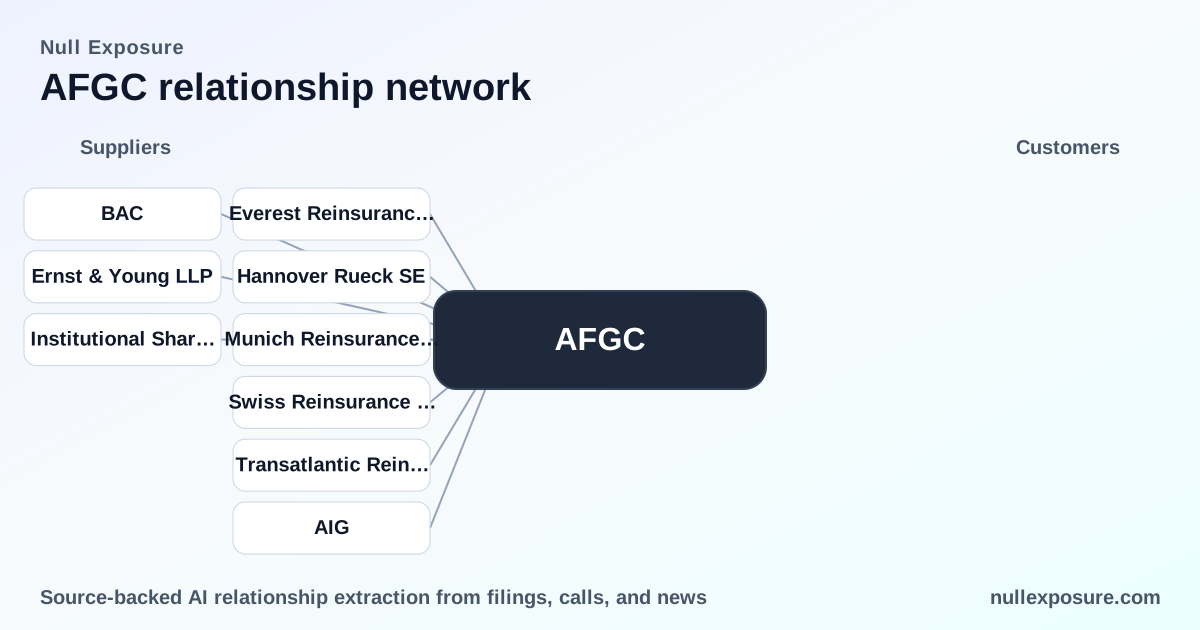
AFGC supplier map: reinsurance counterparties, lenders and controls that drive underwriting economics
AFGC sits in the financial-grade reinsurance ecosystem as an issuer tied to American Financial Group’s underwriting platform; the company monetizes by writing property & casualty risk and transferring portions of that risk through reinsurance treaties and facultative agreements, while funding operations with a revolving credit facility and transactional cash flows. Counterparty strength in reinsurance and access to committed bank liquidity are the operational levers that determine AFG’s capital efficiency and loss-absorbing capacity. For investors assessing supplier risk, the mix of rated reinsurers, a government reinsurance program, and bank financing creates a layered counterparty exposure profile that is high-dollar and sensitivity to reinsurer credit and collateral arrangements. Learn more at https://nullexposure.com/.
Why counterparties matter to the preferred-holder investor
Underwriting economics for an insurer are only as durable as the counterparties that assume loss or provide liquidity. AFG’s public disclosures identify multiple reinsurers that each represent material recoverables (5–12% of total P&C reinsurance recoverable) at year-end, a multi-year revolving credit facility, and both audit and governance providers whose opinions anchor investor confidence. These relationships are not ancillary; they are core to capital deployment and loss recovery.
Explore the platform in more depth at https://nullexposure.com/.
Who AFGC counts as suppliers and what each relationship means
Below I cover every relationship referenced in the public materials supplied.
Everest Reinsurance Company
Everest Reinsurance is among the group of reinsurers that accounted for between 5% and 12% of AFG’s total P&C reinsurance recoverable at December 31, 2024; that positions Everest as a meaningful counterparty for loss recovery and collateral arrangements. According to AFG’s FY2024 Form 10‑K, recoverables from Everest were material within the company’s reinsurance recoverable bucket (FY2024 10‑K).
Hannover Rueck SE
Hannover Rueck SE likewise represented 5–12% of AFG’s P&C reinsurance recoverable at the same reporting date, indicating that Hannover is a significant reinsurer counterparty for ceded business and thus a contributor to AFG’s credit exposure on ceded claims. (AFG FY2024 10‑K.)
Munich Reinsurance America, Inc.
Munich Reinsurance America is listed among the reinsurers with material recoverables (5–12% of the total reinsurance recoverable), signaling the company’s role as a major counterparty in treaty and facultative arrangements supporting AFG’s underwriting capacity. (AFG FY2024 10‑K.)
Swiss Reinsurance America Corporation
Swiss Re is identified in the FY2024 disclosures as contributing 5–12% of the aggregate reinsurance recoverable, reinforcing that Swiss Re is a top-tier counterparty used to cede portions of AFG’s P&C risk. (AFG FY2024 10‑K.)
Transatlantic Reinsurance Company
Transatlantic Reinsurance Company completed the list of reinsurers that individually formed 5–12% of reinsurance recoverables as of year-end 2024, making it another materially exposed reinsurer for AFG’s ceded claims. (AFG FY2024 10‑K.)
AIG
AFG completed a cash payment to AIG of $234 million (based on $24 million in net tangible assets) at closing of a referenced transaction, reflecting a material cash outflow tied to a corporate transaction reported in FY2026 filings. The transaction detail is summarized in a StockTitan SEC filing synopsis of AFG’s 10‑K (March 2026).
Bank of America, N.A.
AFG’s liquidity posture is supported by an Amended and Restated Credit Agreement with Bank of America, N.A. serving as Administrative Agent; that agreement is presented in AFG’s disclosure package (Exhibit 10.1 to Form 8‑K filed June 27, 2023) and underpins a revolving facility that gives AFG access to committed bank funding. (StockTitan SEC filing summary, March 2026; AFG Form 8‑K filing reference.)
Ernst & Young LLP
Ernst & Young LLP is the external auditor that attested to AFG’s internal control over financial reporting as of December 31, 2025, with a dated audit opinion included in AFG’s filings (signed February 25, 2026), providing the independent assurance necessary for investor reliance on the financial statements. (AFG filing cited via StockTitan, FY2026 audit opinion.)
Institutional Shareholder Services (ISS)
ISS is the corporate governance scoring provider referenced in AFG’s public profile for FY2025, supplying governance scores that market participants and institutional investors use as part of stewardship and proxy voting analysis. (Yahoo profile referencing ISS governance scores, FY2025.)
What the constraints tell you about operating posture and risk concentration
AFG’s disclosures reveal a clear operating model with implications for investors:
- Contracting posture — multi-year and framework-based. AFG maintains a revolving credit facility that provides committed liquidity (allowed borrowings up to $450 million under the facility, expiring June 2028), which is a long-term financing instrument supporting working capital and transactional flexibility (company-level signal). The reinsurance program is structured as a mix of facultative and treaty contracts, with treaty reinsurance operating as a framework that automatically cedes risks meeting prescribed criteria (company-level signal).
- Counterparty mix — government plus investment-grade reinsurers. AFG cedes a portion of its multi-peril crop insurance business to the Federal Crop Insurance Corporation under the Standard Reinsurance Agreement, typically reinsuring 10–20% of MPCI gross written premiums with the FCIC, creating a direct government counterparty exposure (company-level signal). For commercial reinsurance, AFG limits ceded exposures to A-rated (or better) reinsurers or secures ceded positions with funds-withheld or collateral, indicating deliberate counterparty selection toward investment-grade counterparties (company-level signal).
- Concentration — several reinsurers each account for material recoverables. The 5–12% recoverable range across multiple reinsurers signals meaningful per-counterparty exposure, which raises concentration risk if one counterparty fails or delays payment.
- Criticality and spend scale. Reinsurance ceded totals in the billions (reported ceded reinsurance amounts of $3,394m / $2,964m / $2,851m across periods) place AFG’s reinsurance relationships in a > $100 million spend band, making these counterparties operationally critical to loss settlement and capital protection (company-level signal).
- Maturity and control environment. The presence of an established Big Four auditor and public governance scoring indicates a mature control and reporting environment, which supports transparency but does not eliminate counterparty credit risk.
Operational implications for investors and counterparties
AFG’s business model relies on a network of rated reinsurers and bank liquidity; therefore, monitoring reinsurer ratings, collateral arrangements (funds withheld), and the health of the revolving facility are priority KPIs for any investor or operator. Concentration across several reinsurers at the 5–12% level means that a deterioration at any one of those counterparties would have non-trivial balance-sheet implications.
If you evaluate counterparty risk for AFG holdings or supplier sourcing, focus on:
- Reinsurer credit trajectories and collateral clauses.
- Utilization and covenants of the revolving credit facility.
- The extent and terms of the FCIC relationship for crop reinsurance.
Access connected intelligence and ongoing supplier monitoring at https://nullexposure.com/.
Conclusion — portfolio actions and next steps
AFG’s supplier map is anchored by investment-grade reinsurers, a government reinsurance program, and bank liquidity, which together moderate underwriting volatility but create concentrated counterparty exposures that are material to loss recovery and capital. For investors, prioritize ongoing surveillance of reinsurer ratings, collateral profiles, and facility covenant cushions.
For a structured view of these relationships and continuous monitoring, visit https://nullexposure.com/ and review the supplier analytics platform to convert these disclosures into actionable risk signals.