AFGD (American Financial Group): Reinsurance partners, ratings, and what that means for investors
American Financial Group operates as an insurance holding company that underwrites property & casualty risks and monetizes through underwriting margins plus investment income, with capital structure exposed to preferred equity under the ticker AFGD. The company transfers risk through structured reinsurance programs—both treaty and facultative—paying ceded premiums and recording recoverables from major global reinsurers; it also relies on industry ratings for capital and funding cost management. For anyone assessing supplier concentration and counterparty risk in AFG’s model, the reinsurance roster and credit ratings are the primary levers to watch. Learn more about supplier risk analysis at https://nullexposure.com/.
How AFG’s reinsurance program actually runs — the operating mechanics that matter
AFG cedes a material portion of its property & casualty risk to other insurers to limit volatility and aggregate exposure. The company documents that reinsurance is provided on either facultative (risk-by-risk) or treaty (framework) bases, and that ceded business is typically placed with investment-grade counterparties or secured arrangements such as “funds withheld” or other collateral. Those contractual choices create a predictable contracting posture: AFG acts principally as a buyer of reinsurance capacity under long-established frameworks while retaining ultimate liability to policyholders.
Reinsurance ceded is large in scale relative to AFG’s revenue (AFG reports Revenue TTM of 7,287,000,000), which makes counterparty performance and rating stability economically critical to earnings and capital planning. The company also uses government counterparties for its multi-peril crop insurance via the Federal Crop Insurance Corporation (FCIC) under the Standard Reinsurance Agreement (SRA)—a distinct operating channel with different counterparty risk characteristics than commercial reinsurance.
Who AFG cedes to — the supplier list and what each relationship signals
The following relationships are all disclosed in AFG’s public reporting and investor commentary.
-
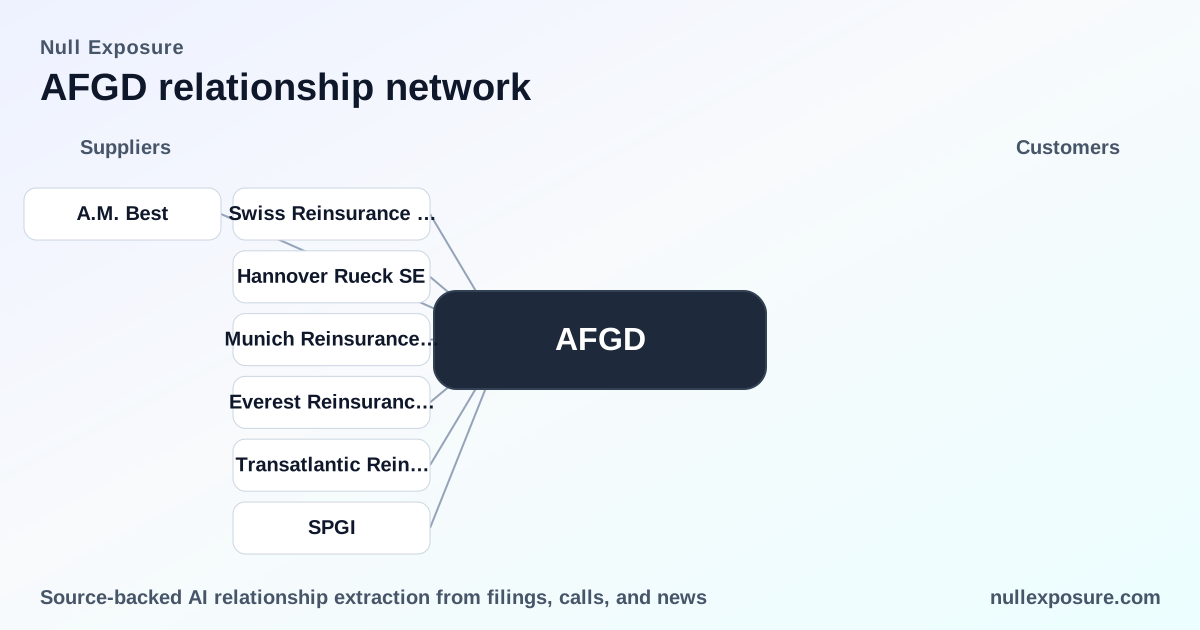
Swiss Reinsurance America Corporation — Recoverables from Swiss Re were reported as individually representing between 5% and 12% of AFG’s total property and casualty reinsurance recoverable, signaling Swiss Re is a material reinsurance counterparty in AFG’s program (AFG 2024 Form 10‑K, FY2024).
-
Hannover Rueck SE — Hannover Rück appears among the reinsurers whose recoverables each make up 5%–12% of AFG’s P&C reinsurance recoverable, indicating meaningful exposure to this large reinsurer (AFG 2024 Form 10‑K, FY2024).
-
Munich Reinsurance America, Inc. — Munich Re is listed as one of the reinsurers with recoverables in the 5%–12% band of total reinsurance recoverables, affirming its role as a core counterparty (AFG 2024 Form 10‑K, FY2024).
-
Everest Reinsurance Company — Everest Re also ranks in the 5%–12% range of AFG’s P&C reinsurance recoverables, placing it among the top ceded counterparties (AFG 2024 Form 10‑K, FY2024).
-
Transatlantic Reinsurance Company — Transatlantic Re is likewise cited as a reinsurer whose recoverables fall between 5% and 12% of the total P&C reinsurance recoverable, showing AFG’s diversified use of major market carriers (AFG 2024 Form 10‑K, FY2024).
-
Standard & Poor’s (SPGI) — AFG reports an S&P financial strength rating at the A+ level, a rating the company cites as part of its capital and funding narrative in investor communications (Q4 2025 earnings call, transcript posted March 2026).
-
A.M. Best — A.M. Best also assigns AFG an A+ insurance company financial strength rating, which AFG highlights when discussing balance-sheet strength and absence of near‑term debt maturities (Q4 2025 earnings call, transcript posted March 2026).
(References: AFG 2024 Form 10‑K for reinsurer recoverables disclosures; Q4 2025 earnings call transcript published March 2026 on InsiderMonkey for rating commentary.)
What these relationships mean for credit, concentration, and operational risk
AFG’s supplier footprint reveals a deliberately conservative counterparty mix: recoverables concentrated across several global, investment‑grade reinsurers plus government reinsurance for crop exposures. These characteristics create a set of operating constraints investors must treat as company-level signals:
-
Contracting posture (framework + facultative): AFG uses treaty agreements for predictable automatic cessions and facultative placements for selected risks, producing a mixed but controlled contracting strategy that supports scale and flexibility.
-
Counterparty profile (government + large enterprise): For crop insurance, AFG relies on the FCIC under the SRA; for commercial reinsurance it places business with investment‑grade global reinsurers or uses collateralized arrangements, reducing unsecured credit exposure.
-
Relationship role (buyer and service provider): AFG predominantly purchases reinsurance to mitigate loss, while simultaneously remaining the primary obligor to insureds—this dual role creates counterparty dependency but preserves customer-facing control.
-
Spend and scale (100m+): Reported ceded reinsurance figures (for example line items reported as 3,394 across periods) place ceded premiums well into the large spend band relative to operations, making reinsurer performance and collateral structures financially meaningful.
Key takeaway: The combination of framework treaties, large-scale ceded spend, and a roster of top-tier reinsurers plus FCIC for crop business positions AFG to manage volatility effectively, but also creates concentration channels where several reinsurers each represent single-digit-to-low‑teens percentages of recoverables—sufficient to require active counterparty monitoring.
Learn more about assessing supplier concentration and counterparty credit at https://nullexposure.com/.
Operational red flags and monitoring priorities for investors and operations teams
- Rating migration: A+ ratings from S&P and A.M. Best are pivotal to AFG’s funding costs; downgrade risk increases capital and collateral strain.
- Funds‑withheld and collateral terms: These contractual mechanics substitute credit for cash flows; changes in counterparties’ willingness to provide funds withheld will affect liquidity.
- Counterparty diversification vs. single‑counterparty exposure: Recoverables in the 5%–12% band concentrate risk across several partners—monitor treaty limits and aggregation by event.
- Government program dependency: Crop business routed through the FCIC under the SRA reduces commercial credit exposure but introduces programmatic policy and political risk to that line.
Final view and practical next steps
AFG’s reinsurance supplier mix is defensive and institutionally scaled, leveraging major global reinsurers and government arrangements to manage volatility. For investors and operational leaders, priority actions are: validate current collateral and funds‑withheld positions, track rating agency trajectories (S&P and A.M. Best), and quantify aggregation exposure across the named reinsurers. Effective counterparty governance will materially influence AFG’s capital efficiency and preferred‑stock risk profile.
For a deeper supplier-risk profile and dashboarding tools, visit https://nullexposure.com/. If you need bespoke exposure mapping or a supplier concentration briefing for AFG’s counterparties, start here: https://nullexposure.com/.