American Financial Group (AFG): Reinsurance Relationships That Shape Capital and Risk
American Financial Group (ticker: AFGE) underwrites property and casualty insurance and monetizes through underwriting margins and investment income while managing volatility via ceded reinsurance. The company maintains relationships with several major global reinsurers that provide capacity and credit support; these counterparties influence AFG’s balance-sheet recoverables, collateral dynamics, and concentration risk. Market capitalization is roughly $9.9 billion and the stock carries a high dividend yield (~6.7% as reported), making capital stability and reinsurance counterparty strength key investor considerations. Explore the supplier analysis hub for deeper coverage: https://nullexposure.com/
How AFG uses reinsurance to run a capital-efficient insurer
AFG writes P&C risks and then cedes portions to third-party reinsurers to limit single-event exposures, stabilize loss experience, and free up capital for growth. Reinsurance is structured on both treaty (framework) and facultative (risk-by-risk) terms, which gives management a mix of predictable ceded flow and transactional flexibility. AFG’s practice of ceding primarily to highly rated counterparties and using contractual protections such as “funds withheld” demonstrates a conservative contracting posture designed to protect statutory surplus and liquidity.
- Contracting posture: Predominantly framework/treaty plus facultative options to balance scale and selectivity.
- Capital effect: Reinsurance reduces net retained exposure and creates material reinsurance recoverables on the balance sheet that are concentrated across a handful of counterparties.
- Counterparty risk management: Recovery exposures are limited to reinsurers rated “A” or better or secured with collateral.
For a consolidated view of suppliers and counterparties, visit our home page: https://nullexposure.com/
The counterparties named by AFG and what they mean for investors
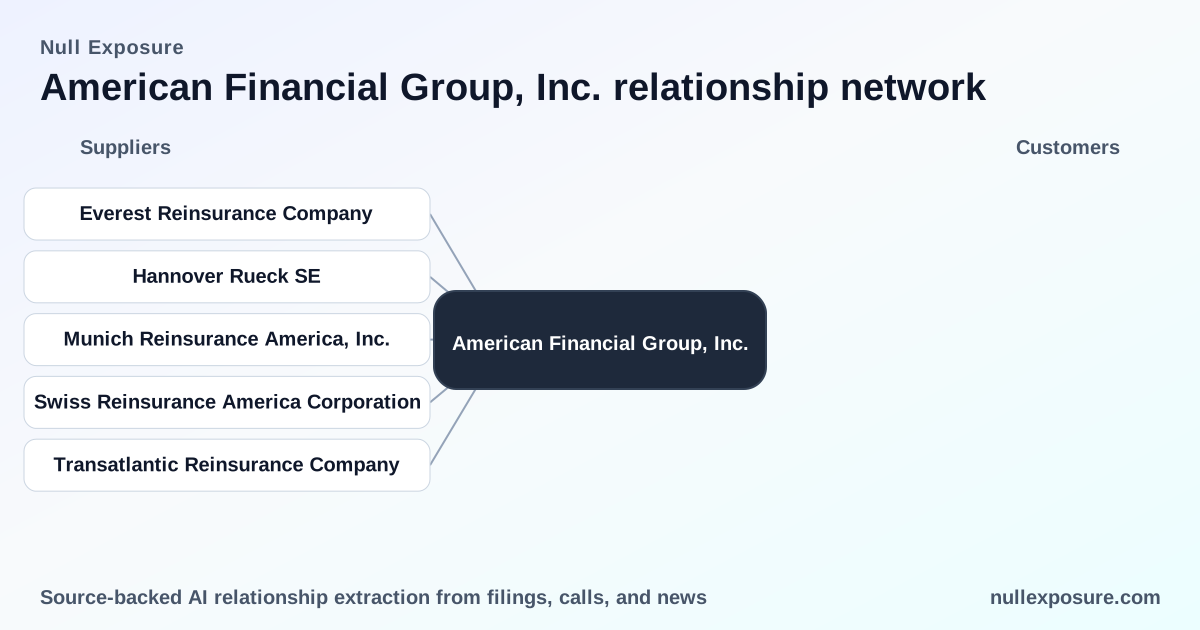
AFG’s FY2024 Form 10‑K lists five reinsurance companies that each represented between 5% and 12% of total property and casualty reinsurance recoverables at year‑end 2024. Below are plain-English takeaways for each relationship, with source references.
Everest Reinsurance Company
Recoverables from Everest Reinsurance Company represented between 5% and 12% of AFG’s total P&C reinsurance recoverables at December 31, 2024, signaling a meaningful exposure to Everest’s credit and claims-paying capacity. According to AFG’s FY2024 Form 10‑K, Everest is among the few reinsurers that account for a non-trivial slice of AFG’s recoverable pool (FY2024 Form 10‑K).
Hannover Rueck SE
AFG reports recoverables from Hannover Rueck SE in the same 5–12% band of P&C reinsurance recoverables at year‑end 2024, indicating Hannover is a prominent counterparty in AFG’s reinsurance program and an important node for counterparty credit analysis (AFG FY2024 Form 10‑K).
Munich Reinsurance America, Inc.
Munich Reinsurance America, Inc. also comprised between 5% and 12% of AFG’s P&C reinsurance recoverables at December 31, 2024, making Munich Re a core provider of reinsurance capacity to AFG and a relevant factor in stress-testing recoverable realizations (AFG FY2024 Form 10‑K).
Swiss Reinsurance America Corporation
Recoverables from Swiss Reinsurance America Corporation were individually between 5% and 12% of AFG’s total P&C reinsurance recoverables at the end of 2024, placing Swiss Re among the top-tier counterparties underpinning AFG’s ceded risk structure (AFG FY2024 Form 10‑K).
Transatlantic Reinsurance Company
Transatlantic Reinsurance Company completed the set of five reinsurers each representing 5–12% of AFG’s P&C reinsurance recoverable at December 31, 2024, highlighting Transatlantic’s role as a material capacity provider in AFG’s reinsurance mix (AFG FY2024 Form 10‑K).
What the constraints say about AFG’s operating model (company-level signals)
AFG’s disclosed constraints and excerpts create a composite view of how the company engages suppliers and manages balance-sheet risk:
- Long-term financing and maturity profile: AFG has access to a revolving credit facility (up to $450 million) that matures in June 2028 with SOFR-based pricing, indicating a medium-term liquidity backstop and conservative debt tenor that supports underwriting flexibility.
- Framework contracting with facultative overlay: Reinsurance is transacted both under treaty frameworks (automatic cessions for qualifying risks) and facultative placements for individual risks; this hybrid model supports scale while allowing selective risk management.
- Global footprint: AFG operates and leases facilities domestically and internationally, supporting geographically diverse underwriting and reinsurance relationships.
- Dual relationship roles: The company functions as a buyer of reinsurance capacity and as a service consumer of outside counsel, engineers, and specialty consultancies, reflecting standard insurance outsourcing and advisory structures.
- Active supplier stage and outsourcing: AFG outsources technology and business process functions to third parties and actively maintains reinsurance arrangements, indicating ongoing operational dependence on external providers.
Together these signals point to a mature insurance operator that relies on established counterparty relationships, structured reinsurance frameworks, and a diversified set of global reinsurers to stabilize earnings and capital.
Investment implications — what investors should monitor now
AFG’s concentration of recoverables across a handful of well-rated reinsurers creates both strength and sensitivity:
- Strength: Ceding to high-quality, global reinsurers reduces net volatility and supports statutory surplus resilience.
- Sensitivity: Each named reinsurer contributes a meaningful share (5–12%) of recoverables, so deteriorating reinsurer credit or disputes over collateral/funds-withheld arrangements would have outsized balance-sheet impact.
- Operational risk: Outsourced technology and business processes introduce third-party operational dependencies that should be tracked alongside counterparty credit risk.
- Liquidity/maturity risk: The revolving credit facility extends to mid‑2028 and offers a liquidity cushion, but investors should watch covenant terms and utilization.
Actionable checklist:
- Review updates to reinsurance recoverables and collateral schedules in quarterly filings.
- Monitor ratings and capital positions of the five named reinsurers.
- Track AFG’s utilization of its revolving credit facility and any changes to contractual terms.
Midway resource: if you want the supplier landscape for comparable insurers, start here: https://nullexposure.com/
Bottom line and next steps
AFG runs a conventional, capital-efficient P&C underwriting platform supported by a small set of high-quality reinsurance counterparties that each represent material recoverables. This structure stabilizes earnings but concentrates counterparty credit exposure; investor due diligence should focus on reinsurer credit trends, collateral arrangements, and AFG’s liquidity posture. Key takeaway: reinsurance partners are a central lever in AFG’s risk transfer and capital management strategy — they are both a source of resilience and a concentration risk.
For ongoing coverage and supplier-level detail, visit our home page and subscribe for alerts: https://nullexposure.com/