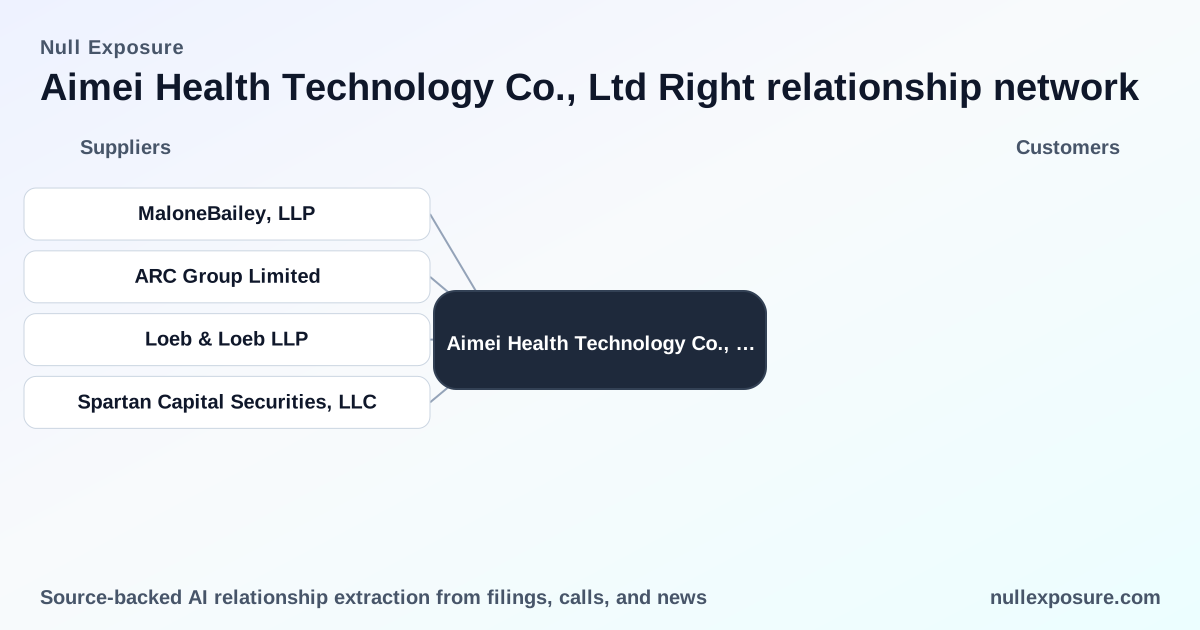
AFJKR (Aimei Health Technology Co., Ltd Right) — supplier relationships and what they mean for investors
Aimei Health Technology Co., Ltd Right operates as an AI-driven healthcare technology company focused on diagnostic and treatment solutions for healthcare providers and systems. The company monetizes by commercializing next-generation products and by contracting for services that increase operational efficiency within healthcare systems; its near-term cashflow profile is shaped heavily by transaction-related financing and sponsor arrangements tied to its corporate lifecycle. Investors should evaluate supplier relationships not just for cost, but for their role in underwriting the listing, legal framework, audit integrity, and short-term liquidity management. For a concise view of coverage and tracking, visit https://nullexposure.com/.
How AFJKR’s external partners shape the business model
AFJKR’s external suppliers fall into two practical buckets: capital-market service providers (underwriters, financial advisers, legal counsel) that enabled the company’s listing and transaction activity, and governance service providers (auditor) that support financial reporting credibility. The company-level disclosures show a mix of short-term transactional engagements and an ongoing administrative services agreement with its Sponsor, which together imply a capital-formation posture rather than a long-established revenue-driven vendor base.
- The company has issued unsecured promissory notes and paid monthly extension fees to extend its business combination timeline, which creates short-term external payment obligations and points to reliance on Sponsor liquidity for near-term operations (promissory notes of $227,700 and monthly extension notes described in company filings from December 2024).
- The Sponsor provides general and administrative services (office space, utilities, administrative support) under a fee arrangement of $10,000 per month for up to 12–24 months, recorded as an unpaid related-party balance ($120,000 as of Dec 31, 2024), illustrating an operational dependency that is contractually explicit.
These dynamics position AFJKR as an organization in a transition stage where supplier relationships are critical to completing strategic transactions and maintaining listing status.
The supplier roster — what each partner does for AFJKR
MaloneBailey, LLP — auditor appointment for 2025
MaloneBailey was appointed as the company’s independent auditor for 2025, replacing prior audit arrangements and signaling an emphasis on refreshed audit coverage for upcoming reporting requirements. According to a press release covered by The Globe and Mail on March 9, 2026, the appointment was made at a shareholder meeting (FY2025 disclosure).
Source: The Globe and Mail press release, March 9, 2026.
ARC Group Limited — financial adviser to the company
ARC Group Limited acted as financial adviser to Aimei in FY2023, supporting transaction planning and advisor-level work around the company’s capital-market activities and business combination efforts. This role underpins the company’s ability to structure deals and extensions.
Source: Yahoo Finance press release, March 9, 2026 (referencing FY2023 engagement).
Loeb & Loeb LLP — legal counsel
Loeb & Loeb LLP served as legal counsel to the Company in FY2023, providing transaction and corporate legal services that are foundational for completion of business combinations and regulatory compliance associated with a Nasdaq listing.
Source: Yahoo Finance press release, March 9, 2026 (referencing FY2023 engagement).
Spartan Capital Securities, LLC — sole book-running manager
Spartan Capital Securities acted as the sole book-running manager for the offering, carrying underwriting responsibilities and placing securities into the market; the underwriters are also entitled to deferred underwriting discounts totaling $690,000 (1.0% of gross proceeds), a material transaction cost disclosed by the company.
Source: Yahoo Finance press release, March 9, 2026 (referencing FY2023 engagement).
Constraints and what they tell investors about AFJKR’s operating posture
AFJKR’s disclosed constraints paint a clear picture of a company operating in a transaction-heavy, sponsor-supported phase rather than as a fully independent, revenue-generating enterprise.
- Contracting posture: Short-term financial obligations dominate — monthly extension promissory notes (non-interest bearing, payable upon closing) and a December 2024 note of $227,700 to extend the business combination timeline indicate reliance on bridge-like instruments to manage listing deadlines. At the same time, there is a standing long-term administrative contract with the Sponsor (office and G&A services) that creates ongoing related-party expense and potential governance scrutiny.
- Spend concentration and scale: Contractual line items and disclosures place supplier spend in the $100k–$1M band for several critical items (e.g., deferred underwriting discounts of $690,000; promissory note balances of $227,700; unpaid related-party balance of $120,000), meaning single engagements can materially affect the company’s near-term cash position.
- Role and criticality: External partners are service providers in the strategic sense — legal counsel, underwriter, financial adviser, and auditor — whose performance is directly tied to AFJKR’s ability to close a business combination and maintain public reporting. These relationships are functionally critical; failure or delay in any of them would directly impede the company’s primary corporate objectives.
- Maturity and stage: The relationship stage signals are active and transactional, focused on deal execution rather than long-term operational procurement. Audit appointment and underwriting discounts are typical of a company in the SPAC/post-SPAC lifecycle.
Investment implications — risks and action points
AFJKR’s supplier profile underscores two central investment themes: execution sensitivity and sponsor dependency.
- Execution sensitivity: With underwriting fees, adviser roles, legal counsel, and auditing services concentrated in a few providers, closing risk is elevated — a failed or delayed business combination materially affects value and triggers the repayment mechanics built into the disclosed promissory notes.
- Sponsor dependency: The Sponsor’s ongoing administrative role and related-party balances create operational and governance concentration, which requires scrutiny of related-party terms, encumbrances on cash, and conflict-of-interest protections.
- Cost transparency: Deferred underwriting discounts and payable promissory notes are visible, but investors should seek confirmation on additional contingent obligations tied to the business combination timeline.
Investors evaluating supplier risk should request current confirmations from the company on the status of the business combination timeline, outstanding promissory notes, and the scope and duration of Sponsor services. For monitoring tools and supplier exposure analytics, explore https://nullexposure.com/ for ongoing tracking and alerts.
Bottom line and recommended next steps
AFJKR is operating at the intersection of capital markets execution and early-stage product commercialization; its supplier relationships are transaction-critical and financially meaningful in the near term. For investors, the primary questions are whether the company can complete its business combination without additional dilutive financing and how Sponsor arrangements will transition if and when operating revenues emerge.
Recommended next steps:
- Request a current audit timeline and confirmation of MaloneBailey’s engagement scope and independence procedures.
- Confirm the status of promissory notes, trust-account balances, and deferred underwriting fees to quantify near-term cash commitments.
- Review Loeb & Loeb and ARC Group engagement letters for termination clauses or contingent fee structures tied to transaction outcomes.
For real-time tracking of these supplier signals and to subscribe for alerts on AFJKR counterparties, visit https://nullexposure.com/.