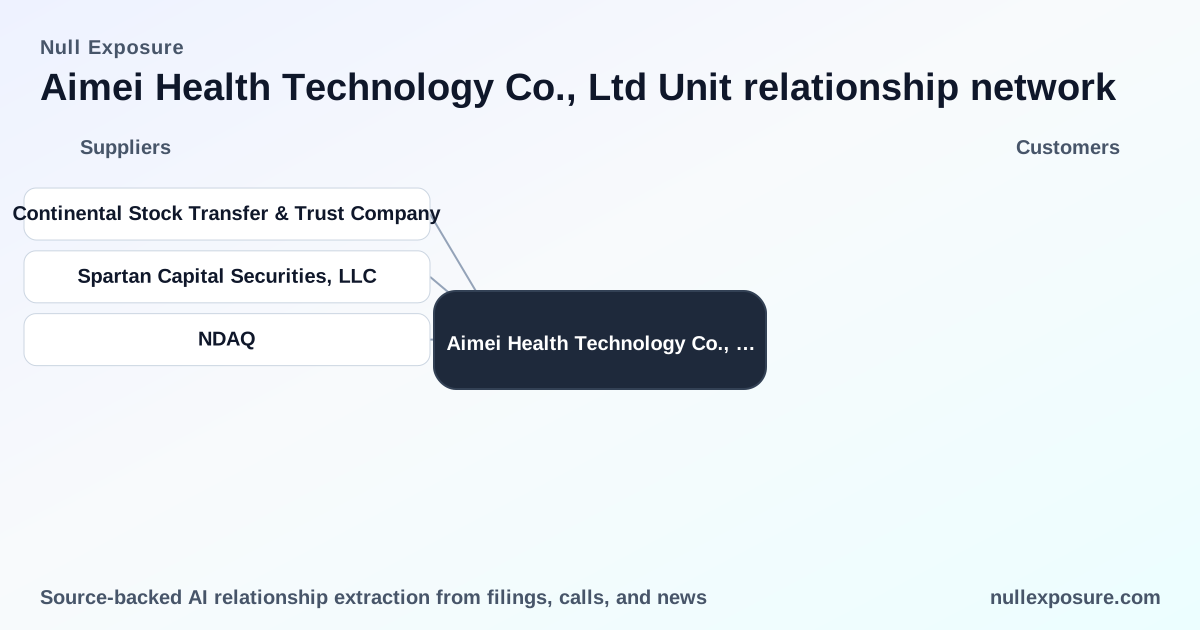
AFJKU (Aimei Health Technology Co., Ltd Unit) — Supplier relationships, commercial posture, and investor implications
Aimei Health Technology develops medical devices and health-management systems and intends to monetize through product sales and strategic partner agreements; however, as a listed unit structure the company currently reports no operating revenue and finances near-term activity through sponsor services, trust-account funding and short-term administrative contracts. For investors and operators evaluating counterparty exposure, the commercial footprint is concentrated, operationally immature and tethered to a small set of capital-market and sponsor counterparties that provide critical administrative and capital extension services.
Explore deeper supplier-relationship intelligence at https://nullexposure.com/ if you need a structured vendor-risk view.
A short operating snapshot investors need now
Aimei’s public profile is that of an early-stage, research-focused healthcare issuer with limited financial history. The company reports zero revenue, zero gross profit and negative book value (-0.562) in its public summary; SharesOutstanding is listed as 0, with a SharesFloat of 4,396,800. Market metrics are sparse and unstable—52-week trading ranged between 7.6 and 70.4, and reported beta is -2.983. These figures underscore a capital-markets orientation rather than a mature commercial operating base: trading units and sponsor arrangements are a central part of the company’s current cash-flow and control picture.
The named counterparties and what they do for Aimei
Below are every relationship captured in the public results and what each party is doing in plain English.
Continental Stock Transfer & Trust Company
Holders of Aimei units must contact Continental Stock Transfer & Trust Company—Aimei’s transfer agent—to separate the publicly traded units into ordinary shares and detachable rights. This administrative role is set out in the company’s January 18, 2024 press release on GlobeNewswire (announcing separate trading of ordinary shares and rights commencing January 22, 2024). Source: GlobeNewswire press release, January 18, 2024 — https://www.globenewswire.com/news-release/2024/01/18/2811979/0/en/Aimei-Health-Technology-Co-Ltd-Announces-the-Separate-Trading-of-its-Ordinary-Shares-and-Rights-Commencing-January-22-2024.html
Spartan Capital Securities, LLC
Spartan Capital Securities acted as the sole book‑running manager for the offering that separated Aimei’s units into ordinary shares and rights; in practice this means Spartan handled placement and market distribution responsibilities for the transaction. Source: GlobeNewswire press release, January 18, 2024 — https://www.globenewswire.com/news-release/2024/01/18/2811979/0/en/Aimei-Health-Technology-Co-Ltd-Announces-the-Separate-Trading-of-its-Ordinary-Shares-and-Rights-Commencing-January-22-2024.html
The Nasdaq Global Market (Nasdaq)
Aimei’s ordinary shares and detachable rights were listed to trade on Nasdaq under the tickers AFJK (ordinary shares) and AFJKR (rights), establishing Nasdaq as the company’s principal trading venue and public-liquidity channel. This listing is documented in the same January 18, 2024 GlobeNewswire disclosure. Source: GlobeNewswire press release, January 18, 2024 — https://www.globenewswire.com/news-release/2024/01/18/2811979/0/en/Aimei-Health-Technology-Co-Ltd-Announces-the-Separate-Trading-of-its-Ordinary-Shares-and-Rights-Commencing-January-22-2024.html
What the contractual constraints reveal about the operating model
The redacted contract excerpts in the filings provide direct company-level signals about how Aimei runs its near-term operations.
- Short-term, sponsor-driven administrative contracts. Aimei has agreed to pay a Sponsor $10,000 per month for general administrative services, initially for up to 12 months with an extension option to 24 months. This structure signals a deliberate, short-duration outsourcing posture for basic corporate operations rather than long-term operating commitments.
- Service-provider dependence and criticality. The Sponsor is contractually required to supply office space, utilities and administrative services through the earlier of a business combination or liquidation—making the Sponsor a critical service provider for day-to-day corporate functionality.
- Moderate counterparty spend and material unpaid balances. The filing records an unpaid balance to the Sponsor of $120,000 as of December 31, 2024, and spend-band evidence places related-party spend in a $100k–$1M range. This points to meaningful but not heavy supplier spend concentration.
- Capital-extension via short promissory funding. On December 11, 2024 the company issued an unsecured promissory note for $227,700 to the Sponsor and United Hydrogen and deposited that amount into the Trust Account to extend time for a business combination until January 6, 2025. That action is a corporate-level financing maneuver rather than an operational revenue stream.
Taken together these signals describe a company that is operationally dependent on a small set of counterparties for basic administration and for bridging capital, with contract terms set at short horizons and balances that are material to a small balance sheet.
Explore vendor concentration and supplier exposure tools at https://nullexposure.com/ for ongoing monitoring.
Key risk and exposure considerations for investors and operators
- Concentration risk: Administrative continuity depends on Sponsor services; loss or renegotiation of that relationship would immediately increase operational friction. Sponsor reliance is a single-point-of-failure risk.
- Liquidity and solvency exposure: With no reported revenue and material unpaid balances to related parties, the company’s short-term survival is tethered to sponsor advances, trust-account mechanics and the outcome of any planned business combination.
- Market-structure complexity: The separation of units into shares and rights and the dual tickers (AFJK / AFJKR) create structural liquidity and governance considerations for holders—especially for investors assessing dilution, rights exercise outcomes, or timing of a business combination.
- Counterparty roles are transactional and short‑maturity: Contracts are explicitly short-term (12–24 months) and subscription-style, which increases the likelihood of renegotiation risk and timing mismatches with any longer-term commercialization plans.
Bottom line and recommended next steps
Aimei (AFJKU) is a public unit with a research- and development-oriented healthcare mission, but current operations are effectively supported by sponsor services and capital-extension instruments rather than product revenue. That profile creates concentrated supplier and financing risk and elevates the importance of monitoring sponsor agreements, the Trust Account activity, and any announcements regarding a business combination.
For action: verify sponsor service agreements and unpaid‑balance remediation; track the status and enforcement of the December 2024 promissory note and trust-account funding; and monitor trading of AFJK/AFJKR for liquidity signals.
If you need granular vendor exposure mapping or continuous monitoring for AFJKU counterparties, start here: https://nullexposure.com/
Final thought: treat Aimei as a capital-markets vehicle with operational dependencies, not a mature healthcare revenue generator—structure diligence and exposure limits accordingly. For vendor risk intelligence and ongoing supplier monitoring, see https://nullexposure.com/