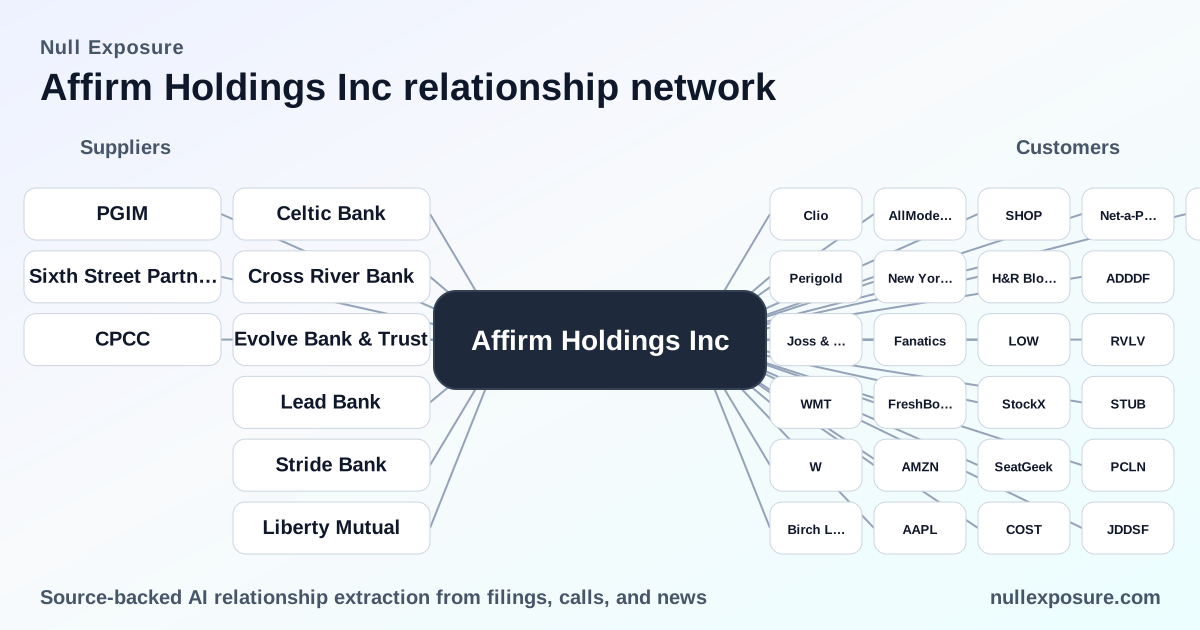
How Affirm monetizes a distributed lender-payments stack — and why partners matter
Affirm operates a point-of-sale financing and digital payments platform that monetizes by originating consumer loans through bank partners, collecting interchange and servicing fees on card products, and leveraging institutional capital and insurance backstops for credit exposure. The company's economics hinge on loan volume growth, interest and fee income, interchange from card programs, and capital provided by institutional partners and insurers that underwrite or purchase credit risk.
For investors evaluating supplier relationships, the core takeaway is simple: Affirm is a platform company that outsources critical regulatory and capital functions to a small set of banks and large institutional backers — that outsourcing accelerates scale but concentrates operational and regulatory risk. Explore deeper partner exposure and constraints at https://nullexposure.com/.
The partner roster, one sentence at a time
- Celtic Bank: Affirm discloses that substantially all U.S. loans facilitated through its platform are originated through Celtic Bank, an FDIC‑insured Utah state‑chartered industrial bank, per Affirm’s FY2025 Form 10‑K.
- Lead Bank: Affirm states that Lead Bank is also one of the primary U.S. originators for loans facilitated on its platform, described in the FY2025 Form 10‑K.
- Cross River Bank: Cross River is named both in Affirm’s 10‑K for permissive interest rate structures and in press coverage as the issuing partner for Affirm’s high‑yield savings account offered through the Affirm app, as noted in the FY2025 Form 10‑K and MarketScreener reporting in March 2026.
- Evolve Bank & Trust: Affirm relied on a single Card Issuing Bank partner, Evolve Bank & Trust, to issue the Affirm Card at the end of fiscal 2025, according to the FY2025 Form 10‑K.
- Stride Bank: Affirm entered a payments program partnership with Stride Bank as an additional issuing bank for the Affirm Card at program launch, per the FY2025 Form 10‑K.
- Liberty Mutual: Institutional backing from Liberty Mutual is cited in media coverage as one of the insurance/capital partners supporting Affirm in recent years (Yahoo Finance, March 2026).
- PGIM: PGIM is referenced as a capital backer alongside other institutional partners in news reporting about Affirm’s funding relationships (Yahoo Finance, March 2026).
- Sixth Street Partners: Sixth Street Partners is listed as another institutional backer highlighted in March 2026 press coverage discussing Affirm’s financing relationships (Yahoo Finance, March 2026).
- Stripe: Recent coverage reports that Affirm expanded its partnership with Stripe to support Shared Payment Tokens for agentic commerce, reflecting a product and payments‑rail collaboration (news summary March 2026).
Each of the above is drawn from Affirm’s FY2025 Form 10‑K or contemporaneous press coverage in March 2026; see Affirm’s FY2025 10‑K and related news reports for the primary disclosures.
Why these relationships matter to valuation and risk
Affirm’s revenue and unit economics are not just product stories — they are contract stories. Banks that originate loans and issue cards carry regulatory licenses, deposit and funding plumbing, and consumer compliance responsibilities that Affirm deliberately outsources. That arrangement lowers Affirm’s capital and regulatory burden while transferring dependent operational and compliance risk to partners.
- Concentration risk is material: the 10‑K states that "substantially all" U.S. loans are originated through Celtic Bank and Lead Bank, and Affirm relied on a single card issuer, Evolve, for the Affirm Card as of fiscal 2025. That level of concentration amplifies single‑counterparty risk to operations and go‑to‑market execution.
- Service dependencies are enterprise‑grade: Affirm disclosed large, non‑cancelable cloud commitments—an aggregate committed spend of $650 million through February 2030—indicating a heavy reliance on a single cloud infrastructure provider. This is both a growth enabler and a fixed‑cost obligation that reduces flexibility.
- Operational criticality is explicit: Affirm flagged that third‑party failures, security breaches, and regulatory enforcement tied to partner incidents can produce economic and reputational harm; the 10‑K specifically references an Evolve Bank & Trust cybersecurity incident reported in June 2024, making that card issuer relationship operationally sensitive.
- Institutional capital and insurance backers de‑risk credit exposure: Partnerships with Liberty Mutual, PGIM and Sixth Street provide capital and loss‑sharing capacity that supports loan origination and liquidity, but those relationships are also covenant and counterparty‑dependent for capital access.
These constraints together describe a company whose contracting posture is partner‑centric, concentration is elevated in several core functions, criticality of partners is high, and the maturity of those arrangements is mixed (long‑dated cloud commitments vs. newer product partnerships with Stripe and Stride).
If you want a deeper parse of how each counterparty affects Affirm’s operational footprint, see https://nullexposure.com/ for mapped supplier intelligence.
Investment implications — what to watch next
- Growth and margin sensitivity: Affirm’s profit mix depends on loan yields, interchange, and fee income; interruptions in the originating banks or card program could disrupt volume and raise funding costs. Operational counterparty failures translate directly to P&L and regulatory exposure.
- Regulatory and reputational risk: Banking partners bring supervisory exposure that flows to Affirm’s platform; incidents like Evolve’s cybersecurity event are potent reminders that outsourced regulatory exposure is still company risk.
- Cost structure and vendor lock: The large cloud commitment implies fixed cost leverage that aids scale but reduces near‑term flexibility if product-market dynamics change.
- Diversification progress: The addition of Stride as an issuing bank and product partnerships with Stripe demonstrate active diversification of rails and capabilities; institutional backers provide funding optionality but are not substitutes for bank licenses.
Final takeaways and next steps
- Affirm is a platform that scales distribution through bank and institutional partners — that model accelerates reach but concentrates regulatory and operational risk with a handful of suppliers.
- Key monitoring items for investors: counterparty performance (Celtic, Lead, Evolve), cloud supplier delivery and committed spend, progress on issuing‑bank diversification (Stride), and the tenor of institutional funding relationships (Liberty Mutual, PGIM, Sixth Street).
For an actionable supplier exposure snapshot and mapping of counterparty concentration, visit https://nullexposure.com/. If you require a tailored supplier risk briefing for Affirm or comparable fintechs, start with https://nullexposure.com/ and request a custom analysis.