AFYA: Auditor swap highlights governance focus and supplier posture investors should track
Afya Limited operates by delivering medical education and healthcare services in Brazil through education programs, vocational training, and clinical services, monetizing via tuition, professional education fees, and healthcare reimbursements. The recent change in independent registered public accounting firms signals a deliberate corporate governance decision with supplier implications for audit, compliance, and external assurance spend. Investors should treat this as a governance and supplier-concentration event — not merely an administrative update. For a deeper supplier-risk view and to monitor subsequent filings, visit https://nullexposure.com/.
Why the auditor change matters for investors
An auditor replacement is a high-visibility supplier event because audit firms perform critical oversight functions that affect financial reporting credibility, investor confidence, and regulatory interaction. Switching from one Big Four firm to another is a concentrated, high-criticality supplier decision that reflects corporate governance priorities and procurement posture. The cost and operational impact are modest relative to core operations, but the reputational and compliance implications can be material for valuation and risk assessments.
The relationships you need to know now
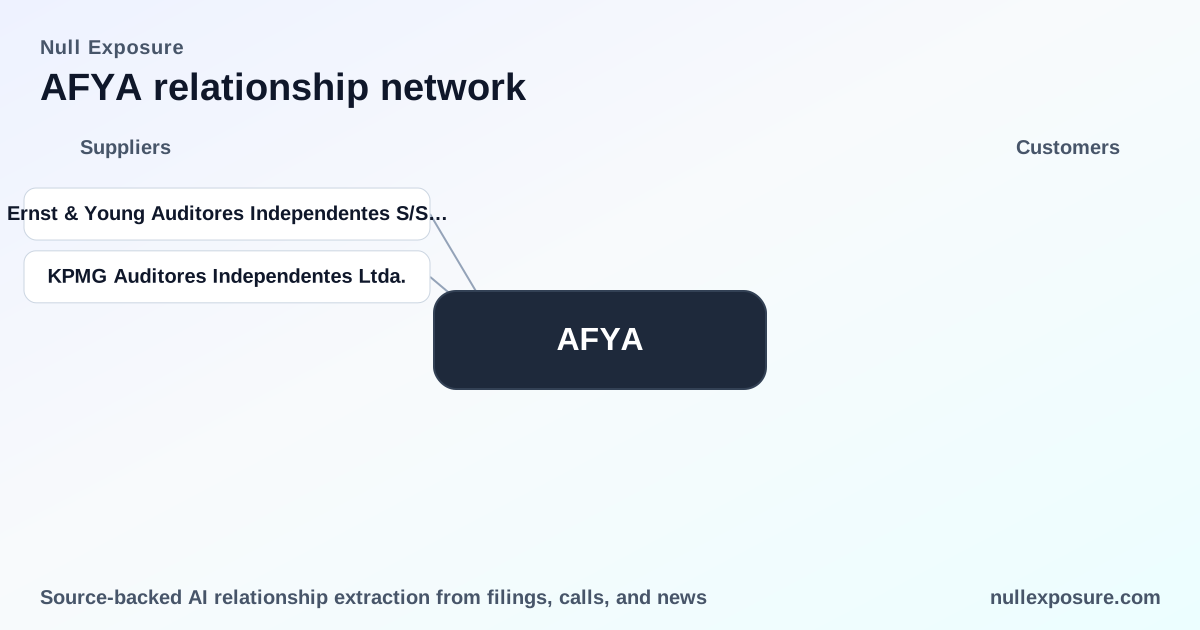
Ernst & Young Auditores Independentes S/S Ltda.
Ernst & Young (EY) served as Afya’s independent registered public accounting firm until the board approved a change; EY is the outgoing auditor in this supplier relationship. According to a StockTitan news release dated March 9, 2026, the company has replaced EY in its role as independent auditor. (Source: StockTitan, March 9, 2026 — https://www.stocktitan.net/news/AFYA/afya-limited-announces-change-of-independent-registered-public-2ogwk9okkgbb.html)
KPMG Auditores Independentes Ltda.
KPMG has been engaged to provide independent auditing services for Afya, replacing EY as the independent registered public accounting firm. The same March 9, 2026 report documents the board-approved engagement of KPMG to perform Afya’s independent audit services going forward. (Source: StockTitan, March 9, 2026 — https://www.stocktitan.net/news/AFYA/afya-limited-announces-change-of-independent-registered-public-2ogwk9okkgbb.html; overview also noted on StockTitan, March 2026 — https://www.stocktitan.net/overview/AFYA/)
What this supplier shift signals about Afya’s operating model
- Contracting posture — centralized and governance-driven. An auditor appointment is routed through the board and audit committee, indicating Afya centralizes critical supplier decisions and treats audit engagements as corporate-level contracts rather than decentralized operational buys.
- Supplier concentration — naturally high for audit services. Large-cap audit services are concentrated among a small set of global firms; Afya’s movement between Big Four providers confirms limited diversification options for high-quality, regulated assurance services.
- Criticality — audit is mission-critical for public-company continuity. Independent auditors underpin financial statement credibility, regulatory filings, and investor trust; this supplier is functionally essential.
- Maturity — supplier relationships governed by standard corporate controls. The transition between established audit firms reflects a mature procurement posture that uses periodic re-tendering or board-level oversight rather than ad-hoc supplier engagements.
These are company-level signals derived from the supplier change and governance mechanics; they represent persistent characteristics investors should treat as part of Afya’s supplier risk profile rather than one-off operating quirks.
Visit https://nullexposure.com/ for comparative supplier exposure metrics and historical change tracking across peer groups.
Risk and valuation implications for investors
The direct financial impact of swapping auditors is usually limited to transition fees and cadence adjustments; however, the broader implications affect three investment vectors:
- Governance and confidence: A board-driven auditor change, particularly between major firms, strengthens the visible governance posture and can improve investor perceptions of controls if disclosed transparently.
- Regulatory signaling: Auditor changes often correlate with enhanced regulatory scrutiny or the conclusion of auditor rotation policies; investors should review Afya’s filings for disclosure on reasons and any disclosed audit issues.
- Operational continuity: While audit continuity interruptions are rare, transitions require management time and can temporarily shift internal control focus. These are short-term operational costs with asymmetric reputational upside if managed well.
Immediate monitoring checklist for operators and investors
- Review Afya’s next quarterly and annual filings for the audit engagement letter, scope, and any disclosed audit-related fees or disagreements.
- Track communications from the audit committee or board minutes to understand whether the change was routine rotation, procurement-driven, or related to technical accounting disagreements.
- Watch for related supplier changes in adjacent compliance services (e.g., tax advisers, legal firms) that can indicate a broader vendor rationalization.
A focused review of these areas will reveal whether this is a governance optimization or a reaction to audit findings.
Bottom line and recommended actions
The auditor change from Ernst & Young to KPMG is a governance-positive supplier decision that increases transparency on Afya’s oversight and confirms a centralized, high-criticality supplier posture. Investors should treat this event as an actionable signal to re-assess governance risk factors and monitor follow-on disclosures rather than a standalone financial event.
- Re-check Afya’s SEC-equivalent filings for audit committee commentary and engagement terms.
- Adjust governance risk scores to reflect a supplier-concentrated model for assurance services.
- Maintain contact with investor relations for any forward-looking guidance related to audit scope or new accounting policies.
For ongoing supplier-risk intelligence and to compare Afya’s supplier moves across the sector, visit https://nullexposure.com/.
This is a concise supplier-focused read for diligence and monitoring: the auditor swap matters for governance, it is concentrated and critical, and it should be folded into your risk and valuation framework now.