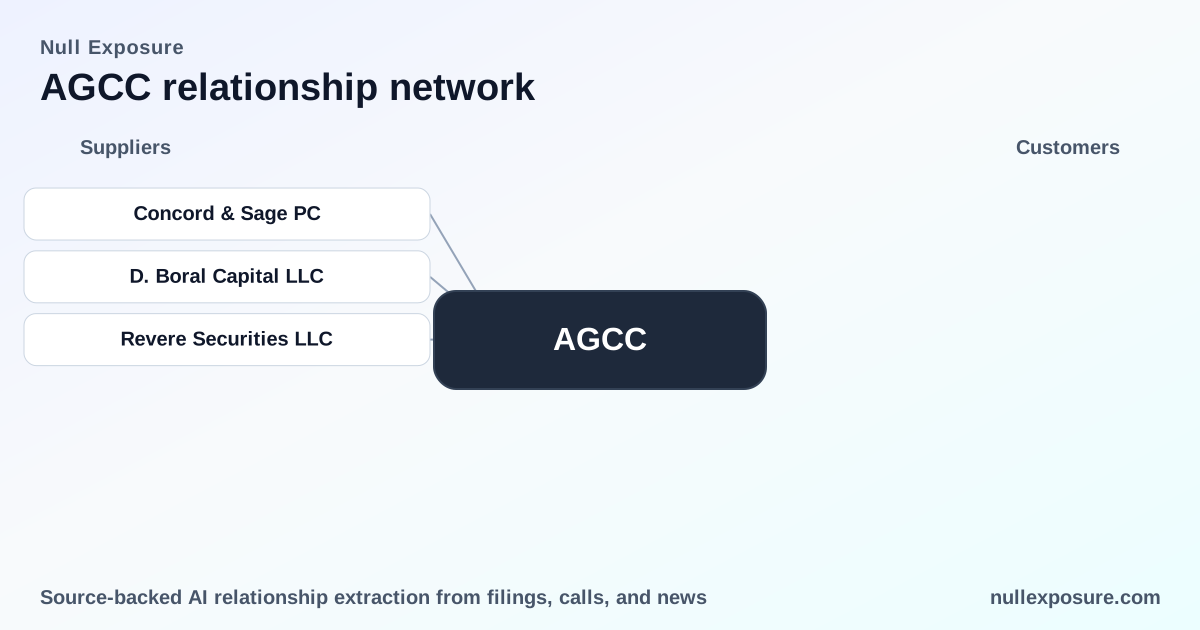
AGCC: Capital partners define near-term liquidity and counterparty exposure
Agencia Comercial Spirits Ltd (AGCC) operates in the beverage and spirits sector and monetizes through product sales to distributors and retailers alongside intermittent capital raises to finance growth and inventory. The company’s most consequential commercial relationships for investors are underwriting and legal service providers tied to a recent $7 million offering; those counterparties govern AGCC’s immediate access to capital and set terms that influence cash runway and investor dilution. For investors and operators, the underwriting and legal network around AGCC is the primary lever on liquidity and execution risk over the next 12–18 months. Learn more at https://nullexposure.com/.
Why the underwriting network matters more than product partners today
AGCC’s visible supplier footprint in public records is dominated by capital markets advisors for a recent financing transaction. When a small-company issuer relies on a discrete underwriting syndicate to close an initial raise, the underwriting group’s execution, fee structure, and allocation policies directly determine speed to market and net proceeds. Legal counsel allocated to the issuer and underwriters further codifies deal protections and representations that affect post-close governance.
- Concentration: The financing was led by a single lead underwriter with a named co‑underwriter, concentrating execution risk.
- Criticality: These relationships are critical for near-term liquidity but transactional in nature; they are not long-term manufacturing or distribution contracts.
- Maturity: The relationship map reads like an early-stage capital event rather than a mature, multi-year supplier ecosystem.
If you would like a deeper counterparty map for diligence, visit https://nullexposure.com/ for our supplier coverage and relationship analytics.
Who AGCC contracted for the offering — the relationship facts
This section catalogs every supplier relationship disclosed in the public reporting tied to AGCC’s financing event. Each item is distilled to a plain-English takeaway with the source.
-
Concord & Sage PC acted as U.S. legal counsel to AGCC for the offering, providing issuer-side legal services for the transaction. According to a StockTitan news report dated March 9, 2026, Concord & Sage PC represented the company in the financing (StockTitan, Mar 9, 2026 — https://www.stocktitan.net/news/AGCC/agencia-comercial-spirits-ltd-announces-closing-of-7-million-initial-ucdgiy3lnfji.html).
-
D. Boral Capital LLC served as the lead underwriter for the offering and therefore carried primary responsibility for syndication, pricing, and allocation of the raise. The same StockTitan report identifies D. Boral Capital LLC as the lead underwriter for the transaction (StockTitan, Mar 9, 2026 — https://www.stocktitan.net/news/AGCC/agencia-comercial-spirits-ltd-announces-closing-of-7-million-initial-ucdgiy3lnfji.html).
-
Revere Securities LLC participated as a co‑underwriter alongside the lead, sharing distribution duties and underwriting exposure for the offering. The March 9, 2026 StockTitan notice lists Revere Securities LLC as the co‑underwriter for AGCC’s financing (StockTitan, Mar 9, 2026 — https://www.stocktitan.net/news/AGCC/agencia-comercial-spirits-ltd-announces-closing-of-7-million-initial-ucdgiy3lnfji.html).
What these supplier relationships imply for investors and operators
The concentration of supplier mentions around one financing event signals a company currently defined by capital markets activity rather than an extensive, diversified supplier base. From an investor diligence lens, prioritize the following points:
- Liquidity hinge: The lead underwriter controls timing and access to capital distribution channels; that affects the company’s near-term cash position and ability to fund operations or marketing.
- Deal economics and dilution: Underwriter fees, placement discounts, and allocation decisions set the effective cost of capital; those terms materially affect shareholder dilution and net proceeds available for growth.
- Contracting posture: Legal counsel for the issuer and underwriters codifies indemnities, disclosure limits, and post-close covenants; these are standard but crucial protections for counterparties and investors.
- Concentration risk: With a compact underwriting syndicate, counterparty failure or secondary market inability to place shares would expose AGCC to refinancing delays.
- Operational criticality: Outside the financing window, these suppliers are not operating vendors for production or distribution; their criticality is high for capital events and low for ongoing product delivery.
For bespoke supplier intelligence and to map downstream counterparty exposure, visit https://nullexposure.com/.
Constraints and company-level signals investors should factor into valuation
No discrete constraint excerpts were provided in the supplier disclosures, which itself is a company-level signal about disclosure depth. From that absence and the relationship set, infer these operating-model characteristics for diligence:
- Contracting posture is transactional and event-driven. Supplier engagements documented are specific to a capital raise rather than long-term service agreements.
- Supplier concentration is high for capital markets services. A small number of underwriters and counsel handled the offering, increasing single-event exposure.
- Criticality is concentrated into financing cycles. For day-to-day operations, product suppliers and distribution partners were not disclosed, which suggests investor focus should be on cash and capital structure risk.
- Maturity of supplier relationships is early-stage. The public record reflects a single financing close rather than a history of repeated multi-year engagements.
These company-level signals should be integrated into scenario analysis when modeling cash runway and downside outcomes.
Risk checklist and final investor takeaways
- Primary risk: Execution failure or adverse terms in future capital raises given concentrated underwriting relationships.
- Secondary risk: Limited public supplier footprint for operations increases opacity on product margin drivers and fulfillment resilience.
- Opportunity: A successful syndication and clean legal documentation reduce execution risk and provide runway for commercialization if management deploys proceeds effectively.
If you are evaluating AGCC for an investment or supplier relationship, prioritize underwriting term sheets, legal indemnities, and the use of proceeds schedule in your next diligence step. For tailored reports and ongoing monitoring of supplier relationships across small-cap issuers, explore our services at https://nullexposure.com/.
Concluding recommendation: treat AGCC as a capital-event-driven equity with high sensitivity to underwriting execution and post-offering cash deployment; investors should require clear evidence of how the recent proceeds will translate to revenue growth before increasing exposure.