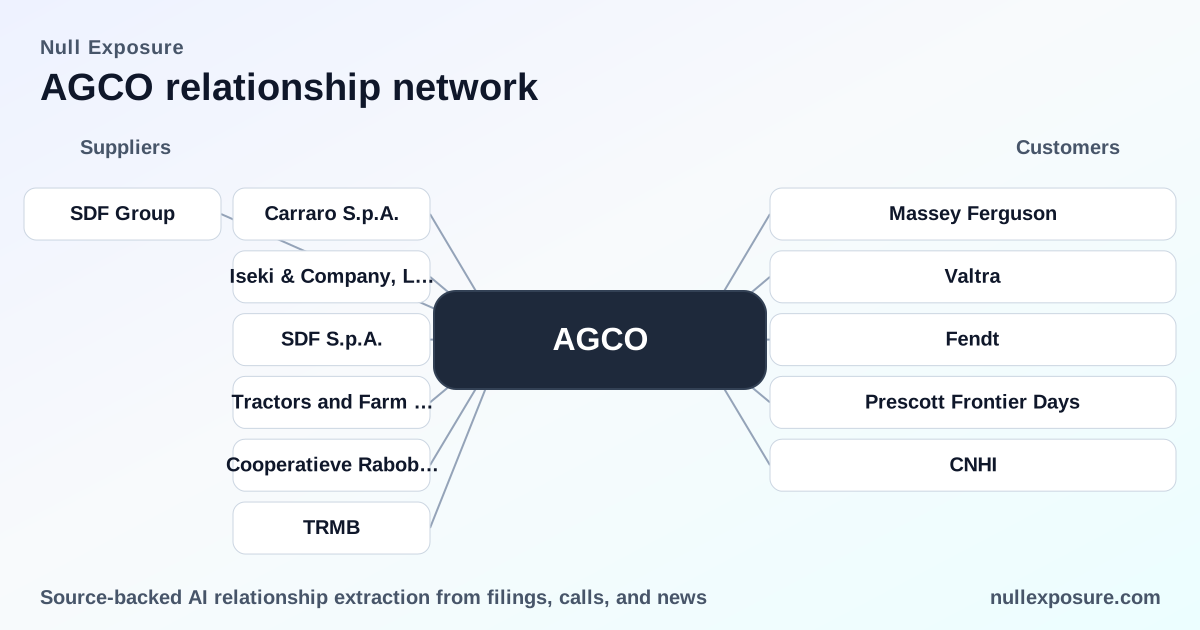
AGCO: how supplier relationships shape margins and operational leverage
AGCO sells agricultural equipment and monetizes primarily through equipment sales, parts and services, and dealer financing programs; the company sources fully manufactured tractors and components from a set of third‑party manufacturers and supports sales through dealer networks and finance joint ventures. For investors, the supplier footprint drives gross margin variability, inventory turn, and working capital exposure because AGCO combines short supplier payment terms with supplier financing arrangements that shift cash flow timing. Learn more about supplier exposures and partner concentration at https://nullexposure.com/.
What investors need to know up front
AGCO operates a hybrid manufacturing and distribution model: it buys some finished tractors and many components externally, then distributes through dealer channels while offering retail and wholesale financing. This model creates operational advantages in speed-to-market and product breadth, but it also generates key vulnerabilities — concentrated supplier relationships for finished tractors, finite payment‑term windows, and reliance on financing partners to manage receivables. The following analysis breaks down individual counterparty links and synthesizes company‑level constraints that matter for valuation and risk assessment.
The supplier map — who AGCO names and what that means
Below I list every relationship from AGCO’s supplier scope and summarize the practical implication for operators and investors, with the source context for each mention.
-
Tractors and Farm Equipment Limited (TAFE): AGCO discloses that it purchases some fully manufactured tractors from TAFE. This is direct procurement of finished goods that complements AGCO’s own manufacturing footprint and widens geographic/product coverage. According to AGCO’s FY2025 Form 10‑K, “We purchase some fully manufactured tractors from Tractors and Farm Equipment Limited (TAFE)…” (FY2025 10‑K).
-
SDF S.p.A.: The FY2025 10‑K explicitly lists SDF S.p.A. among external suppliers of fully manufactured tractors, indicating AGCO sources finished units from the European tractor group as part of its product mix. AGCO’s FY2025 10‑K states that it purchases from SDF S.p.A. (FY2025 10‑K).
-
Carraro S.p.A.: AGCO’s 10‑K includes Carraro S.p.A. in the set of vendors supplying fully manufactured tractors, signaling that Carraro is a component of AGCO’s externally sourced tractor supply chain. This is documented in AGCO’s FY2025 10‑K (FY2025 10‑K).
-
Iseki & Company, Limited: AGCO purchases some fully manufactured tractors from Iseki, reflecting a diversified supplier list that includes Japanese OEMs to serve particular markets or product segments, per AGCO’s FY2025 10‑K (FY2025 10‑K).
-
Cooperatieve Rabobank U.A.: AGCO provides retail and wholesale financing through finance joint ventures with Cooperatieve Rabobank U.A., tying the company’s receivables and dealer financing programs to an external banking partner that helps underwrite and fund customer credit. A March 2026 news item on Intellectia referenced AGCO’s finance joint ventures with Cooperatieve Rabobank U.A. (news, March 2026).
-
Trimble (TRMB): AGCO’s dealer network sells precision planting and Trimble PTX products alongside AGCO offerings, a commercial relationship that broadens product coverage and deepens customer engagement through integrated precision agriculture solutions. An earnings‑call transcript posted in March 2026 described dealers selling both precision planting and PTX Trimble products (InsiderMonkey, Q4 2025 earnings transcript, March 2026).
-
SDF Group (news report): Separately, a Rural News Group report in 2025 noted that AGCO signed a supply agreement with the European‑based SDF Group, confirming a commercial supply arrangement reported in the press and reinforcing the 10‑K disclosure that AGCO actively sources tractors from SDF. Rural News Group covered the agreement in 2025 (Rural News Group, 2025).
How the operating model and constraints interact with suppliers
AGCO’s disclosures and public reporting create a consistent company‑level signal about how procurement and financing are structured:
-
Contracting posture and payment terms are short‑to‑medium term. AGCO reports supplier payment terms typically run 30 to 180 days and contractual rates reference market benchmarks such as SOFR plus a credit spread, which tightens cash conversion cycles and exposes AGCO to interest‑rate dynamics (company filings as of December 31, 2024).
-
Supplier financing and receivable programs shift cash timing. The company runs supplier financing arrangements where banks or intermediaries purchase receivables; AGCO reported $50.6 million outstanding under these arrangements as of December 31, 2024, indicating active use of third‑party funding to manage payables and supplier cash flows (FY2024 disclosure).
-
Roles and maturity are multi‑dimensional. AGCO treats counterparties as sellers (suppliers of finished goods), manufacturers (external sources of machinery and parts), and service providers (including finance and cybersecurity vendors), reflecting a mature and layered supplier ecosystem rather than simple spot buying (company disclosures).
-
Relationships are active and operationally critical. The filings classify these supplier and financing relationships as active, which means they are currently contributing to revenue delivery, inventory replenishment and dealer support.
Strategic implications for investors and operators
-
Margin sensitivity to supplier mix is real. Buying finished tractors externally compresses downstream margins relative to vertical manufacturing but enables broader SKU coverage without capital‑intensive capacity expansion. Investors should model gross margin variability under scenarios where supplier pricing or lead times change.
-
Working capital is a material lever. Short payment terms and supplier‑finance programs concentrate working capital risk; rising benchmark rates (SOFR) or contracting by financing partners like Rabobank will directly affect AGCO’s net interest and cash conversion dynamics.
-
Concentration is moderate but relevant. AGCO names multiple manufacturers (TAFE, SDF, Carraro, Iseki), which diversifies supplier risk geographically, but the company still depends on a finite set of suppliers for fully manufactured tractors — a potential single‑source pressure point for specific models or markets.
-
Technology and distribution partnerships extend competitive moat. The commercial interplay with Trimble through dealer channels improves product stickiness and supports aftermarket parts and services revenue, which increases customer lifetime value.
If you want a deeper counterparty risk analysis or a tailored supplier concentration heatmap, start with a focused review at https://nullexposure.com/ — the point of entry for structured supplier intelligence.
Risk checklist for diligence
- Monitor financing partner commitments and outstanding receivable purchases; changes here alter AGCO’s effective working capital funding.
- Track supplier contract renewals — press reports (e.g., SDF Group in 2025) can precede material shifts in supply terms.
- Evaluate dealer‑level adoption of Trimble products as a proxy for precision agriculture monetization and recurring service revenue.
Bottom line for investors
AGCO leverages a mixed model of internal manufacturing and external sourcing to sustain product breadth while outsourcing capital intensity. That model provides scalability but creates measurable exposure in working capital and supplier concentration. Key watch items are payment‑term dynamics tied to SOFR, the continuity of supply agreements with TAFE, SDF, Carraro and Iseki, and the stability of financing partners such as Cooperatieve Rabobank U.A. For continued monitoring and actionable supplier intelligence, visit https://nullexposure.com/.
Investors assessing AGCO should weigh the tradeoff between product coverage and margin compression from externally sourced tractors, and incorporate supplier financing scenarios into cash‑flow forecasts to capture near‑term liquidity and interest‑rate sensitivity.