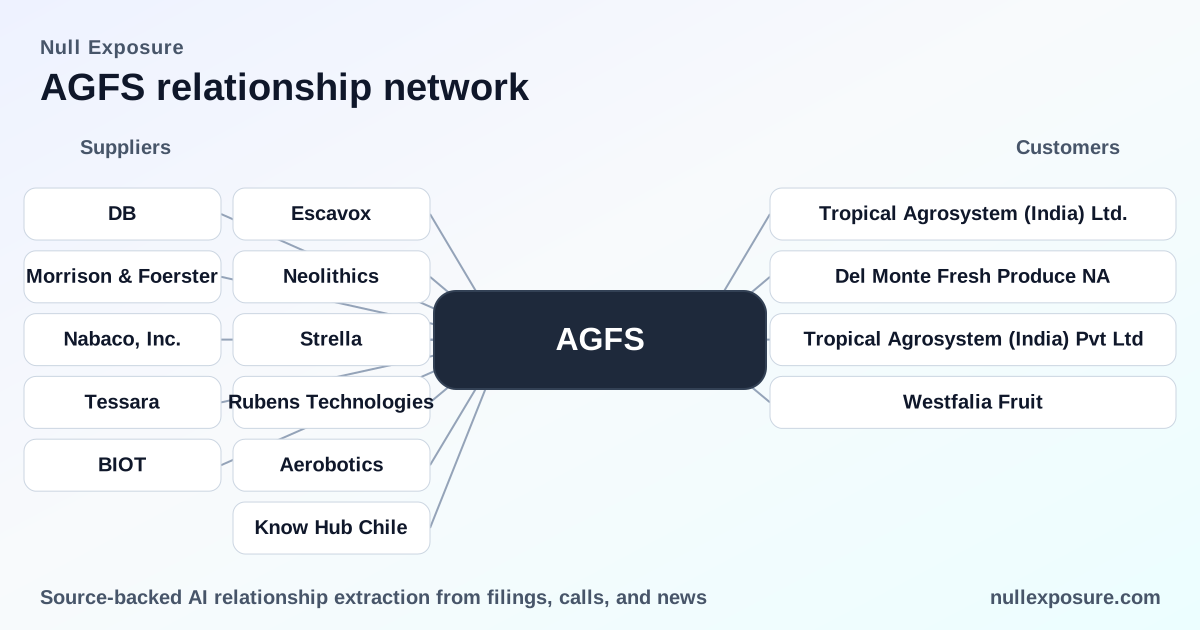
AgroFresh (AGFS) — supplier and partner map investors should price in
AgroFresh monetizes a mix of product sales, exclusive distribution agreements, and platform-enabled services built around its FreshCloud™ offering; the company captures value by bundling chemical and packaging solutions with third-party sensor and AI integrations, then licensing or distributing those combined services to packers and growers. FreshCloud functions as the commercial lever that turns point solutions into recurring, higher-margin services, while strategic M&A and exclusive distribution deals expand proprietary addresses and shorten time-to-market. Learn more about supplier signals and counterparty concentration at https://nullexposure.com/.
Why the partnership set matters for valuation and risk
AgroFresh’s supplier and technology relationships reveal a deliberate platform strategy: aggregate best-in-class sensing and imaging partners, then monetize via distribution, integration fees, and upgraded analytics subscriptions. This contracting posture reduces heavy capex on in-house hardware while exposing AGFS to dependency on third-party proprietary technologies for competitive differentiation. The partner roster is broad—ranging from early-stage sensor providers to established financial and legal advisors—so supplier concentration risk is low on the hardware side but elevated for specific, mission-critical modules (AI imaging and packhouse inspection). For partnership diligence and scenario modelling, see https://nullexposure.com/ for actionable counterparty mapping.
How investors should read the relationships (one-line takeaways with sources)
-
Aerobotics — AgroFresh integrated Aerobotics’ TrueFruit® modules into FreshCloud to provide AI-powered orchard and packhouse intelligence, expanding field-to-packhouse analytics and inspection capability (PR Newswire, FY2025: https://www.prnewswire.com/news-releases/agrofresh-announces-new-ai-powered-imaging-and-orchard-analytics-partnerships-with-aerobotics-and-neolithics-302606239.html).
-
Neolithics — Neolithics’ next‑generation AI imaging is now available in FreshCloud to enable rapid, non‑destructive quality inspections at industrial scale, turning inspection from a bottleneck into a quality-control revenue driver (PR Newswire, FY2025: https://www.prnewswire.com/news-releases/agrofresh-announces-new-ai-powered-imaging-and-orchard-analytics-partnerships-with-aerobotics-and-neolithics-302606239.html).
-
Escavox — Escavox is one of several connected sensor partners whose data AgroFresh aggregates into FreshCloud, supporting sensor-driven post‑harvest decisioning (iGrowNews / PR Newswire, FY2025: https://igrownews.com/agrofresh-latest-news/ and https://www.prnewswire.com/news-releases/agrofresh-announces-new-ai-powered-imaging-and-orchard-analytics-partnerships-with-aerobotics-and-neolithics-302606239.html).
-
Rubens Technologies — Rubens is cited as a FreshCloud integration partner that supplies real‑time sensing data, extending AgroFresh’s ability to offer condition-aware logistics and packhouse control (iGrowNews / PR Newswire, FY2025: https://igrownews.com/agrofresh-latest-news/ and https://www.prnewswire.com/news-releases/agrofresh-announces-new-ai-powered-imaging-and-orchard-analytics-partnerships-with-aerobotics-and-neolithics-302606239.html).
-
Strella — Strella is included among the sensor innovators feeding FreshCloud, enabling non‑destructive fruit quality assessment in the company’s connected‑sensors strategy (PR Newswire / iGrowNews, FY2025: https://www.prnewswire.com/news-releases/agrofresh-announces-new-ai-powered-imaging-and-orchard-analytics-partnerships-with-aerobotics-and-neolithics-302606239.html and https://igrownews.com/agrofresh-latest-news/).
-
Know Hub Chile — AgroFresh holds an exclusive global licensing agreement with Know Hub Chile to test and potentially commercialize a patent‑pending natural technology for superficial scald control in apples and pears, representing a product‑line innovation and IP-led moat enhancement (Food Engineering Magazine, FY2021: https://www.foodengineeringmag.com/articles/99515-natural-post-harvest-solution-for-apples-and-pears).
-
Deutsche Bank — Deutsche Bank acted as AgroFresh’s financial advisor on the Pace International acquisition, signaling institutional capital markets support and standard M&A advisory governance for AGFS’s inorganic growth (PR Newswire, FY2024: https://www.prnewswire.com/news-releases/agrofresh-acquires-pace-international-llc-expanding-post-harvest-solutions-portfolio-302101560.html).
-
Morrison & Foerster — Morrison & Foerster served as legal advisor in the Pace International transaction, indicating investment‑grade legal structuring for acquisitions as part of AgroFresh’s roll‑up playbook (PR Newswire, FY2024: https://www.prnewswire.com/news-releases/agrofresh-acquires-pace-international-llc-expanding-post-harvest-solutions-portfolio-302101560.html).
-
Nabaco, Inc. — AgroFresh entered an exclusive distribution agreement with Nabaco to commercialize NatuWrap® fruit protection technologies, expanding eco‑friendly packaging and distribution revenues (PR Newswire, FY2025: https://www.prnewswire.com/news-releases/agrofresh-expands-global-post-harvest-solutions-portfolio-with-natuwrap-in-exclusive-distribution-agreement-with-nabaco-302485113.html).
-
Tessara — AgroFresh acquired Tessara to integrate intelligent packaging capabilities, a move that shifts some product scope in‑house and strengthens the company’s preservation and packaging offering (Nuf‑Food Spectrum / Global Agriculture, FY2024: https://nuffoodsspectrum.in/2024/02/13/agrofresh-takes-steps-to-address-industrys-most-pressing-challenges.html and https://www.global-agriculture.com/crop-protection/agrofresh-expands-its-commitment-to-address-the-industrys-most-pressing-challenges/).
-
Biotalys — Biotalys and AgroFresh launched a collaboration to develop and commercialize sustainable biological fungicides for postharvest use, extending AgroFresh’s product set into bio‑control solutions that address food waste and regulatory pressure on chemicals (Growing Produce, FY2025: https://www.growingproduce.com/production/postharvest-handling/biotalys-and-agrofresh-partner-to-better-protect-produce/).
Operational constraints and what they signal about AGFS
There are no explicit supplier-contract constraints disclosed in the provided material; this absence is itself a signal. At the company level, AgroFresh operates a partnership-first, asset-light model for sensing and imaging; it supplements that with selective acquisitions and exclusive distribution arrangements to internalize higher-margin capabilities. That posture implies:
- Contracting posture: platform integrator—favors commercial partnerships over owning every technology stack.
- Concentration: low supplier concentration across many small sensor partners, but single-module concentration risk for specific AI imaging providers that deliver packhouse inspection capabilities.
- Criticality: Sensor and imaging relationships are mission-critical for FreshCloud’s value proposition; advisory relationships are transaction‑critical but not operationally critical.
- Maturity: Mix of early‑stage tech partners and mature professional service firms, indicating a hybrid maturity curve that supports rapid capability rollout while maintaining transactional rigor.
Refer to the partner list above and review deal announcements at https://nullexposure.com/ for deeper counterparty scoring.
Investment implications — what to watch next
- Upside: Integrated AI imaging and exclusive distribution deals create cross-sell opportunities and recurring analytics revenue that justify a premium multiple for software-enabled margins.
- Risk: Reliance on third-party proprietary sensors for key FreshCloud features introduces switching and licensing risk that should be stress-tested in financial models.
- Catalysts: Successful commercialization of Know Hub Chile technology or Biotalys biologicals would materially expand addressable market and reduce regulatory exposure.
For a practical counterparty risk assessment and to track future announcements, visit https://nullexposure.com/.
Bottom line: AgroFresh’s supplier map supports an asset-light, platform-driven growth thesis balanced by tactical acquisitions to internalize high-value capabilities; investors should value FreshCloud’s integrations while stress-testing vendor dependency on AI imaging and key sensor partners.