Aureus Greenway (AGH): What the placement agents and supplier signals tell investors
Aureus Greenway operates and monetizes a portfolio of public golf country clubs in Florida by generating membership fees, green fees, food & beverage revenue and ancillary services, then scaling through capital markets and placements to fund operations and growth. The company leans on third-party service providers for core course operations while using capital raises — including at-the-market placements and an IPO process supported by underwriters — to manage liquidity, which creates a dual sensitivity to supplier concentration and capital-marketing execution.
If you want a structured supplier-risk view of AGH or to benchmark its counterparty posture for underwriting or vendor diligence, start with our platform: Explore supplier intelligence at Null Exposure.
What the disclosed placement relationships reveal about market access
Aureus Greenway’s public filings and press releases show explicit underwriting and placement relationships tied to capital-raising events in 2024–2025. These banks and placement agents are the market-facing partners that enabled the company to access equity capital at key inflection points, including the pricing of an IPO and a later at-the-market private placement. Underwriting relationships are direct indicators of market acceptance and syndicate support, and for AGH they reflect active engagement with boutique securities firms rather than large bulge-bracket banks.
Relationship inventory — who AGH is working with and what they did
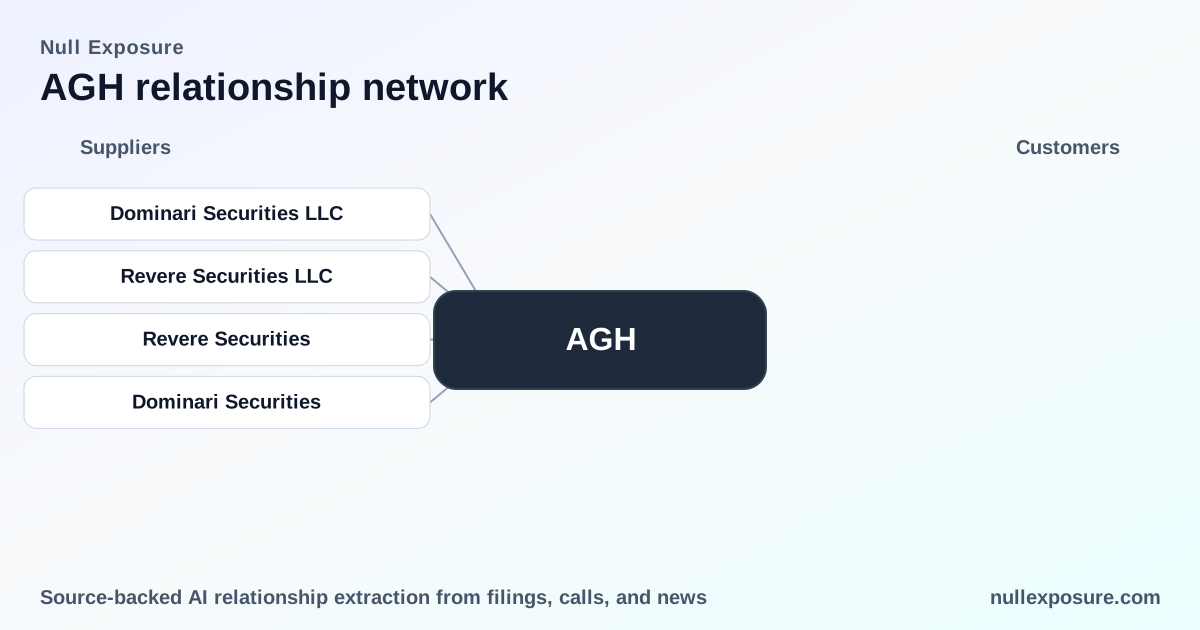
Dominari Securities LLC — Multiple press releases in July 2025 describe Dominari Securities LLC as a co-placement agent and joint bookrunner on AGH’s equity offerings, including an at-the-market private placement and IPO pricing activity. According to GlobeNewswire (July 23 & July 25, 2025) and Renaissance Capital coverage (FY2025), Dominari participated as a joint bookrunner on offerings that raised capital for the company. (Sources: GlobeNewswire July 23 & 25, 2025; Renaissance Capital FY2025; StockTitan news summary FY2025)
Revere Securities LLC — Revere Securities LLC is named as either sole bookrunner in earlier coverage or a joint bookrunner in later reports that document AGH’s market activity; press releases confirm Revere acted alongside Dominari as co-placement agent on the at-the-market offering and led IPO structuring work. Renaissance Capital and GlobeNewswire note Revere’s role in the IPO pricing and the private placement closing in mid-2025. (Sources: Renaissance Capital FY2024–FY2025; GlobeNewswire July 23 & 25, 2025; StockTitan FY2025)
Note: the public record in mid-2025 consistently attributes primary market execution of both the IPO and the $26 million placement to combinations of Revere and Dominari across filings and press releases. These relationships are transactional and event-driven rather than ongoing supplier contracts for operations. (Sources: GlobeNewswire & Renaissance Capital, July 2025)
How the supplier constraints shape operational and financial risk
AGH’s supplier and contract disclosures provide clear operational signals that belong at the company level:
- Contracting posture — long-term leases are in place. The firm reports operating leases for corporate office, golf carts and equipment with four- to five-year terms, which indicates multi-year vendor commitments and limited near-term flexibility on those capital and facilities inputs.
- Supplier type — large third parties supply critical services. Management describes its vendors as equipment and service suppliers that are independent third parties, signaling that AGH outsources core operational functions rather than performing them in-house.
- Materiality and concentration — a single supplier is critical. As of December 31, 2024 and 2023, 84% and 85% of accounts payable were owed to a key supplier, respectively, a concentration that is operationally critical and financially meaningful for vendor negotiations and continuity planning.
- Spend scale — mid-range vendor spend. Reported operating-cost concentration and totals imply a vendor spend band roughly in the $1m–$10m range for large suppliers, consistent with outsized line-item suppliers for maintenance, carts and F&B services.
- Relationship role — service provision is the dominant form. The vendor mix is described as golf-course maintenance, equipment, professional services, carts, merchandise and food & beverage suppliers — all service providers essential to customer experience and revenue realization.
Together these constraints form a consistent operating model signal: AGH outsources execution to large, long-term third parties, carries meaningful supplier concentration risk, and relies on capital markets partnerships for liquidity.
Investment implications for operators and counterparties
- Concentration risk is a primary vulnerability. With a single supplier accounting for the vast majority of payables, management needs robust contingency plans and supplier diversification to reduce operational single points of failure. This is a credit and operational risk for counterparties and lenders.
- Contract maturity supports predictability but limits flexibility. Four- to five-year lease terms stabilize cost forecasting but reduce the company’s ability to rapidly re-contract if supplier costs spike.
- Boutique underwriter relationships indicate accessible capital markets but limited distribution breadth. Revere and Dominari provided execution, but the absence of larger bank names suggests a narrower investor base and potential volatility if market conditions sour.
- Service-provider reliance increases KPIs tied to vendor performance. Operators evaluating partnerships should require contract-level SLAs and visibility into the key supplier that represents the concentrated payable exposure.
If your team needs a concise diligence pack or wants to map AGH’s counterparty graph for underwriting or negotiation, get the intelligence delivered here: Explore supplier intelligence at Null Exposure.
Practical next steps and risk mitigation
- Require operational continuity plans and proofs of alternative suppliers given the 84–85% AP concentration signal.
- Reassess covenant structures with liquidity metrics that reflect the company’s reliance on equity placements and boutique underwriters.
- Negotiate termination and transition rights where possible on multi-year leases to avoid lock-in on deteriorating vendor economics.
Final takeaway and how we can help
Aureus Greenway runs a service-heavy operating model financed through market placements and supported by small-to-mid boutique underwriters; this combination yields manageable operational predictability but elevated supplier concentration risk. Investors and operators should prioritize supplier diversification, contingency planning, and a closer read of placement terms when modeling liquidity scenarios.
For a tailored supplier-risk assessment or to benchmark AGH against comparable leisure operators, request a briefing: Explore supplier intelligence at Null Exposure.