AGIG: Who the company is doing business with, and what those links tell investors
Abundia Global Impact Group Inc. (AGIG) runs a dual commercial model: technology solutions converting waste into renewable fuels and chemicals in the U.S., plus legacy oil & gas interests concentrated in the Permian Basin. The company monetizes through project-level revenue from its renewable-technology operations and through income and asset appreciation from its oil & gas holdings, while using capital markets placements to fund growth and working capital. Given minimal recent revenues, negative EBITDA, and outsized insider ownership, AGIG’s supplier and capital-market relationships are critical for near-term liquidity and delivery of operating programs. For a concise companion view of counterparties and contract signals, visit https://nullexposure.com/.
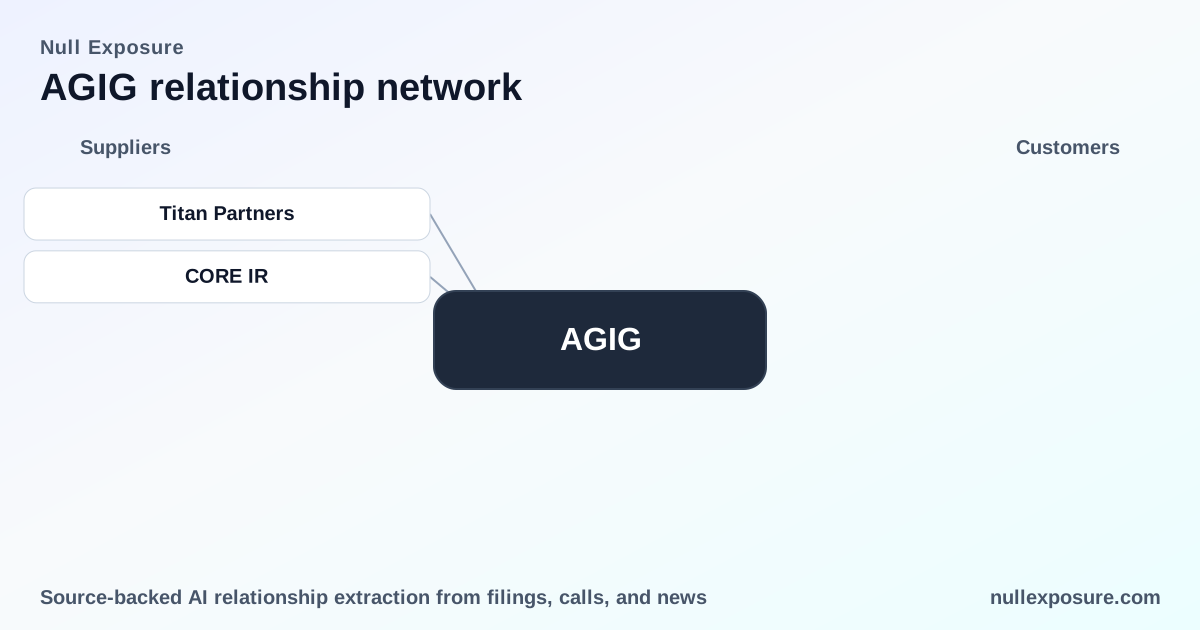
Who AGIG is working with right now — two visible counterparties and what they do for the company
Titan Partners — placement agent for equity offering
Titan Partners, a division of American Capital Partners, acts as the sole placement agent for AGIG’s equity offering in FY2026, handling the capital raise execution and distribution to investors (press release via GlobeNewswire published on EnergyDigital, March 9, 2026: https://energydigital.com/globenewswire/3241653 and https://energydigital.com/globenewswire/3243060). This is a conventional capital-markets engagement: Titan provides access to private and institutional channels and is the primary external conduit for new funding.
CORE IR — investor-relations contact listed in the offering materials
CORE IR is named as the investor contact for the company in the same FY2026 disclosure, providing shareholder communications and investor outreach services (GlobeNewswire/EnergyDigital, March 9, 2026: https://energydigital.com/globenewswire/3241653). CORE IR’s role is tactical and reputational: they manage messaging and investor inquiries around the placement and ongoing disclosures.
What the relationship set tells you about AGIG’s operating posture
The two visible relationships are tightly focused on capital formation and investor communications, not on engineering or core feedstock agreements. That configuration signals a company in capital-build or restructuring mode where financing and narrative management are prioritized. Concrete company disclosures reinforce that read:
- AGIG discloses an office lease that expires October 31, 2025, indicating the firm runs short-term facilities commitments (company filings/excerpts). This short lease horizon aligns with a flexible, low-fixed-cost approach to corporate overhead — a sensible posture for a small-cap company with limited revenue but also a potential operational fragility if relocation or re-leasing is disruptive.
- The company’s oil and gas operations are geographically concentrated in the Permian Basin, Texas, which accounted for all oil and gas operations reflected in 2024 consolidated statements (company disclosures). That concentration drives single-basin exposure for any upstream revenue or asset sales.
- AGIG operates as a non-operator and uses third-party service providers for well operations, website, email, and financial record keeping, highlighting dependency on external operators and consultants to execute production and corporate functions (company disclosures). This service-provider posture places execution risk with counterparties and creates dependency on the quality of operator performance.
Collectively, these are company-level signals: short-term contracting for corporate facilities, high geographic concentration in a single hydrocarbon basin, and a reliance on service providers for both field operations and corporate functions. These elements shape commercial risk, counterparty diligence needs, and capital-allocation priorities.
(If you want a one-page counterparty map for board or procurement use, get a tailored export at https://nullexposure.com/.)
Financial context that elevates counterparty importance
AGIG’s market capitalization is small (about $73 million), revenue reported in the TTM is roughly $225,680, and EBITDA is negative (about -$13.1 million), with diluted EPS at -$0.65. Insider ownership is very high at ~74.7% while institutional ownership is low (~3.4%). These facts create an elevated reliance on placement agents for financing and on investor-relations services to maintain market access. When funding channels are narrow and insiders control equity, external placement arrangements and clear investor communications become the operational lifeline.
Risk implications investors and operators should prioritize
- Execution dependency on third-party operators. AGIG’s non-operator status for wells transfers day-to-day operational control to counterparty operators; investors must underwrite operator competence, contractual controls, and dispute remedies when evaluating upstream exposure (company disclosures).
- Capital availability concentrated through placement agents. Titan Partners is the visible capital conduit; underwriting of cost of capital, securities terms, and placement timelines is essential because successful rollout of renewable projects will depend on predictable financing (GlobeNewswire/ EnergyDigital, March 2026).
- Geographic concentration. Permian-only oil and gas operations concentrate geological and regulatory risk; hedging or diversification strategies warrant discussion at the board level (company disclosures).
- Corporate overhead fragility. The short office lease and limited operating margin raise the risk of management distraction from relocations or vendor transitions during critical project phases (company disclosures).
Practical playbook for investors and operating partners
For analysts and counterparties evaluating commercial relationships, focus on these items:
- Ask the placement agent (Titan Partners) for concrete timelines, minimum closing size, and investor composition: retail vs. institutional; committed vs. marketed (referencing the FY2026 placement notices: https://energydigital.com/globenewswire/3241653).
- Verify SLAs and escalation paths with operators that control wells; require performance metrics, bond/insurance evidence, and audit rights because AGIG’s cash flows depend on operator execution (company disclosures).
- Reassess counterparty concentration: insist on written plans for alternative capital routes if the placement stalls, and validate investor-relations cadence and transparency with CORE IR to reduce information asymmetry (GlobeNewswire/EnergyDigital, March 9, 2026).
Final takeaways and recommended next steps
- Placement and IR are the immediate priorities for AGIG’s near-term viability; Titan Partners and CORE IR are the transaction and communications partners driving public and private investor access (GlobeNewswire/EnergyDigital, March 9, 2026).
- Operational delivery sits with third-party operators, so counterparty diligence and contractual protections are the single most important mitigant to upstream execution risk (company disclosures).
- High insider ownership and small revenues make external financing outcomes and investor sentiment structural determinants of valuation and resource allocation for renewable projects (company financials).
For a structured counterparty report you can use in investment committees or vendor negotiations, download a formatted brief at https://nullexposure.com/. To commission a custom supplier-risk briefing for AGIG and related counterparties, start here: https://nullexposure.com/.