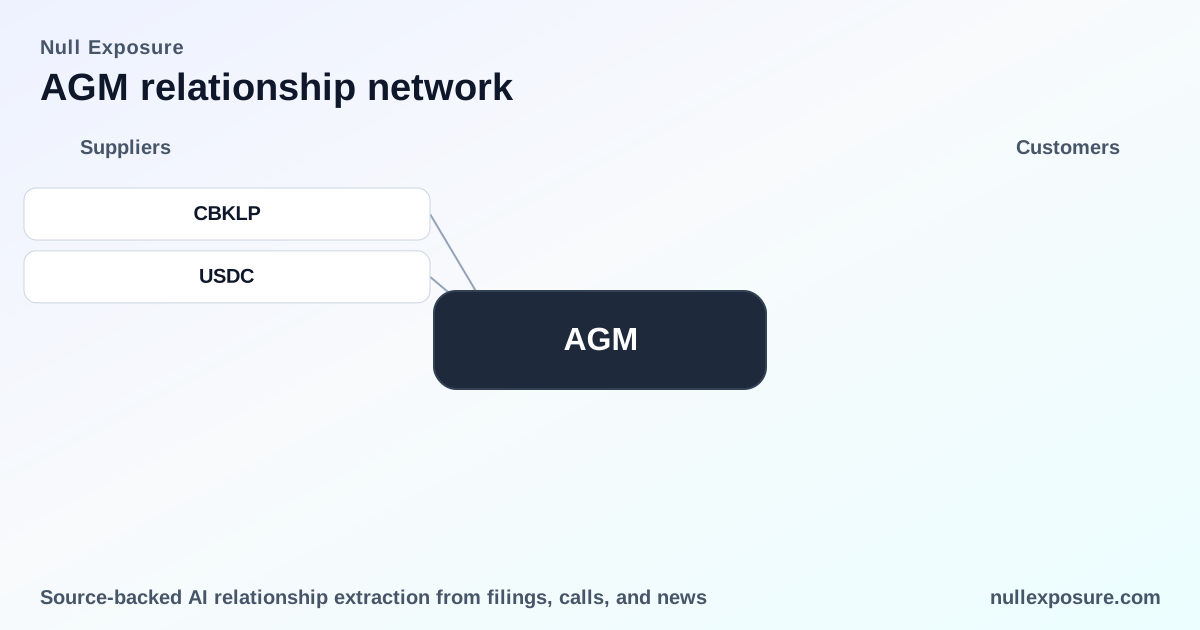
Farmer Mac’s supplier posture: CoBank, USDA and what AGM investors should price in
Federal Agricultural Mortgage Corporation (AGM, known as Farmer Mac) operates a secondary market for U.S. agricultural and rural loans by purchasing loans and participations, issuing guarantees and securities backed by those assets, and collecting guarantee and servicing fees. The company monetizes through net interest and fee spreads on purchased loans and guarantees, plus recurring servicing income, while distributing a meaningful portion of earnings as dividends. For investors evaluating supplier and counterparty risk, the mix of bank-originated participations and government-guaranteed securities defines both credit exposure and concentration dynamics.
Discover actionable supplier intelligence and partner signals at NullExposure.
How the supplier relationships actually show up on the balance sheet
Farmer Mac sources assets in two clear channels: purchases from large financial institutions (participations and pools) and securities backed or guaranteed by the U.S. government. That dual sourcing is visible in historical disclosures and investor commentary.
- CoBank and other large lenders are direct sellers of loan participations and pools; Farmer Mac buys these assets into its Agricultural Finance and Infrastructure Finance portfolios. According to recent company disclosures, Farmer Mac purchased $442.7 million of loans and participations from CoBank in 2024 (with comparable purchases in 2023 and 2022). A 2019 earnings call also recorded a master participation agreement with CoBank and a $546 million purchase of seasoned rural utility loan participations. (Source: Farmer Mac filings; a Q1 2019 call transcript published on The Motley Fool.)
- USDA-related business is structured around government guarantees, with Farmer Mac offering guaranteed securities and holding USDA‑guaranteed instruments; company disclosures state credit exposure for those securities is covered by the full faith and credit of the United States, which materially reduces credit risk but creates policy and political-dependency exposure. (Source: Farmer Mac regulatory disclosures and a Q1 2019 earnings transcript.)
CoBank — a recurring counterparty and asset source
Farmer Mac maintains an active purchasing relationship with CoBank under a master participation framework. A Q1 2019 earnings call transcript documents the February 2019 master participation agreement and a $546 million purchase of seasoned rural utility loan participations, while Farmer Mac’s more recent filings show repeat purchases of $442.7 million in 2024 (and similar volumes in 2023 and 2022) across Infrastructure Finance and Agricultural Finance. CoBank functions as a material, large-enterprise seller to Farmer Mac and a consistent source of portfolio volume. (Source: Q1 2019 earnings call transcript on The Motley Fool; Farmer Mac 2024 disclosures.)
USDA guarantees — government backing that changes the risk profile
Farmer Mac’s USDA Guarantees line is a structural risk mitigant: company disclosures explicitly state that credit exposure on USDA securities, including those underlying Farmer Mac guaranteed securities, is covered by the full faith and credit of the United States. Operationally, this shifts credit risk to the sovereign while leaving Farmer Mac exposed to guarantee program rules, prepayment dynamics and the liquidity/market-risk of related securities. A Q1 2019 earnings call noted a net decrease of $31 million in the USDA Guarantees line in that quarter, reflecting active portfolio flows in the guarantee program. Government backing is a central counterparty characteristic for this segment. (Source: Farmer Mac filings; Q1 2019 earnings call transcript.)
What the constraints tell investors about business model durability
Translate the constraint signals into investment-grade takeaways:
- Contracting posture and investor base: Farmer Mac’s statutory charter limits stock ownership to banks, insurers and Farm Credit System institutions, concentrating stakeholders in regulated financial institutions and creating a captive supply/ownership network. This legal structure supports stable access to counterparties but limits diversification of the shareholder base. (Company disclosures.)
- Concentration and criticality: Repeated multi-hundred-million-dollar purchases from a single lender like CoBank indicate counterparty concentration in the origination channel; that concentration accelerates portfolio growth but raises reliance on a limited set of large-originators for deal flow. (Company disclosures.)
- Counterparty mix and credit profile: The combination of large-enterprise originators and government-guaranteed securities balances private-credit exposure with sovereign risk transfer — an explicit part of Farmer Mac’s risk architecture. (Company disclosures.)
- Operational maturity and outsourcing: Farmer Mac uses approved servicers under contract and pays meaningful servicing fees (for example, Zions retained servicing fees of roughly $11.2 million in recent years), indicating a mature servicer network rather than an insourced servicing model. This reduces operational overhead but introduces third-party operational risk. (Company disclosures.)
- Scale of transactions: Farmer Mac reports multi-hundred-million-dollar single-counterparty transactions and occasional $100m+ pools purchased from single lenders, confirming a high spend band and institutional-sized counterparty engagements. (Company disclosures.)
These are company-level operating signals that explain why Farmer Mac’s revenue and margins are sizable relative to its balance-sheet footprint and why counterparty selection drives both earnings volatility and regulatory sensitivity.
Explore how this supplier posture compares across the market at NullExposure.
How investors should price the relationships
For valuation and risk modeling, calibrate three factors explicitly:
- Counterparty concentration — model stress scenarios where access to large-originators tightens or reprices; CoBank-level repeat purchases show this is a first-order exposure.
- Sovereign dependency — treat USDA-backed assets as low-credit-risk but high-policy-risk instruments; embed policy-shock scenarios in capital and liquidity stress tests.
- Servicing and operational continuity — include outsourcing risk and compensation trends (servicing fees) as recurring expense drivers and potential points of disruption.
Key takeaway: Farmer Mac’s mixed-sourcing strategy reduces pure credit risk through government guarantees while concentrating execution risk in a small set of institutional counterparties and servicers; investors must underwrite both rotation in bank-seller behavior and shifts in guarantee program terms.
Bottom line and next steps
Farmer Mac runs a purposeful, two‑track supply model: large-bank participations fuel volume while government-guaranteed instruments secure credit quality. For investors, the CoBank relationship illustrates concentrated sourcing at scale; USDA-related holdings underline the policy dependence of part of the balance sheet. Both dynamics are central to AGM’s earnings stability and regulatory profile.
If you want deeper, relationship-level analytics and ongoing signals for AGM counterparties, visit NullExposure to see how counterparties, contracts and constraint signals are tracked across market participants.
For a tailored briefing on how these supplier concentrations affect AGM valuation and stress scenarios, contact our research team through NullExposure.