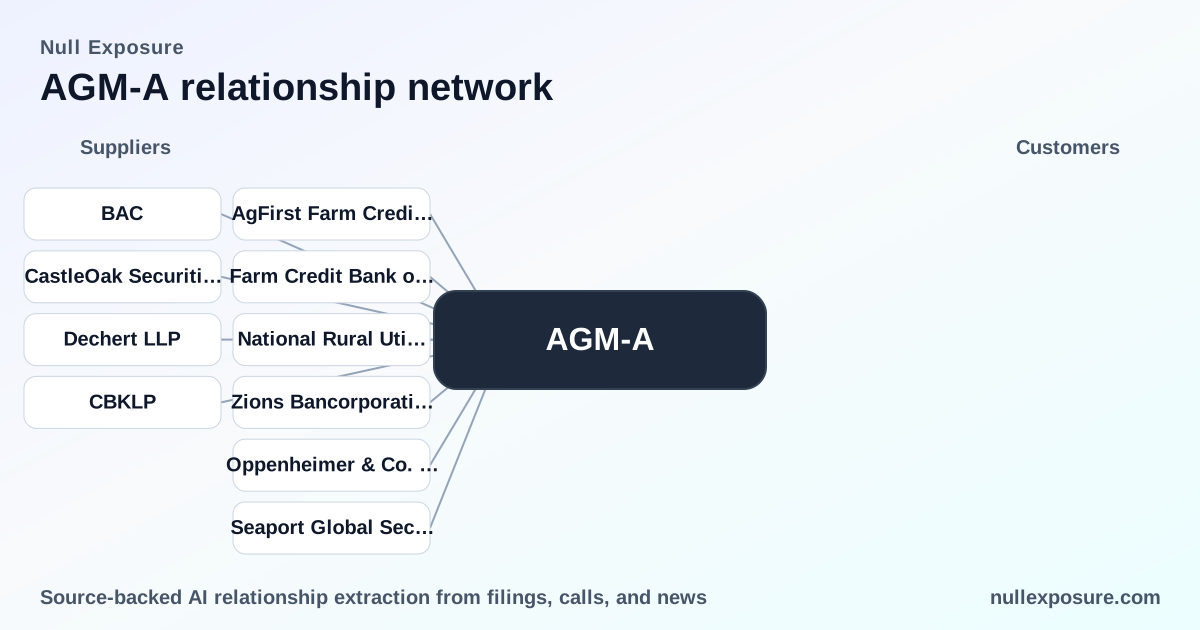
Farmer Mac (AGM-A): Supply-side relationships that define access, concentration, and execution
Federal Agricultural Mortgage Corporation (Farmer Mac) operates a public secondary market for U.S. agricultural loans: it buys eligible loans and participation interests from lenders, bundles them into securities, provides long‑term standby purchase commitments (LTSPCs), and funds those purchases by issuing debt and securitizations to investors. Revenue comes from the spread on held assets, servicing and guaranty fees, and transaction fees tied to securitizations. For investors and operators assessing counterparty exposure and execution capacity, the supplier map is a direct window into Farmer Mac’s ability to source collateral, execute AMBS deals, and manage servicing and legal relationships. For a full view of counterparty exposures and structural signals, visit the Nillexposure homepage: https://nullexposure.com/.
How to read Farmer Mac’s supplier posture — practical takeaways for investors
Farmer Mac’s operating model is contract‑driven, concentrated, and dependent on both capital markets and a small set of large counterparties. Its contractual posture includes long‑dated commitments — LTSPCs that can run up to 30 years — creating structural, long‑term linkage between Farmer Mac and originating lenders. The company also maintains framework relationships with approved servicers under ongoing servicing contracts. Farmer Mac’s counterparty base mixes government‑backed exposures (USDA‑guaranteed securities), major Farm Credit institutions and regional banks, and capital markets intermediaries that underwrite and place Farmer Mac securitizations.
- Concentration: Ten institutions generated roughly 65% of loan purchase volume in 2024, a clear signal that sourcing is concentrated and that Farmer Mac’s origination pipeline is highly dependent on a small number of sellers.
- Contract maturity and criticality: LTSPCs and sizable AgVantage securities create long‑dated risk linkages; Farmer Mac reports that $7.6 billion of $8.5 billion AgVantage outstanding was issued by three counterparties, underscoring single‑counterparty criticality at scale.
- Service reliance: Farmer Mac outsources significant loan servicing and uses third‑party providers for technology, clearing and legal work; servicers collect material servicing fees and are embedded in the economics and operational continuity of the platform.
- Geographic focus: Activities and eligible collateral are explicitly U.S. agricultural real estate and related infrastructure, concentrating credit and systemic risk within North America.
For an aggregated operational view and follow‑up due diligence tools, see https://nullexposure.com/.
Counterparties that matter — what each relationship signals (concise, sourced)
AgFirst Farm Credit Bank
Farmer Mac recorded $415.2 million of Agricultural Finance LTSPCs outstanding as of December 31, 2024, a reflection of AgFirst’s role as a long‑term originator/counterparty under LTSPC arrangements (Farmer Mac FY2024 Form 10‑K).
Farm Credit Bank of Texas
The aggregate amount of Agricultural Finance LTSPCs outstanding with Farm Credit Bank of Texas was $1.2 billion at December 31, 2024 (up from $923.9 million a year earlier), highlighting a material origination partnership that supplies Farmer Mac’s loan inventory (Farmer Mac FY2024 Form 10‑K).
National Rural Utilities Cooperative Financial Corporation (CFC)
Power & Utilities loans and AgVantage securities issued by CFC represented roughly 19.0% and 20.4%, respectively, and Farmer Mac reported $30.0 million of interest receivable from these exposures as of year‑end 2024, showing CFC’s structural importance in infrastructure finance (Farmer Mac FY2024 Form 10‑K).
Zions Bancorporation, National Association
Loans purchased and USDA securities from Zions represented 3.1% of Farmer Mac’s outstanding business volume at year‑end 2024; Zions also retained meaningful servicing fees (reported elsewhere in the filings), indicating a dual role as seller and servicer (Farmer Mac FY2024 Form 10‑K).
CoBank
Farmer Mac purchased $442.7 million of loans and participations from CoBank in 2024 (with similar levels in prior years), marking CoBank as a primary source for both Infrastructure Finance and Agricultural Finance product lines (Farmer Mac FY2024 Form 10‑K).
BofA Securities, Inc.
BofA Securities acted as a joint bookrunner on a $308.1 million AMBS securitization that closed in early March 2026, demonstrating the firm’s active role in Farmer Mac’s capital markets distribution (PR Newswire, March 9, 2026).
Oppenheimer & Co. Inc.
Oppenheimer served as a joint bookrunner alongside BofA on the March 2026 $308.1 million AMBS offering, providing placement capacity for Farmer Mac securitizations (PR Newswire, March 9, 2026).
CastleOak Securities, L.P.
CastleOak participated as a selling group member in the March 2026 AMBS closing, contributing to distribution breadth for Farmer Mac’s securitizations (PR Newswire, March 9, 2026).
Seaport Global Securities LLC
Seaport was a selling group member on the $308.1 million AMBS deal (March 2026), offering retail/intermediary distribution support in that transaction (PR Newswire, March 9, 2026).
Dechert LLP
Dechert served as legal advisor to Farmer Mac on the March 2026 securitization, confirming reliance on large law firms for transaction counsel and legal structuring (PR Newswire, March 9, 2026).
What the relationship map implies for portfolio decisions
Farmer Mac’s counterparty set shows a blend of structural strengths and concentrated exposures. Strengths include ongoing access to capital markets (multiple bookrunners and selling‑group partners) and deep sourcing relationships with major Farm Credit institutions (CoBank, Farm Credit Bank of Texas, AgFirst). Concentration is meaningful: a handful of institutions generate most loan purchase volume and a small number of issuers account for the majority of AgVantage supply, which creates single‑counterparty and sector concentration risk that impacts asset quality and funding resiliency.
Key investment risks and operational controls to monitor:
- Concentration risk from large originators and issuers of AgVantage securities.
- Contractual maturity risk due to LTSPCs and long‑dated commitments (contracts up to 30 years).
- Servicing and operational risk from reliance on third‑party servicers and external clearing/legal partners.
Investors should track the cadence of securitizations and the mix of bookrunners, monitor changes in the top ten originators by volume, and stress test scenarios where one of the major AgVantage issuers or a top originator reduces supply.
For a practical due diligence checklist and to map these counterparties against Farmer Mac’s financials and contractual disclosures, explore tools at https://nullexposure.com/.
Bottom line: concentrated sourcing, reliable market access, and visible structural risk
Farmer Mac’s supplier relationships provide stable sourcing and execution capacity, underpinned by LTSPCs, major Farm Credit institutions, and an active set of capital markets intermediaries. The same relationships also concentrate risk: a small number of counterparties supply the bulk of volume and a few issuers dominate AgVantage issuance. For investors and operators, the investment case rests on Farmer Mac’s ability to maintain diversified sourcing within a U.S. agricultural footprint, preserve access to multiple bookrunners, and manage long‑dated commitments through credit and market‑risk controls. For an actionable, interactive analysis of these relationships and to monitor changes over time, go to https://nullexposure.com/.