AGM-P-E: Preferred equity that trades on access to market liquidity and distribution
AGM-P-E is a preferred stock issue that monetizes through regular dividend distributions to investors and by leveraging a bank-backed capital structure to maintain payout stability. The security’s economics depend on issuer funding strategy and access to underwriting and listing channels; operationally, the issuer sells concentrated slices of capital (preferred series) into public markets and captures investor demand for yield. For investors and counterparties, the key questions are liquidity, underwriting relationships, and listing continuity — all of which drive pricing and execution risk.
If you want a concise supplier profile and relationship map for AGM-P-E, visit the supplier hub on NullExposure: Explore supplier profiles on NullExposure.
Why AGM-P-E matters to yield-focused allocations
AGM-P-E sits in the niche between bank capital instruments and market-traded income securities. It offers predictable cash flow characteristics relative to common equity while remaining sensitive to interest-rate dynamics and issuer credit. Institutional allocators evaluate this instrument as a fixed-income complement when assessing yield pickup versus risk, but the investment case depends heavily on the issuer’s ability to issue and re-issue preferred tranches efficiently and keep the security listed and liquid.
- Primary monetization driver: dividend payments funded by issuer earnings and capital management.
- Secondary drivers: liquidity from exchange listing and active underwriting that supports tight spreads at issuance.
Partnerships that move capital markets for this security
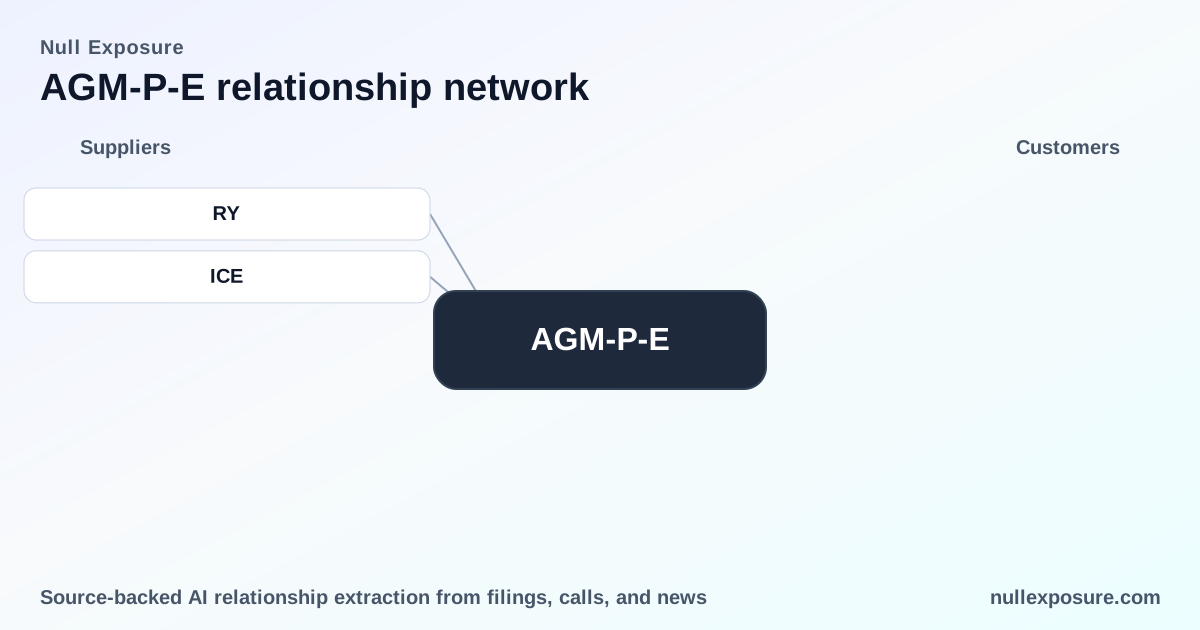
This preferred issue’s practical performance reflects two explicit market relationships disclosed in recent filings and press. Each relationship below is essential for the security’s distribution and tradability.
RBC Capital Markets, LLC — underwriting and distribution muscle
A PR Newswire release on March 9, 2026 notes that RBC Capital Markets, LLC served as the Sole Book‑Running Manager for the related preferred-stock transaction, signaling that a single lead underwriter handled allocations and market placements for the deal. This underwriter relationship supports primary-market pricing and initial liquidity. (PR Newswire, March 9, 2026: https://www.prnewswire.com/news-releases/farmer-mac-prices-100-million-of-series-h-preferred-stock-302535041.html)
New York Stock Exchange — venue for secondary liquidity
The same PR Newswire release states the issuer expects to list the new preferred series on the New York Stock Exchange under the symbol “AGM PRH,” indicating the transaction was structured for an established exchange listing to ensure ongoing trade execution and visible pricing. Exchange listing is a structural enabler of secondary-market liquidity and regulatory transparency. (PR Newswire, March 9, 2026: https://www.prnewswire.com/news-releases/farmer-mac-prices-100-million-of-series-h-preferred-stock-302535041.html)
For portfolio managers and operators, these partnerships explain the route-to-market: a lead underwriter to place the offering and a major exchange to sustain liquidity.
If you want to compare how these relationships affect supplier performance across instruments, see our coverage at NullExposure.
What the relationships imply about operating posture and execution risk
The combination of a sole book‑running manager and an NYSE listing reveals several operational and business-model characteristics:
- Contracting posture: The issuer relies on formal underwriting contracts and single-lead placement strategies, which streamlines execution but concentrates counterparty exposure to the lead manager. This contracting posture speeds issuance but increases reliance on the underwriter’s distribution network.
- Concentration: Using a sole book-runner concentrates placement risk and decision-making; acquisition of favorable allocations depends on that manager’s appetite and syndicate structure.
- Criticality: Exchange listing is critical to the security’s tradability. If listing continuity or exchange rules change, liquidity and pricing transparency would be impaired.
- Maturity: Preferred-series issuance is a mature capital-market activity for banking-backed issuers; the repeatability of such transactions depends on market conditions and the issuer’s capital needs.
These are company-level signals about how the issuer runs capital transactions — not specific to any one counterparty unless the source explicitly names that partner.
Risk considerations that investors and operators must weigh
Beyond headline relationships, AGMP-E’s risk profile is shaped by structural factors:
- Liquidity risk: Exchange listing reduces but does not eliminate liquidity risk; series-specific trading volumes determine execution costs in secondary markets.
- Underwriting concentration risk: With a single book‑runner, the issuer gains execution efficiency but increases concentration risk if that underwriter withdraws support or changes syndicate terms.
- Dividend and credit dependence: Preferred yield is dependent on the issuer’s payout policy and balance-sheet health; counterparties should monitor issuer capital actions and regulatory changes.
- Regulatory and listing risk: Continued eligibility for NYSE listing and any changes in listing rules materially affect pricing and tradability.
Major takeaway: the security’s stability is a function of issuer discipline and the strength of its market relationships — particularly the underwriter and exchange.
Actionable steps for investors and operators
- For investors: validate secondary-market depth and recent trade data for the specific preferred series before allocating capital; prioritize series with demonstrated trading activity on the NYSE.
- For operators: maintain active dialogue with underwriting partners to understand syndicate appetite and be prepared for concentration-specific contingency plans.
- For counterparties performing diligence: obtain primary-market documentation (prospectus/supplement) and confirm the lead manager’s placement terms.
If you want tailored, deal-level intelligence or a deeper supplier relationship map, check our research gateway: NullExposure homepage.
Final read: what matters most for AGM-P-E relationships
AGM-P-E’s market performance is driven less by headline ratings than by two operational realities: underwriting execution and exchange listing. RBC Capital Markets’ role as sole book‑runner and the NYSE listing commitment are the concrete relationships that support issuance and secondary liquidity. Investors should treat those relationships as core inputs to pricing, liquidity planning, and counterparty risk assessment.
For ongoing updates and comparative supplier analytics, return to the platform: NullExposure.