Farmer Mac’s AGM-P-F Preferred: Who Routed the Deal and Why It Matters for Investors
AGM-P-F is a preferred issue tied to the Federal Agricultural Mortgage Corporation (Farmer Mac) that channels capital into agricultural and rural lending; the issuer monetizes through structured debt and preferred instruments that support liquidity for agricultural lenders while offering investors a steady dividend-like yield. Farmer Mac operates as a conduit between capital markets and rural finance, and its preferred issuances are underwritten through institutional syndicates that determine pricing, distribution reach, and investor access. For diligence and competitive sourcing intelligence, visit https://nullexposure.com/.
Quick read on the transaction and why investors should care
Farmer Mac completed a $313.5 million offering in early March 2026, deploying a syndicate-led distribution strategy to place its preferred paper with institutional buyers. The composition of the syndicate—two joint bookrunners supported by regional and boutique firms—signals a balanced distribution posture: national scale for price discovery and specialist dealers for targeted placement into niche investor channels. (Source: Yahoo Finance coverage, March 9, 2026.)
If you evaluate supplier relationships for capital markets activity, tracking these syndicate patterns reveals who Farmer Mac relies on to access liquidity and which dealers control downstream flow to investors. Get the full supplier view at https://nullexposure.com/.
The deal mechanics and what the syndicate configuration implies
The transaction uses a classic underwriting structure: two joint bookrunners to lead pricing and execution, with several selling-group members to broaden distribution. This contracting posture—lead managers plus a selling group—reflects a mid-market issuer seeking both execution muscle and placement breadth without excessive concentration of execution risk.
Operationally, that structure implies:
- Maturity: Farmer Mac uses experienced capital markets partners rather than sole-market alternatives; the placement is routine and market-facing.
- Criticality: Underwriters are critical in setting execution speed and investor reception; joint leads carry primary market risk.
- Concentration: With two joint bookrunners, execution concentration is moderate; selling-group members reduce placement concentration.
- Contracting posture: Standard underwriting relationships rather than bespoke bilateral funding arrangements.
Mid-deal analysis and comparative supplier intelligence are available at https://nullexposure.com/ for institutions assessing counterparty exposure.
Who the suppliers were and what they did
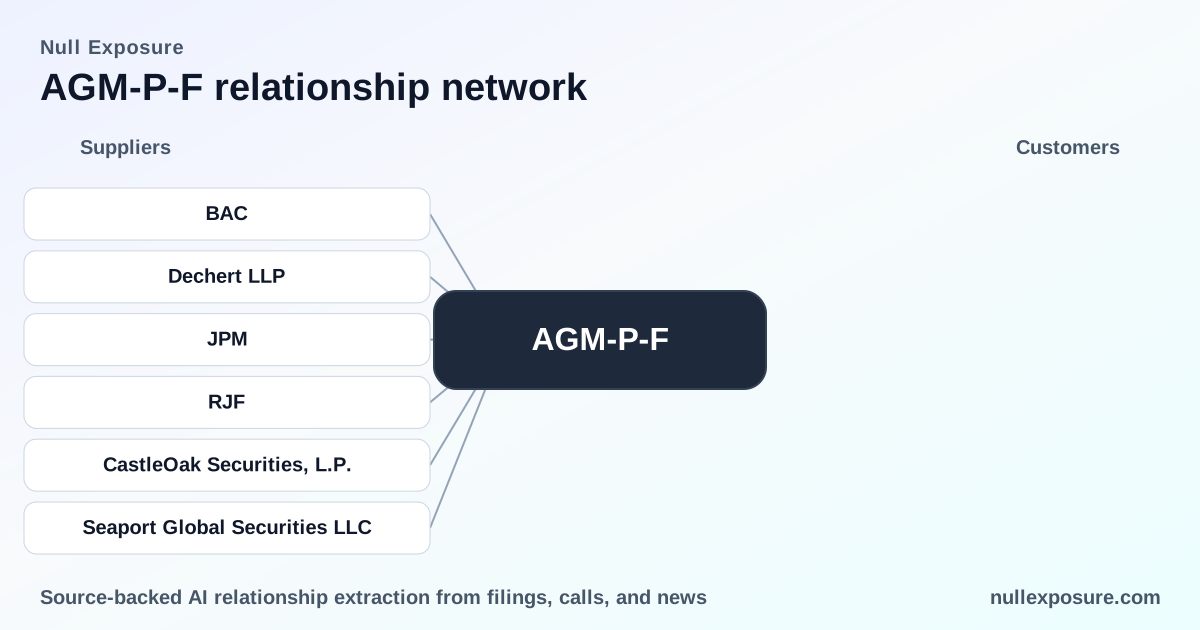
The following lists every named participant in public coverage of the transaction with concise, plain-English descriptions and a source citation for each.
BofA Securities, Inc.
BofA Securities acted as a joint bookrunner on the offering and therefore led pricing and primary distribution efforts alongside J.P. Morgan. According to a March 9, 2026 Yahoo Finance report, BofA shared primary execution responsibilities for the $313.5 million placement. (Source: Yahoo Finance, March 9, 2026.)
J.P. Morgan Securities LLC
J.P. Morgan served as the co‑lead joint bookrunner, partnering with BofA to manage order books and set deal terms, anchoring institutional demand for the preferred issue. The same Yahoo Finance coverage identifies J.P. Morgan as the other joint bookrunner in the syndicate. (Source: Yahoo Finance, March 9, 2026.)
Raymond James & Associates, Inc.
Raymond James participated as a selling-group member, extending distribution reach into regional accounts and retail-affiliated channels that larger lead managers may not access as efficiently. The transaction report lists Raymond James among selling-group members supporting placement. (Source: Yahoo Finance, March 9, 2026.)
CastleOak Securities, L.P.
CastleOak joined the selling group, supplying additional placement channels likely focused on fixed‑income desks and specialty institutional buyers that follow agricultural-credit instruments. The March 2026 news item cites CastleOak as a selling-group participant. (Source: Yahoo Finance, March 9, 2026.)
Seaport Global Securities LLC
Seaport Global acted as a selling-group member, contributing to distribution to institutional and boutique client bases that target yield and credit diversification. The issuer’s press coverage names Seaport Global among the selling-group firms. (Source: Yahoo Finance, March 9, 2026.)
Dechert LLP
Dechert LLP served as legal advisor to Farmer Mac for the offering, supervising regulatory disclosures and transaction documentation necessary for the preferred issuance. The legal role is explicitly called out in the public report on the deal. (Source: Yahoo Finance, March 9, 2026.)
Constraints and company-level signals (what’s not in the record)
No explicit supplier constraints or contracting limits were provided in the available coverage. That absence is a company-level signal in itself: public reporting shows a conventional underwriting arrangement with no disclosed special covenants, exclusivity clauses, or supplier-side restrictions tied to the transaction. Investors should infer that Farmer Mac executed a standard market offering rather than a constrained bespoke financing. This suggests the issuer favors flexible, market-standard underwriting relationships when accessing capital markets.
Investment implications and risk considerations
- Concentration risk is moderate. Two joint bookrunners handle execution, limiting over-dependence on a single lead while retaining centralized price discovery. Selling-group members dilute placement concentration.
- Operational criticality of the leads is high. BofA and J.P. Morgan carry the primary execution burden; performance and market access through these firms materially affect issuance success and secondary liquidity.
- Legal and compliance oversight is standard. Engagement of a national law firm for documentation confirms conventional governance and regulatory process; that reduces execution risk for institutional buyers.
- Distribution quality will determine secondary liquidity. The mix of national and regional dealers supports breadth but also implies that secondary market depth could concentrate around institutional desks at the lead banks.
For investors, the key takeaway is that Farmer Mac executed a standard, well-distributed preferred offering via established capital markets partners, minimizing bespoke counterparty risks while leveraging institutional placement networks.
Final thoughts and next steps
For portfolio managers assessing exposure to Farmer Mac paper or mapping vendor concentration across capital markets workflows, this syndicate reveals both the firms that control primary distribution and the legal advisor that verifies documentation. Track these relationships over successive transactions to identify persistence in counterparty reliance and to anticipate liquidity pathways in secondary markets.
Explore deep supplier analysis and historical syndicate footprints at https://nullexposure.com/ — our platform aggregates deal-level connections for institutional diligence. If you want a concise supplier map or a tailored counterparty concentration analysis for Farmer Mac and peers, visit https://nullexposure.com/ and request a briefing.