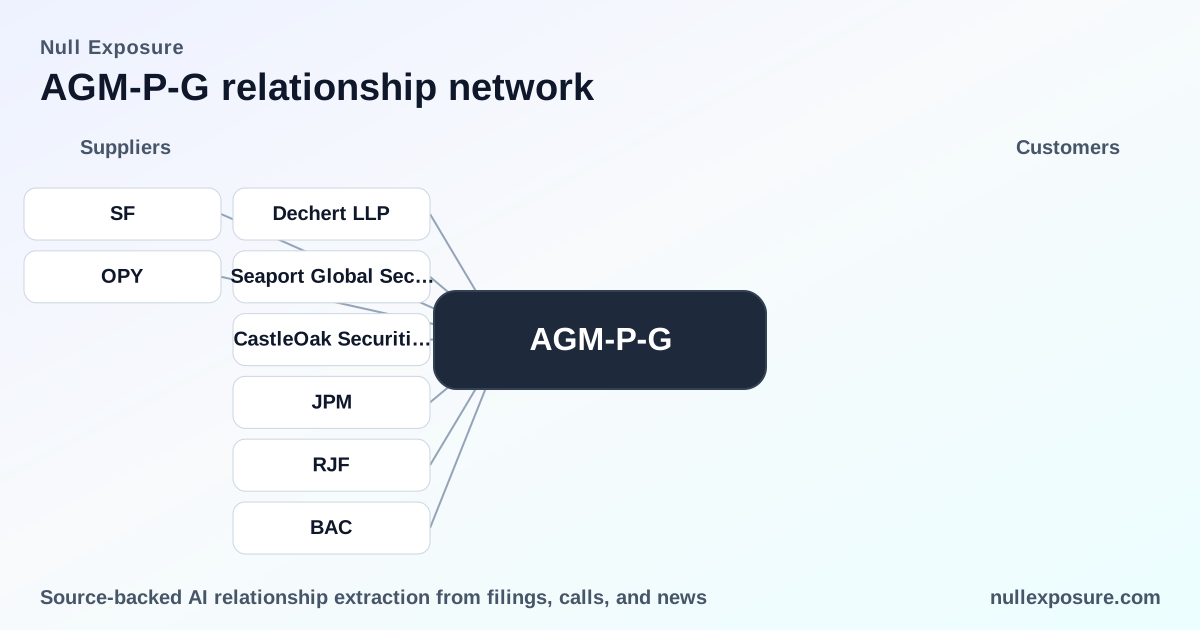
AGM-P-G supplier footprint: what institutional counterparties tell investors
AGM-P-G participates in the agricultural mortgage-backed securities market by engaging capital-markets and legal service providers to place and structure offerings; it monetizes through issuance activity and transaction-related fees tied to securitizations. The FY2025 record of counterparties shows a standard capital-markets operating model: reliance on investment banks for distribution, law firms for documentation, and a mix of regional and national selling-group partners to reach investors.
If you track provider continuity and counterparty exposure for preferred-issue or securitization strategies, these supplier mentions reveal where execution and reputation risk sit in the stack. For a quick look at our coverage and deeper supplier analytics visit https://nullexposure.com/.
Why these supplier relationships matter
- Execution is contract-driven and episodic. Fee revenue and market access flow when deals are launched; the supplier roster changes transaction-by-transaction but reflects long-term market relationships.
- Counterparty mix signals distribution breadth. Presence of both top-tier bookrunners and smaller selling-group firms indicates a distribution strategy that balances scale with specialty placement channels.
- Legal counsel is a gating function. A repeat legal advisor role indicates standardized documentation and reduced operational friction for future deals.
Read on for a detailed roll call of every FY2025 relationship that shows up in the public record, followed by investor implications and recommended due diligence steps.
A compact review of FY2025 counterparties and what each engagement means
- Dechert LLP — Dechert served as legal advisor to the issuer in the FY2025 AMBS transaction, handling documentation and closing mechanics; the engagement was reported in PR Newswire on March 9, 2026 (PR Newswire, March 9, 2026: https://www.prnewswire.com/news-releases/farmer-mac-closes-300-1-million-securitization-of-agricultural-mortgage-backed-securities-ambs-302479059.html).
- Seaport Global Securities LLC — Listed as a selling-group member on a FY2025 securitization, Seaport Global contributed distribution capacity for the deal reported on March 9, 2026 (StockTitan/Stocktitan.net, March 9, 2026: https://www.stocktitan.net/news/AGM/farmer-mac-closes-313-5-million-securitization-of-agricultural-a4680n417aw7.html).
- CastleOak Securities, L.P. — Appears as a selling-group participant across FY2025 deal announcements, supporting placement to niche investor channels (StockTitan report, March 9, 2026: https://www.stocktitan.net/news/AGM/farmer-mac-closes-313-5-million-securitization-of-agricultural-a4680n417aw7.html).
- J.P. Morgan Securities LLC — Named as a joint bookrunner on the FY2025 offering, indicating lead underwriting and distribution responsibilities consistent with major-bank execution (StockTitan, March 9, 2026: https://www.stocktitan.net/news/AGM/farmer-mac-closes-313-5-million-securitization-of-agricultural-a4680n417aw7.html).
- Raymond James & Associates, Inc. — Served as a selling-group member and distribution partner for the FY2025 securitization, signaling regional institutional reach (StockTitan, March 9, 2026: https://www.stocktitan.net/news/AGM/farmer-mac-closes-313-5-million-securitization-of-agricultural-a4680n417aw7.html).
- BofA Securities, Inc. — Listed repeatedly as a joint bookrunner across FY2025 transactions, representing a primary underwriter role and a central point of market access and execution (StockTitan and PR Newswire reports, March 9, 2026: https://www.stocktitan.net/news/AGM/farmer-mac-closes-313-5-million-securitization-of-agricultural-a4680n417aw7.html; https://www.prnewswire.com/news-releases/farmer-mac-closes-300-1-million-securitization-of-agricultural-mortgage-backed-securities-ambs-302479059.html).
- Stifel, Nicolaus & Company, Incorporated — Appeared as a selling-group participant on the FY2025 closing, contributing to broader retail and institutional distribution routes (PR Newswire, March 9, 2026: https://www.prnewswire.com/news-releases/farmer-mac-closes-300-1-million-securitization-of-agricultural-mortgage-backed-securities-ambs-302479059.html).
- Oppenheimer & Co. Inc. — Named as a joint bookrunner on a FY2025 deal alongside other senior banks, indicating shared underwriting responsibility and fee allocation (PR Newswire, March 9, 2026: https://www.prnewswire.com/news-releases/farmer-mac-closes-300-1-million-securitization-of-agricultural-mortgage-backed-securities-ambs-302479059.html).
- (Duplicate listing) CastleOak Securities, L.P. — Also referenced in the PR Newswire FY2025 disclosure as a selling-group member, reinforcing CastleOak’s role across multiple filings (PR Newswire, March 9, 2026: https://www.prnewswire.com/news-releases/farmer-mac-closes-300-1-million-securitization-of-agricultural-mortgage-backed-securities-ambs-302479059.html).
- (Duplicate listing) Dechert LLP — Appears again in the StockTitan FY2025 coverage as legal advisor, confirming the firm’s advisory continuity across announcement channels (StockTitan, March 9, 2026: https://www.stocktitan.net/news/AGM/farmer-mac-closes-313-5-million-securitization-of-agricultural-a4680n417aw7.html).
- (Duplicate listing) BofA Securities, Inc. — Also included in the PR Newswire FY2025 release in its joint bookrunner capacity, underscoring the bank’s prominence on the underwriting syndicate (PR Newswire, March 9, 2026: https://www.prnewswire.com/news-releases/farmer-mac-closes-300-1-million-securitization-of-agricultural-mortgage-backed-securities-ambs-302479059.html).
- (Duplicate listing) Raymond James & Associates, Inc. — Reappears in the StockTitan coverage for the same FY2025 transaction, confirming syndicate composition across outlets (StockTitan, March 9, 2026: https://www.stocktitan.net/news/AGM/farmer-mac-closes-313-5-million-securitization-of-agricultural-a4680n417aw7.html).
Interpretation of supplier signals and operating-model constraints
- Contracting posture: Transactional and market-driven; counterparties are engaged per offering, which gives the issuer flexibility but requires repeat underwriting relationships for reliable pricing and placement. This is a company-level signal derived from multiple bookrunner and selling-group mentions across FY2025.
- Concentration: Supplier concentration is moderate — a small set of major banks (BofA, J.P. Morgan, Oppenheimer) handle lead underwriting while a broader set of selling-group firms expands distribution; that structure reduces single-counterparty dependency but concentrates primary execution risk in a few large banks.
- Criticality: Legal counsel and joint bookrunners are critical to deal execution; the repeated appearance of the same legal advisor and primary bookrunners signals operational maturity and reduced gate risk.
- Maturity of the model: The recurring mix of bookrunners and selling-group members indicates an established securitization workflow capable of supporting repeat issuances.
Practical implications for investors and operators
- Underwriting concentration is the primary execution risk. Investors should validate underwriting commitments and fee economics with each issuance to assess potential margin pressure from lead banks.
- Distribution breadth is a strength. The mix of national bookrunners and regional selling-group firms supports wider investor reach, which stabilizes placement probability and secondary liquidity.
- Operational continuity is visible. Repeated legal counsel and recurring bank relationships reduce deal friction and accelerate future issuance — a positive signal for revenue predictability tied to securitizations.
If you want a structured supplier-risk scorecard or deeper counterparty profiles for AGM-P-G, start here: https://nullexposure.com/. For bespoke analysis and alerts on counterparties and syndicate changes, visit our homepage at https://nullexposure.com/ — we publish actionable supplier intelligence that investors use to model execution risk.
Bottom line: FY2025 activity shows a predictable, market-standard sourcing model centered on major underwriters and repeat legal counsel, with broader selling-group partners supporting distribution. Investors should focus due diligence on underwriting terms, counsel continuity, and syndicate composition for any upcoming issuances.