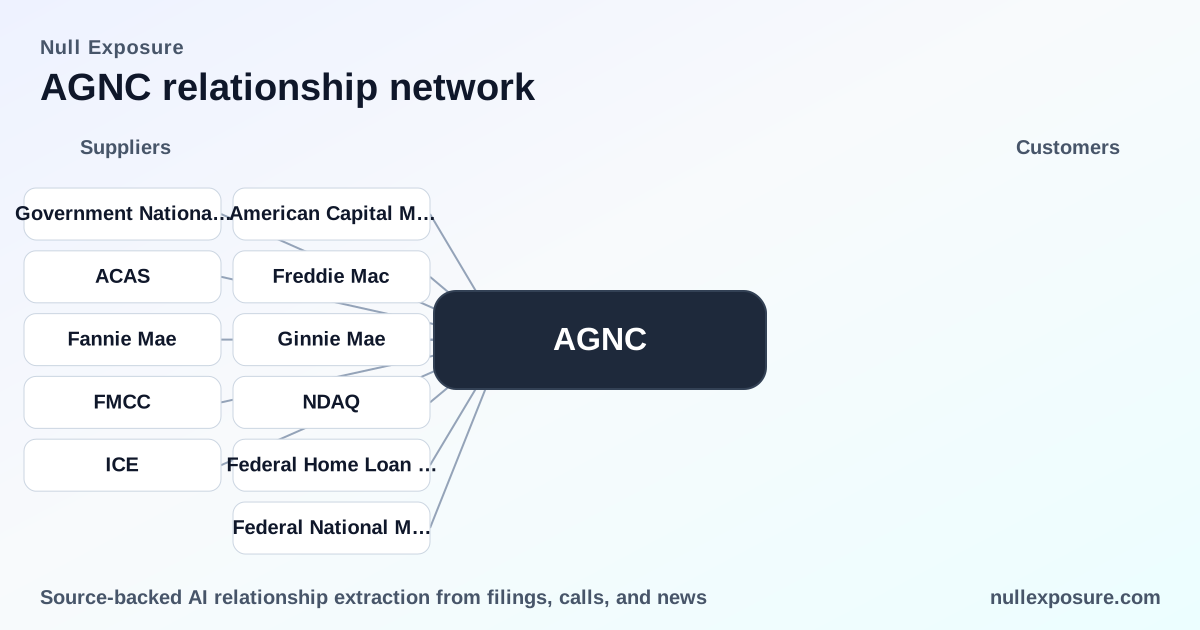
AGNC Investment Corp: who supplies the risk that underpins the dividend
AGNC monetizes by buying Agency residential mortgage‑backed securities (Agency RMBS) and funding those positions largely with short‑term repurchase agreements, capturing the spread between mortgage yields and financing costs while distributing most income as dividends. For investors and ops teams evaluating supplier relationships, the critical reality is that AGNC is a leveraged buyer of government‑guaranteed MBS with large, active financing relationships and a small universe of structurally important counterparties. For more supplier intelligence and relationship maps, visit https://nullexposure.com/.
How AGNC's supplier universe actually builds the business
AGNC is a self‑managed REIT that earns net interest income on Agency MBS financed through repo and hedged with interest‑rate swaps. The firm’s economics depend on three linked supplier groups: the GSEs/agencies that guarantee credit on the securities the firm buys, the financing counterparties that provide repo liquidity, and market infrastructure partners that support trading and indices. The company converts mortgage cash flows into corporate dividends by running large notional exposure on relatively thin margins, which makes counterparty access and funding stability the central operational risk.
The relationships you need on your radar
Below I list every relationship the source material links to AGNC, each with a concise, plain‑English takeaway and the source reference.
American Capital Mortgage Management, LLC
AGNC’s external manager originally sat under the American Capital umbrella, and that parent relationship framed AGNC’s early governance and management arrangements before internalization. (CNBC release, Oct 2012.)
American Capital (ACAS)
American Capital’s sale of assets in 2016 triggered AGNC’s internalization of management — a structural change that converted AGNC from externally managed to self‑managed, shifting supplier dynamics from a parent manager to in‑house capability. (REIT.com feature, Nov–Dec 2020.)
Federal National Mortgage Association (Fannie Mae)
AGNC’s portfolio consists predominantly of securities whose principal and interest are guaranteed by Fannie Mae, establishing Fannie as a primary source of credit protection on the company’s assets. (MarketScreener dividend notice, Jan 2026.)
Federal Home Loan Mortgage Corporation (Freddie Mac)
Freddie Mac is likewise a guarantor of many Agency MBS held by AGNC and therefore represents a foundational counterparty in the firm’s credit‑risk architecture. (MarketBeat filings coverage and The Motley Fool commentary, FY2025–FY2026.)
Government National Mortgage Association (Ginnie Mae)
Ginnie Mae guarantees certain Agency MBS in AGNC’s portfolio, giving the firm exposure to mortgage securities that carry explicit U.S. government agency backing. (CityBiz board announcement and MarketScreener, FY2026.)
The Nasdaq Global Select Market
AGNC lists on the Nasdaq Global Select Market, which governs certain disclosure and listing requirements that affect capital‑markets access and investor communications. (SEC filings referenced through StockTitan, FY2026.)
Intercontinental Exchange (ICE)
AGNC collaborated with ICE to launch three Agency MBS indices, tying the company to exchange‑level market infrastructure and index licensing that supports transparency and product distribution. (StockTitan news item, FY2025.)
Operational constraints that determine how those relationships behave
AGNC’s filings and public notices make the operating model explicit: funding is largely short‑term and repo‑centric, while interest‑rate hedges extend over multi‑year horizons, producing a matched but asymmetric supplier posture.
- Contracting posture — short‑term funding, some long‑term hedges. Repurchase agreements are typically short‑term (generally one day to less than a year) while interest‑rate swaps run from one to ten years, creating ongoing rollover risk on the financing side and duration risk on the hedging side.
- Counterparty profile — government guarantees plus large financial institutions. The credit protection on assets comes from government‑sponsored enterprises and agencies, while financing and clearing counterparties are concentrated among registered clearinghouses and major banks.
- Geography — U.S. housing market exposure. AGNC’s business is materially focused on the U.S. mortgage market; domestic policy and GSE changes materially affect asset availability and pricing.
- Materiality — repo is critical, TBAs are notable. Repo borrowing is critical to operations (AGNC reported roughly $60.8 billion of repo outstanding as of Dec 31, 2024), and TBAs accounted for about 9% of the investment portfolio, a non‑trivial exposure that behaves differently from pass‑throughs.
- Spend and scale — large, repeat funding. The company’s funding bands are large (>$100m), reflecting continuous, high‑volume counterparty engagement rather than one‑off vendor relationships.
These constraints create a supplier ecosystem where funding counterparties and market infrastructure are operationally critical, while the GSEs/agencies are credit‑risk suppliers central to the asset side of the balance sheet.
What investors and operator teams should watch next
- Repo access and counterparty concentration are the top operational exposures: any disruption in tri‑party repo services or a meaningful withdrawal of repo counterparties would compress net spread quickly. The company itself discloses dependency on tri‑party services and diversification across multiple counterparties.
- Prepayment and interest‑rate path drive realized yield; AGNC relies on internal analytics and third‑party service inputs for prepayment assumptions, which are a service dependency in valuation and hedging.
- Regulatory and market structure changes at the GSEs will have immediate balance‑sheet effects; agency policy changes alter the supply and pricing of the very securities AGNC trades.
- Operational governance after internalization reduces counterparty layering associated with an external manager, but it concentrates operational execution in AGNC’s in‑house teams — investors should monitor governance disclosures and attestation reports noted in filings.
For a structured vendor map and ongoing monitoring, check the supplier intelligence hub at https://nullexposure.com/.
Bottom line: supplier risk is funding risk
AGNC’s model converts government‑guaranteed mortgage cash flows into a high‑yield dividend through scale and leverage. That model works only while short‑term funding markets function and clearing/clearinghouse relationships remain intact. For investors, the most actionable signals are changes in repo volumes, terms, and the availability of GCF/tri‑party services; for operators, priority one is counterparty coverage and contingency planning.
If you manage capital or run operations that intersect with Agency MBS, integrate counterparty‑level monitoring and scenario testing into your routine — and explore deeper relationship mapping at https://nullexposure.com/ for ongoing coverage.