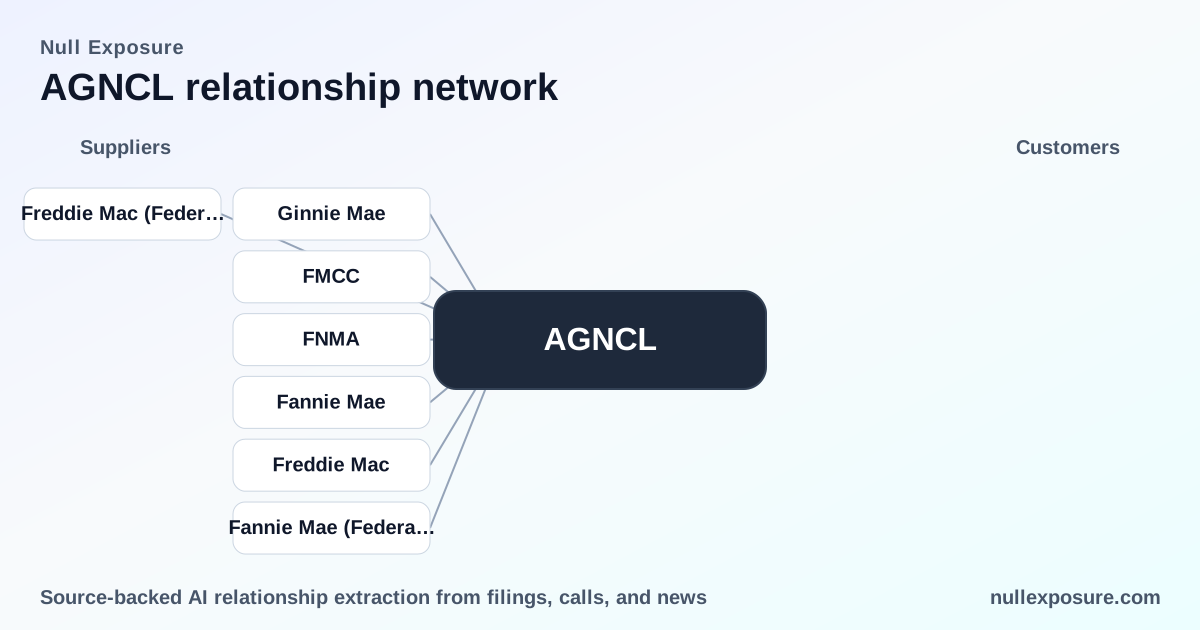
AGNCL: Agency MBS Exposure, Repo Reliance, and the Counterparty Map Investors Need
Thesis — AGNC Investment Corp (AGNCL) is a self-managed mortgage REIT that earns by arbitraging the spread between yield on Agency residential mortgage-backed securities (Agency MBS) and short-term funding costs. The firm holds Agency MBS guaranteed by Ginnie Mae, Fannie Mae and Freddie Mac and funds those positions primarily through large-scale, short-term repurchase agreements (repo); profitability is driven by leverage, MBS convexity management, and dividend distribution from net interest income. For primary research and supplier relationship intelligence, visit https://nullexposure.com/.
How the business operates and where the economics come from
AGNCL purchases Agency RMBS — mortgage pools where principal and interest are guaranteed by U.S. government-sponsored enterprises or agencies — and finances those holdings with collateralized borrowings (repo). The company’s monetization engine is interest spread and leverage: interest received on MBS less the cost of repo funding, with returns amplified by gearing. AGNCL is self-managed, which keeps operating costs aligned with portfolio throughput and positions dividends as the direct transmission of portfolio income to shareholders.
According to press coverage and company filings through FY2025–FY2026, the portfolio tilt is heavily toward Agency MBS with protections against credit loss provided by Ginnie Mae, Fannie Mae and Freddie Mac (read the firm’s 2024 annual disclosures cited below). That structure makes counterparty guarantees central to credit risk and repo counterparties central to funding risk.
Visit https://nullexposure.com/ for targeted exposure analysis and supplier diligence.
Operating model constraints that shape supplier risk
AGNCL’s supplier relationships are shaped by several company-level constraints that investors must treat as structural features, not transient notes:
- Contracting posture — short-term funding dominates. The firm’s repo book is overwhelmingly short-term, typically under one year, with occasional longer maturities up to five years; repo is the company’s primary financing source and requires continuous access to markets. This creates rollover and liquidity dependency as a persistent operational constraint.
- Counterparty profile — government guarantees plus large financial institutions. Holdings are concentrated in Agency MBS guaranteed by U.S. GSEs/agencies, while repo counterparties are largely major financial institutions and registered clearinghouses, limiting the set of eligible counterparties but increasing systemic interconnectedness.
- Criticality and scale — funding is material and mission-critical. With tens of billions of dollars of repo outstanding ($60.8B at 12/31/2024), funding is a critical input; interruptions would materially impair the company’s ability to maintain leverage and meet dividend targets.
- Geographic focus and market maturity — U.S. housing finance. AGNCL operates squarely within the U.S. residential mortgage market and relies on mature, liquid Agency MBS markets.
- Relationship role — buyer and service integrator. AGNCL acts primarily as a large-scale buyer of Agency MBS and as a service coordinator via its in-house broker-dealer Bethesda Securities (BES), which is a conduit to FICC and tri-party repo markets.
These constraints create an operating model where counterparty concentration, repo market functioning, and GSE guarantee frameworks are the dominant risk levers.
Counterparty mentions in the public record (exhaustive list)
Below is every supplier/counterparty mention surfaced in public coverage and filings related to AGNCL in the supplied results. Each entry is a 1–2 sentence plain-English summary with its source.
-
Ginnie Mae — MarketBeat instant alert (2026-02-28) explains AGNCL invests in residential MBS guaranteed by Ginnie Mae alongside Fannie and Freddie; the reference underlines Ginnie Mae’s role as a credit guarantor for portions of the portfolio. Source: https://www.marketbeat.com/instant-alerts/filing-trivium-point-advisory-llc-grows-position-in-agnc-investment-corp-agnc-2026-02-28/
-
Freddie Mac — TS2 Tech coverage (marquee market note, 2026) stated AGNC’s portfolio leans heavily on Agency MBS instruments backed by Freddie Mac, noting sensitivity to interest-rate and spread moves tied to those guarantees. Source: https://ts2.tech/en/agnc-stock-price-slips-after-soft-u-s-cpi-dividend-and-fed-minutes-loom/
-
Fannie Mae — MarketBeat instant alert (2026-02-28) repeats that AGNCL acquires RMBS guaranteed by Fannie Mae, affirming the firm’s reliance on FNMA-backed collateral. Source: https://www.marketbeat.com/instant-alerts/filing-trivium-point-advisory-llc-grows-position-in-agnc-investment-corp-agnc-2026-02-28/
-
Freddie Mac (alternate mention) — MarketBeat (same filing context, 2026) again lists Freddie Mac among the GSEs whose guarantees back AGNCL’s Agency MBS holdings, reinforcing the counterparty mix described in AGNCL materials. Source: https://www.marketbeat.com/instant-alerts/filing-trivium-point-advisory-llc-grows-position-in-agnc-investment-corp-agnc-2026-02-28/
-
Fannie Mae (TS2) — The TS2 Tech market note (2026) reiterates that FNMA-backed Agency MBS are core to AGNC’s income generation, highlighting market sensitivity around Fed commentary and CPI releases. Source: https://ts2.tech/en/agnc-stock-price-slips-after-soft-u-s-cpi-dividend-and-fed-minutes-loom/
-
Fannie Mae (StockTitan dividend report) — A StockTitan press item (2026) references that AGNCL’s securities benefit from Fannie Mae credit guarantees when describing dividend declarations, linking guarantees to dividend sustainability messaging. Source: https://www.stocktitan.net/news/AGNC/agnc-investment-corp-declares-monthly-common-stock-dividend-of-0-12-97mokgwam76x.html
-
Freddie Mac (StockTitan) — StockTitan’s dividend announcement (2026) also notes Freddie Mac guarantees for a portion of AGNC’s MBS holdings when summarizing portfolio backing behind the dividend. Source: https://www.stocktitan.net/news/AGNC/agnc-investment-corp-declares-monthly-common-stock-dividend-of-0-12-97mokgwam76x.html
-
Ginnie Mae (StockTitan) — The StockTitan release (2026) mentions Ginnie Mae along with the other agencies as providing guarantees for AGNCL holdings, grounding dividend commentary in guarantee-backed collateral. Source: https://www.stocktitan.net/news/AGNC/agnc-investment-corp-declares-monthly-common-stock-dividend-of-0-12-97mokgwam76x.html
-
Fannie Mae (Federal National Mortgage Association) — The Globe and Mail press release (2026) identifies Fannie Mae by full legal name while noting AGNC’s primary investments in agency RMBS guaranteed by FNMA. Source: https://www.theglobeandmail.com/investing/markets/stocks/AGNC-Q/pressreleases/37037178/better-dividend-stock-agnc-investment-vs-ares-capital/
-
Freddie Mac (Federal Home Loan Mortgage Corporation) — The Globe and Mail press release (2026) similarly identifies Freddie Mac by its full corporate name while describing the Agency MBS backing of AGNC’s portfolio. Source: https://www.theglobeandmail.com/investing/markets/stocks/AGNC-Q/pressreleases/37037178/better-dividend-stock-agnc-investment-vs-ares-capital/
-
Ginnie Mae (TS2 mention) — TS2 Tech (2026) also highlights Ginnie Mae as part of the triad of guarantee providers that underpin AGNC’s MBS exposure. Source: https://ts2.tech/en/agnc-stock-price-slips-after-soft-u-s-cpi-dividend-and-fed-minutes-loom/
-
Fannie Mae (MarketScreener FY2025 item) — MarketScreener (FY2025 press coverage) states AGNCL invests primarily in Agency RMBS benefiting from Fannie Mae guarantees, a restatement included in director-election materials. Source: https://www.marketscreener.com/news/agnc-investment-corp-elects-christine-hurtsellers-to-its-board-of-directors-ce7d50d9dc81f525
-
Freddie Mac (MarketScreener FY2025 item) — MarketScreener (FY2025) parallels the FNMA reference with Freddie Mac as another guarantor noted in AGNCL’s corporate communications. Source: https://www.marketscreener.com/news/agnc-investment-corp-elects-christine-hurtsellers-to-its-board-of-directors-ce7d50d9dc81f525
-
Ginnie Mae (MarketScreener FY2025 item) — MarketScreener (FY2025) again lists Ginnie Mae as a guarantee provider for AGNCL’s Agency RMBS holdings in corporate filings coverage. Source: https://www.marketscreener.com/news/agnc-investment-corp-elects-christine-hurtsellers-to-its-board-of-directors-ce7d50d9dc81f525
What this map means for investors and operators
- Funding risk is the dominant operational risk: repo is short-term and large in scale; any market stress that increases repo rates or reduces access will compress net interest spread and pressure dividends.
- Credit risk is managed but not eliminated: GSE and agency guarantees remove credit-default risk for the underlying mortgages, but prepayment, interest-rate, and basis risk remain and drive performance.
- Counterparty selection is both concentrated and standardized: the company limits counterparties to large banks and clearinghouses, which reduces idiosyncratic counterparty failure risk but increases exposure to systemic events.
For more tailored supplier and counterparty diligence on mortgage REIT counterparties, visit https://nullexposure.com/.
Investment implications and recommended next steps
- Monitor repo market signals and FICC/GCF functioning as lead indicators of funding cost shocks.
- Stress-test dividend sustainability under higher short-term rates and increased prepayment volatility.
- Track regulatory and policy signals around Ginnie Mae/Fannie/Freddie that could change guarantee mechanics or market liquidity.
For bespoke supplier mapping and continuous monitoring of AGNCL counterparties, see https://nullexposure.com/.