AGNCM: How a mortgage-REIT preferred monetizes government-guaranteed paper
AGNC Investment Corp (AGNCM) is a self-managed mortgage REIT that earns spread by investing in residential mortgage-backed securities (RMBS), predominantly those guaranteed by U.S. government-backed entities, and funds those positions primarily through short-term repurchase agreements. The vehicle monetizes by capturing net interest margin between asset yields and the cost of collateralized borrowings, while returning income to holders through regular dividends on its preferred shares. For investors and operators evaluating supplier and counterparty relationships, the critical lens is funding stability, counterparty credit, and prepayment dynamics that drive realized yields. Visit https://nullexposure.com/ for a concise supplier-risk dashboard and comparative context.
What the operating model looks like in practice
AGNCM runs a levered buyer model: it purchases Agency RMBS and non-Agency residential securities and finances those positions with collateralized, short-term repo borrowings. The company’s filings state that repurchase agreements are their primary financing source and typically mature in under one year, although some repos can extend longer. That short-term contracting posture creates a structural sensitivity to funding markets and counterparty relationships.
- Contracting posture: predominantly short-term repurchase agreements, creating recurring rollover exposure and a need for diversified funding partners.
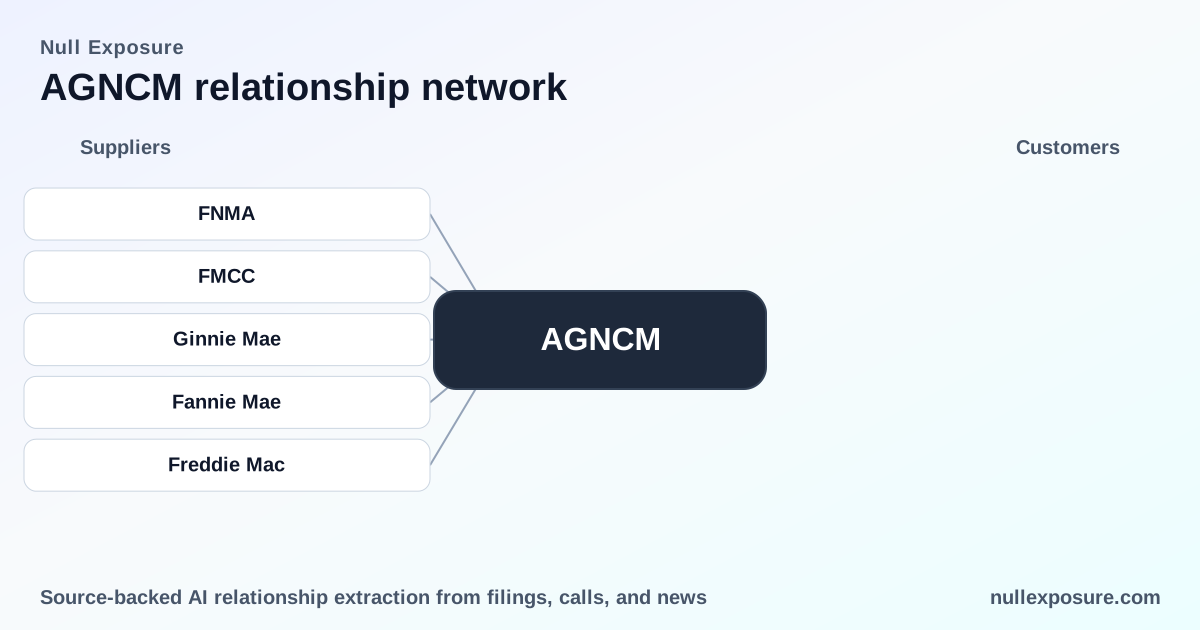
- Counterparty mix: includes government-backed guarantors (Fannie Mae, Freddie Mac, Ginnie Mae) for Agency RMBS, and large financial institutions and registered clearinghouses as repo counterparties.
- Concentration and criticality: repo financing is critical to operations—$60.8 billion outstanding in repurchase agreements as of year-end 2024—so counterparty performance directly impacts liquidity and leverage.
- Geographic focus and maturity profile: assets are U.S.-centric residential mortgages and collateral within the United States, which concentrates macro and regulatory risk domestically.
These characteristics combined make AGNCM operationally simple but execution-sensitive: funding access, margin calls, and prepayment speed are the levers that determine realized returns.
Who AGNCM transacts with (relationship map)
The public reporting and market coverage in the results identify three primary government-related counterparties. Each description below ties the relationship to the public source where AGNCM’s exposure is documented.
Fannie Mae (FNMA)
AGNC purchases RMBS that are guaranteed by Fannie Mae, making Fannie a fundamental guarantor of principal and interest on a portion of AGNCM’s holdings; this reduces credit risk on those instruments while leaving interest-rate and prepayment exposure intact. According to a MarketBeat instant-alert about filings in early 2026, AGNC’s portfolio includes securities guaranteed by Fannie Mae (MarketBeat, 2026). An industry overview piece in 2025 reiterated that AGNC mainly owns mortgage-backed securities guaranteed by Fannie Mae (ad-hoc-news, 2025).
Freddie Mac (FMCC)
Freddie Mac plays the same role for another tranche of AGNCM’s Agency RMBS holdings—guaranteeing payments on the underlying mortgages and thereby limiting counterparty credit exposure while preserving duration and prepayment risk. This linkage is documented in the same MarketBeat instant-alert (MarketBeat, 2026) and referenced again in the 2025 overview that described AGNC’s concentration in GSE-backed securities (ad-hoc-news, 2025).
Ginnie Mae
Ginnie Mae–guaranteed securities also sit in AGNCM’s investment mix; because those securities are backed by a U.S. government agency, they carry different legal and credit protections compared with GSE-guaranteed paper. MarketBeat’s 2026 filing summary explicitly lists Ginnie Mae among the guarantors of AGNC’s RMBS holdings (MarketBeat, 2026).
What the relationship and constraint signals imply for investors
The plain operational signals extracted from AGNC’s reporting produce a coherent risk profile for counterparties and suppliers:
- Short-term repo funding dominates: Most repurchase agreements mature within one year, so funding continuity is an operational dependency rather than a one-off counterparty exposure. This creates rolling refinancing risk and sensitivity to short-term money market dislocations.
- Government agencies and large financial institutions are central partners: Agency guarantees (Fannie, Freddie, Ginnie) reduce credit losses on the underlying collateral, while repo counterparties are large clearinghouses and major banks chosen for their credit standing—this is deliberate and reduces bilateral concentration risk.
- Funding is material and critical: The business cannot operate without access to repo markets; repo outstanding was reported at tens of billions, which makes counterparty performance and haircuts fundamental to liquidity management.
- Active, not idle, relationships: Filings show repo balances and active financing; this is an ongoing operational posture, not a legacy exposure.
These signals translate directly into monitoring priorities for investors: repo counterparty credit, haircut trends, margin call history, and prepayment model reliability. For a deeper supplier-risk view and entity benchmarking, go to https://nullexposure.com/.
Risk factors that determine near-term performance
- Funding volatility: Because repurchase agreements are short-dated, a spike in repo rates, a tightening of haircuts, or the loss of a major counterparty would compress spread or force deleveraging.
- Prepayment speed and convexity: Agency guarantees remove default risk but not prepayment risk; faster-than-expected prepayments reduce yield and shorten duration.
- Regulatory and policy movements: Changes in GSE structure, guarantee fees, or FHFA guidance can change the economics of Agency RMBS quickly.
- Operational dependency on vendors: AGNC relies on third-party analytics for prepayment estimation and registered auditors for financial attestations, introducing vendor operational risk into portfolio valuation processes.
Active monitoring of these vectors is essential; the company’s business model is simple to describe but complex to execute under stress.
Investor takeaways and next steps
- AGNCM is a play on interest-rate spreads funded by short-term repo markets; success depends on funding access and prepayment forecasting.
- Counterparty exposure is deliberately concentrated on government-guaranteed paper and large financial institutions, which reduces credit risk but leaves market and liquidity risks front and center.
- Operationally critical relationships—repo counterparties and guarantors—require ongoing surveillance for haircuts, margin behavior, and regulatory developments.
If you are benchmarking AGNCM against peer supplier relationships or preparing a counterparty risk scorecard, start with its repo counterparties, GSE exposure, and prepayment model vendors. Explore comparative supplier analytics and counterparty histories at https://nullexposure.com/ to see how AGNCM’s profile stacks up within the mortgage-REIT universe.
For deal teams and risk officers, maintain daily funding-run metrics, stress repos under higher rates, and keep a close watch on FHFA or Treasury announcements that could alter GSE economics. For portfolio investors, weight dividend yield against the operational fragility driven by short-term financing.
For a consolidated supplier-risk view and real-time alerts, visit https://nullexposure.com/—the data and relationship maps will help you prioritize counterparties and monitor critical funding lines.