AGNC Investment Corp. (AGNCN): Agency exposure and counterparty plumbing that underwrites the dividend
AGNC Investment Corp. is a mortgage REIT that earns a spread on Agency residential mortgage-backed securities financed with short- and long-term repurchase agreements and interest-rate swaps; it monetizes by leveraging high-credit-quality Agency RMBS, collecting interest income, and returning cash through a monthly dividend. For investors and operators evaluating supplier relationships, the critical issues are the company’s reliance on government-guaranteed MBS, concentrated funding channels, and third-party service providers that feed valuation and prepayment assumptions. Learn more about supply-chain visibility and counterparty profiles at https://nullexposure.com/.
How AGNCN’s operating model converts mortgage exposure into distributable yield
AGNCN runs a classical leveraged agency-mortgage book: purchase Agency RMBS and related securities, fund them largely with repo financing, and hedge duration with interest-rate swaps. The balance sheet scale is meaningful — the company reported an investment portfolio in the tens of billions and repurchase agreements outstanding in the tens of billions as of year-end disclosures — supporting the company’s reported dividend and yield profile. Market capitalization and book-value metrics indicate this is a large, market-facing REIT with active funding relationships; the company’s December 2025 quarter metrics (market cap approximately $8.8 billion and dividends that produce a >5% yield on the preferred) reflect that positioning.
Operationally, AGNCN runs both short-term and long-term contractual exposure: repurchase agreements are generally short-term (days to one year), while interest-rate swaps run one to ten years. This mix produces a contracting posture that is both active and time-staggered — funding can roll frequently, while hedges provide multi-year duration management. For a deeper view into counterparty composition and funding reliance, visit https://nullexposure.com/.
Agents of the book: the agency counterparties in plain English
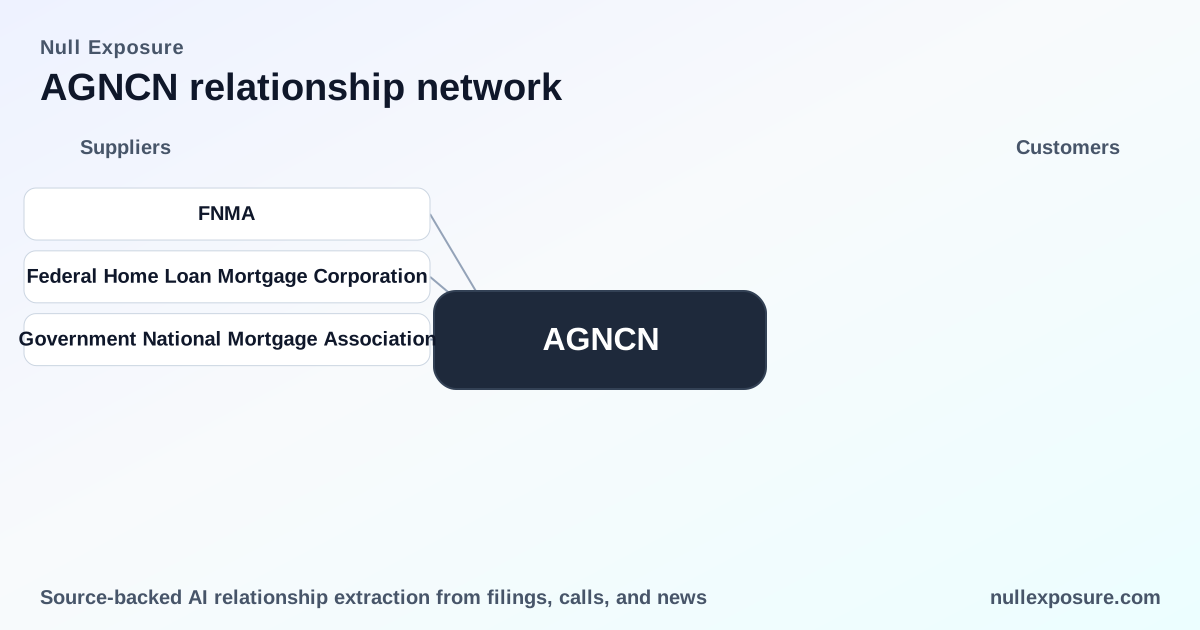
The relationships that underpin AGNCN’s business are concentrated in government-backed mortgage guarantors. Below I list each reported relationship from public reporting and media coverage, with a short plain-English summary and source reference.
Federal National Mortgage Association (as referenced in Intellectia)
AGNCN invests in residential mortgage pass-through securities and CMOs whose principal and interest are guaranteed by government-sponsored enterprises such as the Federal National Mortgage Association (Fannie Mae) — these guarantees are a foundation of AGNCN’s credit profile. According to an Intellectia news piece dated March 9, 2026, Agency RMBS guaranteed by FNMA form a core part of the investment portfolio.
Federal Home Loan Mortgage Corporation (Freddie Mac) via Intellectia reporting
AGNCN’s holdings include securities guaranteed by the Federal Home Loan Mortgage Corporation, and the company explicitly classifies these GSE-guaranteed securities as part of their Agency RMBS exposure, supporting predictable cash flows. This relationship is documented in the same Intellectia article on March 9, 2026.
Government National Mortgage Association (Ginnie Mae) as referenced in Intellectia
Portfolio disclosures cite securities guaranteed by Government National Mortgage Association, which represents agency-guaranteed paper backed by government agencies (Ginnie Mae) and contributes to the high credit quality of the firm’s RMBS sleeve. The Intellectia March 9, 2026 report lists Ginnie Mae among the guarantors supporting AGNCN’s MBS holdings.
Fannie Mae — press release coverage from FY2025 (The Globe and Mail)
Public press materials note that AGNCN supports its monthly dividend with investments in Agency RMBS, including pools guaranteed by Fannie Mae, underscoring the centrality of Agency guarantees to dividend coverage. This point was reiterated in a press release covered by The Globe and Mail in FY2025.
What the supplier and counterparty signals tell an investor
The disclosure set and constraint excerpts produce a clear picture of how AGNCN contracts and where the operational risks sit:
- Contracting posture is mixed: short-term funding and multi-year hedges. Repurchase agreements are primarily short-dated (often less than one year), while interest-rate swaps extend up to a decade, creating liquidity roll risk alongside interest-rate exposure that is actively hedged.
- Counterparty universe is dominated by sovereign-backed entities and large financial institutions. The firm’s primary credit exposures are to government-sponsored enterprises and agencies (Fannie Mae, Freddie Mac, Ginnie Mae) and to large clearing and bank counterparties for repo and swap execution.
- Geography is U.S.-centric and mission-critical for the domestic mortgage market. AGNCN explicitly positions itself as a provider of private capital to the U.S. housing market, so the counterparty and product concentration are domestic by design.
- Materiality and audit focus are high. Prepayment assumptions and premium amortization are identified as a critical audit matter — valuation and prepayment modeling are central to reported results and therefore to investor confidence.
- Spend and scale are very large. The company’s portfolio and repo outstanding are measured in tens of billions, placing suppliers and counterparties squarely in the >$100M relationship band and making funding counterparties strategically important.
- Relationship roles are dual: buyer of securities and consumer of services. AGNCN is a buyer of core Agency RMBS and simultaneously depends on third-party service providers for prepayment estimates, accounting attestation, and clearing/funding access.
These signals are company-level characteristics drawn from public filings and reporting, not claims about any single named counterparty unless the filing explicitly ties that counterparty to the excerpt.
Risks that suppliers and counterparties bring to the P&L and liquidity
Two immediate operational risk vectors stand out and are sourced in disclosures:
- Funding concentration and operational reliance on tri-party repo infrastructure — the company notes significant dependence on FICC’s GCF Repo, which ties AGNCN’s funding capacity to the operational and regulatory standing of clearing participants. This is a material funding risk for the business.
- Model risk in prepayment estimation and valuation — auditors flagged long-term prepayment-speed estimation as a critical audit matter, which is consequential because prepayment rates drive premium amortization and net yield.
Both items are company-level risk drivers that influence supplier selection, counterparty limits, and operational contingency planning.
Bottom line and suggested actions for investors and operators
AGNCN’s model is straightforward: leverage government-guaranteed RMBS, fund them through repo markets, hedge with swaps, and return cash via dividends. The supplier relationships that matter are the GSEs and the large financial counterparties that provide repo and clearing. Given the scale of funding and the critical audit focus on prepayment assumptions, investors should prioritize counterparty resilience and transparency around valuation and funding mechanics.
- For a deeper supplier relationship readout and monitoring toolkit, visit https://nullexposure.com/.
- If you require a tailored counterparty stability assessment or a supply-chain stress test for AGNCN exposures, start here: https://nullexposure.com/.
- Monitor funding counterparties, GSE policy shifts, and prepayment-model disclosures as the primary triggers for portfolio re-pricing or liquidity stress.
AGNCN’s yield is supported by high-credit-quality agency collateral and large-scale funding, but that structure requires ongoing vigilance on repo access, clearing counterparties, and prepayment-model integrity — the precise variables that determine whether the dividend is sustainable over the next cycle.