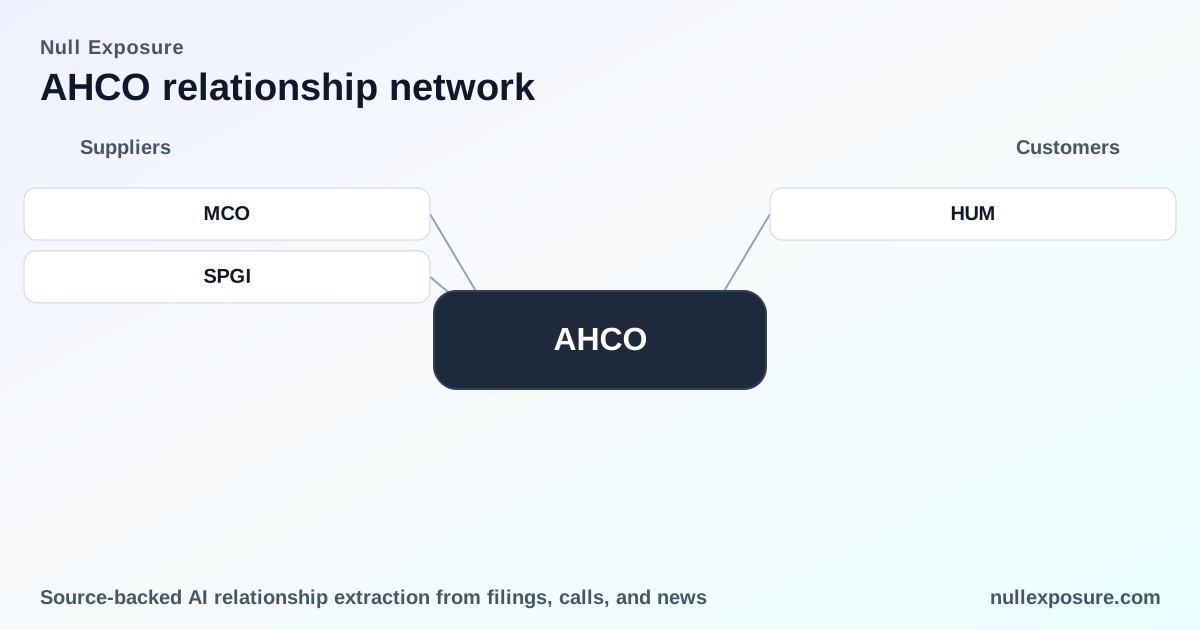
AdaptHealth (AHCO) — Supplier relationships, operational constraints, and what investors should know
AdaptHealth operates and monetizes as a national distributor and services platform for home medical equipment, durable medical devices, sleep therapy and diabetes management products. The company purchases devices and supplies from manufacturers and distributors, bills payers for recurring services and equipment, and extracts margin through scale, billing efficiencies and ancillary service offerings; revenue TTM is $3.24 billion with gross profit of $678 million, indicating a high-volume, low-margin goods-plus-services model that depends on supplier continuity and payer reimbursement stability. For investors and operators evaluating AHCO supplier exposure, focus on contracting posture (spot vs. long-term), supplier concentration, offshore service providers, and vendor spend bands — these are the operational levers that will determine margin durability and supply-side risk.
Explore deeper supplier mapping and signals at https://nullexposure.com/.
The supplier network in plain terms: how AdaptHealth buys and relies on partners
AdaptHealth purchases medical devices and supplies primarily from manufacturers and a small number of suppliers per product category, while also contracting national distribution firms to ship certain products directly to patients. The company combines physical goods procurement with outsourced service functions: business process outsourcing (BPO) providers handle billing, accounts payable and administrative work, and third-party cybersecurity and order-intake vendors supplement core operations. These relationships are active and material to operations — collectively they underpin patient delivery, revenue capture and cost structure.
Key operating signals to understand:
- Contracting posture: Many distributor relationships are spot arrangements where distributors invoice AdaptHealth at the time of sale, giving AdaptHealth price flexibility but limited long-term supply guarantees.
- Counterparty scale: AdaptHealth contracts with large enterprise national distributors for direct-to-patient shipping, making these counterparties both powerful and essential to last-mile fulfillment.
- Offshore service footprint: BPO providers are concentrated in APAC and LATAM jurisdictions (India, the Philippines, Guyana), providing a scalable, lower-cost workforce (about 4,700 FTEs reported as of 12/31/2024).
- Supplier concentration and criticality: The company acknowledges reliance on a relatively small number of suppliers for each product category — a structural concentration that elevates supply disruption risk.
- Spend bands and material vendors: Several vendors produce payments in the $10m–$100m range over recent years, and others fall in the $1m–$10m band, indicating multiple materially sized third-party relationships that affect cash flow and negotiating leverage.
These company-level signals point to a business that monetizes scale but remains sensitive to supplier terms, offshore labor continuity and vendor concentration.
Named external relationships and what they signify
AdaptHealth’s public materials and market reporting show interactions with credit ratings firms that impact financing costs and supplier confidence.
-
Moody's elevated AdaptHealth’s credit rating at the end of January following an earlier upgrade from S&P Global, a development reported in March 2026 that reflects improving credit metrics and market confidence going into FY2026. (Source: ad-hoc-news report, March 2026 — https://www.ad-hoc-news.de/boerse/news/ueberblick/adapthealth-s-strategic-trajectory-a-prelude-to-2026-growth/68555531)
-
S&P Global issued an upgrade in November that triggered subsequent ratings movement and public commentary on AdaptHealth’s strategic trajectory for 2026, signaling stronger perceived liquidity and operational improvement. (Source: ad-hoc-news report, March 2026 — https://www.ad-hoc-news.de/boerse/news/ueberblick/adapthealth-s-strategic-trajectory-a-prelude-to-2026-growth/68555531)
Both ratings actions reduce borrowing risk and improve AdaptHealth’s negotiating position with suppliers and financing partners; investors should treat these developments as credit-driven tailwinds to supplier relationships and working capital cost.
Operational detail investors should file under "important"
Several excerpts from company disclosures provide granular signals for vendor risk and leverage:
- Spot invoicing by distributors: Distributors invoice AdaptHealth for cost of shipped products at time of sale, confirming the spot nature of these purchase flows and limited inventory financing from vendors. This is a company-level contracting characteristic rather than a single-supplier attribute.
- Manufacturers ship directly: Manufacturers for HME and diabetes devices sell and ship directly to AdaptHealth, establishing direct manufacturer relationships that bypass intermediaries in some product lines.
- BPO scale and geography: Outsourced administrative functions are provided primarily in India, the Philippines and Guyana, with about 4,700 FTEs under arrangement as of year-end 2024 — a sizable offshore dependence that reduces labor cost but adds geopolitical and continuity risk.
- Material vendor spend: Payments to certain vendors were approximately $73.9M in 2024, $24.2M in 2023 and $80.3M in 2022, with related expense lines of $14.9M in 2024 (and smaller amounts in prior years). Other service-provider payments were $5.3M for the quarter ended March 31, 2024 and $21.8M / $20.0M in 2023/2022. These figures indicate multiple vendors in the $10M–$100M spend band and several in the $1M–$10M band — a mix that creates concentrated counterparty exposures.
- Integrated technology vendors: AdaptHealth holds equity interest with a vendor that supplies automated order intake software, and it uses third-party cybersecurity providers — showing strategic vendor integrations that are partially proprietary and partially outsourced.
These points are company-level constraints and operational characteristics that determine negotiating dynamics with suppliers and the resiliency of the supply chain.
Explore more supplier intelligence and implications at https://nullexposure.com/.
Risk and opportunity implications for investors
- Concentration is the principal risk. Relying on two to three suppliers per product category creates procurement leverage but also a single-point failure risk that can compress revenue and margin if a supplier disrupts deliveries.
- Spot contracting increases flexibility but reduces supply assurance. The distributor spot model supports rapid price capture but forces AdaptHealth to manage inventory, pricing and potential stockouts proactively.
- Offshore BPOs are a structural margin lever and an operational vulnerability. The 4,700-FTE offshore base reduces SG&A and supports scale, but it increases sensitivity to labor markets, regulatory changes and geopolitical friction in APAC/LATAM.
- Credit upgrades materially improve supplier dynamics. Upgrades from S&P Global and Moody’s strengthen AdaptHealth’s financing profile and reduce supplier financing costs, improving working capital flexibility and the ability to negotiate favorable terms.
Investors should weight these dynamics against the company’s scale: $3.24B revenue provides negotiating muscle, but supplier concentration and spot contracting require active monitoring.
Concrete takeaways and what to watch next
- Monitor procurement concentration disclosures and any single-supplier revenue callouts; a shift from spot to term contracting would change risk profiles materially.
- Track ongoing credit rating commentary and financing spreads; improved ratings directly translate into improved supplier and freight terms.
- Watch offshore vendor continuity metrics and any regulatory changes in India, the Philippines or Guyana that could affect labor supply or costs.
For ongoing supplier risk intelligence and updates on how these relationships affect valuation and operations, visit https://nullexposure.com/.
AdaptHealth’s supplier footprint is simultaneously a source of competitive margin and a vector of operational risk — investors should prioritize supplier concentration, contracting posture, and credit trajectory when building exposure to AHCO.