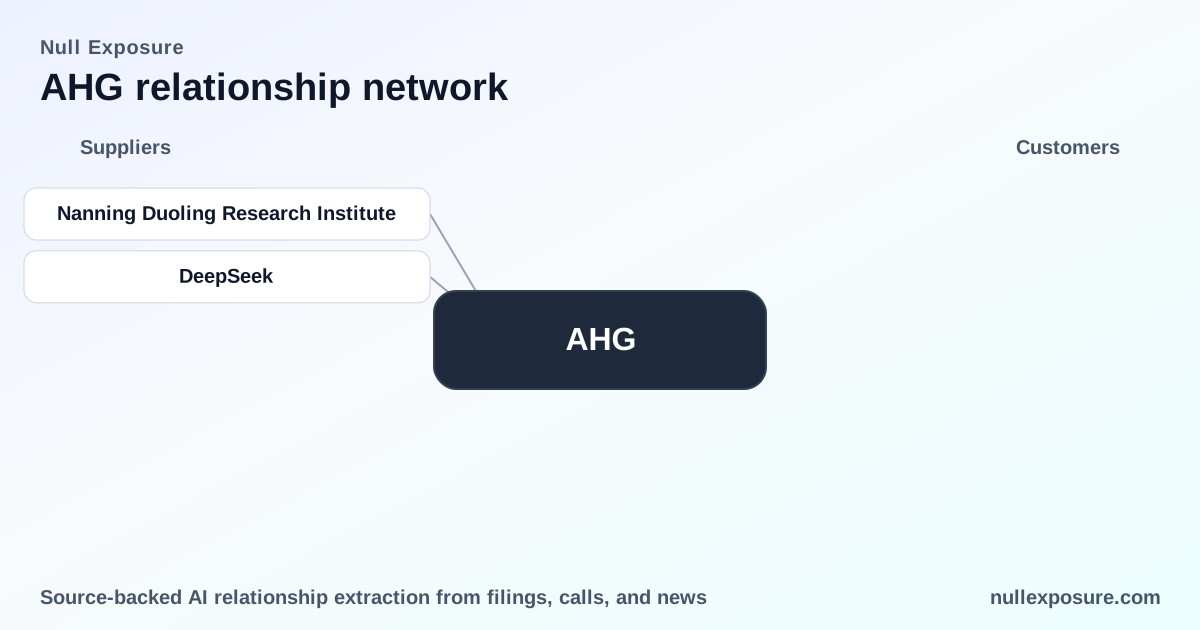
Akso Health Group (AHG) — supplier relationships that shape a high-risk, high-opportunity health-tech play
Akso Health Group monetizes by licensing and integrating advanced diagnostic and treatment technologies into its patient-care platform while selling associated reagents, consumables, and services; revenue comes from product sales and integrated service contracts, with margin pressure from early-stage deployment costs and R&D. Investors should view AHG as a small-cap, China-based medical distribution and health-technology integrator whose near-term commercial trajectory depends on a small number of strategic supplier relationships and on early adoption of AI-enabled diagnostics. For an at-a-glance hub of supplier intelligence, visit https://nullexposure.com/.
Why these supplier links matter to an investor’s thesis
AHG is operating as a commercialization engine: it sources proprietary diagnostic technologies and AI toolkits from external partners, bundles those capabilities into clinical offerings, and sells the resulting services and consumables to patients and providers. That operating model creates three practical implications:
- Contracting posture: The company uses strategic cooperation framework agreements and exclusive supply language to lock in access to specialized oncology diagnostic tech. That posture supports differentiated product offerings but elevates dependency on a few counterparties.
- Concentration and criticality: Given AHG’s modest trailing revenue (~$14.8M TTM) and negative operating margins, a limited number of supplier relationships are highly critical to revenue growth and clinical credibility. Loss or underperformance of a key supplier would materially affect commercial rollout.
- Maturity and timing risk: The partnership announcements are recent (FY2025–FY2026), indicating an early commercialization phase where technical validation, regulatory alignment, and local market adoption still determine value capture.
Key takeaway: AHG’s upside depends on converting exclusive supplier capabilities into scalable patient volumes; its downside is supplier concentration and limited financial cushion.
Check current supplier profiles and monitoring tools at https://nullexposure.com/ for direct updates.
Supplier relationship details — every reported item in the public results
Below are the relationships reported in the source set, each summarized in plain English with source context.
Nanning Duoling Research Institute — StockTitan news (first seen March 9, 2026)
AHG and Nanning Duoling entered a strategic cooperation framework where Nanning Duoling will supply exclusive cancer diagnosis and treatment technologies, reagents/consumables, laboratory testing capabilities, and an expert clinical team. According to the StockTitan release in March 2026, this arrangement is positioned as an exclusive supply and capability transfer for oncology services.
Nanning Duoling Research Institute — PR Newswire via The Manila Times (February 3, 2026)
A PR Newswire release (published via The Manila Times on February 3, 2026) confirms the strategic cooperation framework and frames the relationship as the backbone of a new global patient-support initiative centered on cancer diagnosis and treatment. The statement emphasizes clinical teams and reagent supply as operational deliverables.
Nanning Duoling Research Institute — Intellectia.ai coverage (March 9, 2026)
Media coverage from Intellectia.ai described the partnership as creating a closed-loop model of “global resource connection + local technology landing + full-cycle patient service,” targeting cost and access problems for millions of new cancer patients. The article highlights the exclusivity of diagnostic technologies as central to AHG’s product differentiation.
DeepSeek — StockTitan overview (FY2025 reporting, noted March 2026)
AHG reports deployment of DeepSeek’s multimodal large-scale models and deep learning frameworks to upgrade its AI-powered diagnostic system, indicating an active technology partnership to advance diagnostic automation and data processing. The FY2025 reference indicates the AI integration was in place prior to the FY2026 oncology cooperation announcements.
What the disclosed relationships imply for commercial execution
The combination of an exclusive oncology supplier (Nanning Duoling) and an AI partner (DeepSeek) implies a two-track commercialization plan: secure unique clinical content and then scale diagnostics through AI-enabled workflows. This is a common route to defensibility in health tech, but success depends on three operational vectors:
- Clinical validation and regulatory alignment for oncology diagnostics.
- Supply chain reliability for reagents and consumables under exclusive terms.
- Adoption velocity from providers and payors to convert pilot cases into recurring revenue.
Investor signal: exclusivity provides differentiation; early-stage execution and validation determine whether the premium is real or speculative.
Risk profile and constraints (company-level signals)
The dataset contains no explicit contractual constraints flagged against AHG, which itself is an informative company-level signal: public reporting does not surface material legal encumbrances or disclosed supply limits in the provided results. That absence is not a green light — it simply means the current reporting set lacks such constraint excerpts.
Financial and structural constraints are evident from AHG’s reported metrics: modest revenue (about $14.8M TTM), negative operating margin (~-43%), negative EPS, and a thin institutional ownership base. These create practical constraints on runway, bargaining power, and the ability to absorb supplier-induced shocks. Key risks include supplier concentration, cash burn from scaling clinical operations, and the need to convert technology partnerships into repeatable sales.
Actionable recommendations for investors and operators
- Conduct targeted vendor diligence on Nanning Duoling’s clinical validation data, reagent supply capacity, and the exact exclusivity terms in the cooperation framework agreement.
- Validate DeepSeek integration milestones and production-readiness of AI models; confirmed model performance metrics and data governance are essential before scaling.
- Monitor quarterly filings and press releases for commercial KPIs (patient volumes, recurring consumables revenue, contract length and renewal terms) to judge whether the partnerships move from pilot to scale.
For investor-grade monitoring and continuous supplier intelligence, see the AHG supplier tracker at https://nullexposure.com/.
Bottom line: pivot or play?
AHG is a classic early-stage health-technology integrator: it has differentiated supplier tie‑ups that justify investor attention, but execution risk is high given financial fragility and supplier concentration. The next 12 months of clinical rollouts, reagent supply tracks, and AI integration will determine whether AHG converts its partnerships into sustainable revenue streams or remains a speculative technology bet.
For ongoing coverage and a centralized view of AHG’s supplier relationships, visit https://nullexposure.com/ and subscribe for updates.