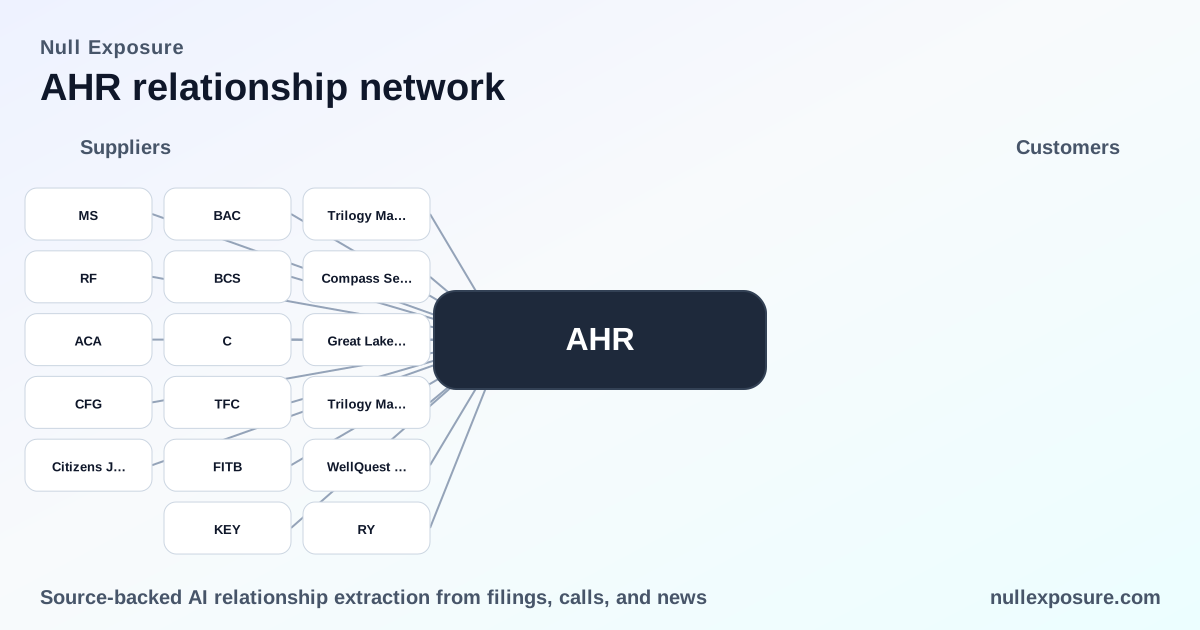
American Healthcare REIT (AHR): Supplier map and what counterparties tell investors
American Healthcare REIT is a specialized healthcare REIT that acquires and leases senior housing, skilled nursing and medical office properties to affiliated TRSs and third‑party operators. The company monetizes through long‑dated leases and operator relationships that generate stable rent streams and drive asset appreciation, while supplementing balance sheet flexibility with equity raises and ATM programs. For investors, supplier relationships are the operational lever that converts portfolio occupancy into distributable cashflow and the capital markets relationships are the financing lever that determines growth pace. Learn more at https://nullexposure.com/.
How AHR runs its business and why suppliers matter
AHR’s operating model bundles real estate ownership with outsourced facility operations: the REIT owns the real estate, often leases it to taxable REIT subsidiaries (TRSs), and those TRSs contract independent third‑party management companies to run day‑to‑day care and resident services. That separation concentrates operational risk in a small set of operators whose performance directly feeds AHR’s revenue and operating income. On the financing side, AHR relies on large investment banks and securities firms for equity programs and ATM capacity that support acquisitions and deleveraging actions.
- Operational concentration: integrated senior health campuses are managed by a small number of regional operators, creating meaningful counterparty dependence.
- Financing concentration and capacity: AHR’s large ATM and forward sale arrangements involve top‑tier banks and broker‑dealers, establishing a clear capital markets supply chain for equity issuance.
If you evaluate counterparties for underwriting or counterparty risk, start with the operator roster and then map which banks support the company’s capital programs. For a deeper supplier analysis and comparative exposure modeling, visit https://nullexposure.com/.
Operators and regional managers you need to know
AHR’s press releases and filings identify a handful of operators that manage the bulk of its integrated campuses and recent acquisitions. Each summary below is drawn from AHR disclosures and contemporaneous press coverage.
- Trilogy Management Services, LLC — Trilogy is the primary manager of AHR’s integrated senior health campuses and is cited as handling a significant portion of AHR’s revenues and operating income; AHR notes Trilogy manages all of its integrated campuses and continues operating recently developed campuses (PR Newswire, Q4 2025 / FY2026 release: https://www.prnewswire.com/news-releases/american-healthcare-reit-ahr-announces-fourth-quarter-2025-and-full-year-2025-results-issues-full-year-2026-guidance-302698936.html).
- Compass Senior Living — AHR lists Compass as one of its regional operating partners managing acquired properties, implying a revenue‑linked operator relationship for specific assets (PR Newswire, Q3 2025 results: https://www.prnewswire.com/news-releases/american-healthcare-reit-ahr-announces-third-quarter-2025-results-increases-full-year-2025-guidance-302607565.html).
- Great Lakes Management — AHR disclosed that three recently acquired properties in Minnesota and Wisconsin will be managed by Great Lakes Management, identifying the firm as a named regional operator (PR Newswire, Q3 2025 results: https://www.prnewswire.com/news-releases/american-healthcare-reit-ahr-announces-third-quarter-2025-results-increases-full-year-2025-guidance-302607565.html).
- WellQuest Living — AHR established a new regional operating relationship with WellQuest Living to operate four properties in California and Utah, signaling an active operator onboarding (PR Newswire, Q3 2025 results: https://www.prnewswire.com/news-releases/american-healthcare-reit-ahr-announces-third-quarter-2025-results-increases-full-year-2025-guidance-302607565.html).
Capital markets and ATM counterparties: equity capacity partners
AHR’s February 27, 2026 8‑K establishes a broad ATM equity offering and identifies a long list of agent and forward purchaser relationships. These firms are the underwriters and execution partners for equity issuance capacity:
- BofA Securities, Inc. (Bank of America) — Named as an Agent in AHR’s $1.75 billion ATM sales agreement executed February 27, 2026 (8‑K / StockTitan: https://www.stocktitan.net/sec-filings/AHR/8-k-american-healthcare-reit-inc-reports-material-event-44a40830d413.html).
- Barclays / Barclays Capital Inc. — Included among the Agents for the ATM program, serving as an execution counterparty (8‑K / TradingView summary: https://www.tradingview.com/news/tradingview:e36266ee679f6:0-american-healthcare-reit-launches-1-75-billion-atm-program-with-major-banks-ends-2025-facility/).
- Citigroup / Citibank, N.A. / Citigroup Global Markets Inc. — Identified as Agents and potential forward purchasers on the ATM, providing distribution and forward sale capacity (8‑K: https://www.stocktitan.net/sec-filings/AHR/8-k-american-healthcare-reit-inc-reports-material-event-44a40830d413.html).
- RBC Capital Markets / RBC Capital Markets, LLC — Named both as underwriter activity in a prior offering and as an Agent/forward purchaser in the ATM program, showing recurring capital markets involvement (news: StockTitan & TradingView: https://www.stocktitan.net/news/AHR/ ; https://www.tradingview.com/news/tradingview:e36266ee679f6:0-american-healthcare-reit-launches-1-75-billion-atm-program-with-major-banks-ends-2025-facility/).
- Morgan Stanley / Morgan Stanley & Co. LLC — Included as an Agent and forward purchaser for the ATM agreement (8‑K: https://www.stocktitan.net/sec-filings/AHR/8-k-american-healthcare-reit-inc-reports-material-event-44a40830d413.html).
- KeyBanc Capital Markets / KeyBanc Capital Markets Inc. — Listed among Agents for the ATM (8‑K: https://www.stocktitan.net/sec-filings/AHR/8-k-american-healthcare-reit-inc-reports-material-event-44a40830d413.html).
- Truist Securities / Truist Bank / Truist Securities, Inc. — Appears as an Agent/forward purchaser and is listed across trading coverage, indicating Truist’s role in distribution capacity (TradingView & 8‑K: https://www.tradingview.com/news/tradingview:e36266ee679f6:0-american-healthcare-reit-launches-1-75-billion-atm-program-with-major-banks-ends-2025-facility/ ; https://www.stocktitan.net/sec-filings/AHR/8-k-american-healthcare-reit-inc-reports-material-event-44a40830d413.html).
- Fifth Third Securities / Fifth Third Securities, Inc. — Named as an Agent in the ATM arrangement (8‑K: https://www.stocktitan.net/sec-filings/AHR/8-k-american-healthcare-reit-inc-reports-material-event-44a40830d413.html).
- Regions Securities / Regions Securities LLC — Included in the Agent group for the ATM program (8‑K: https://www.stocktitan.net/sec-filings/AHR/8-k-american-healthcare-reit-inc-reports-material-event-44a40830d413.html).
- Credit Agricole / Credit Agricole Securities (USA) Inc. / Credit Agricole Corporate and Investment Bank — Identified as potential forward purchasers and Agents; part of the international banking participation (8‑K: https://www.stocktitan.net/sec-filings/AHR/8-k-american-healthcare-reit-inc-reports-material-event-44a40830d413.html).
- Citizens JMP Securities, LLC / Citizens JMP Securities — Listed among the Agents in the sales agreement (8‑K: https://www.stocktitan.net/sec-filings/AHR/8-k-american-healthcare-reit-inc-reports-material-event-44a40830d413.html).
- Royal Bank of Canada — Identified as a potential forward purchaser in the Sales Agreement language (8‑K: https://www.stocktitan.net/sec-filings/AHR/8-k-american-healthcare-reit-inc-reports-material-event-44a40830d413.html).
What constraints tell investors about AHR’s supplier posture
AHR’s public disclosures and constraint excerpts paint a coherent operating picture:
- Leverage is material. AHR disclosed $1.7 billion of indebtedness as of December 31, 2024 (company filing language cited in constraints), which creates a material balance sheet sensitivity to operating cashflow and capital markets access. This is a company‑level constraint affecting counterparty risk appetite rather than a single relationship.
- Operational service provider concentration. The company explicitly states that Trilogy manages all integrated senior health campuses and that those campuses account for a significant portion of revenue and operating income; that makes Trilogy a critically important active service provider (constraint excerpt naming Trilogy).
- Supplier relationships are active and revenue‑critical. The Trilogy excerpt also supports an “active” relationship stage signal; other operators (Compass, Great Lakes, WellQuest) are likewise cited by AHR as active regional partners in recent press releases.
- High spend / exposure band at the company level. AHR’s indebtedness and mortgage profile signal enterprise‑level capital intensity and large counterparty exposures (spend_band = $100m_plus), which translates into concentrated counterparty exposure through both operators and financing banks.
Investment implications and next steps
- Operational due diligence: Prioritize monitoring performance and contracts with Trilogy, Compass, Great Lakes and WellQuest; these operators are the primary operational counterparties that convert occupancy into rent.
- Financing runway: Track ATM utilization and forward sale activity with the listed banks — BofA, Barclays, Citi, Morgan Stanley, RBC, Truist and others — because equity issuance cadence will determine leverage trajectory.
- Risk checklist: Model downside scenarios that stress occupancy and test covenant and liquidity buffers given AHR’s stated indebtedness.
For a portal that aggregates counterparties, filings and structured relationship signals for buy‑side due diligence, visit https://nullexposure.com/.
If you are evaluating AHR for portfolio inclusion or as a vendor partner, focus initial workstreams on operator contract terms, termination rights, and the granular mechanics of the ATM/forward sale arrangements with the banks named above; those are the two axes that determine operational continuity and capital flexibility. For more supplier intelligence and relationship mapping, see https://nullexposure.com/.