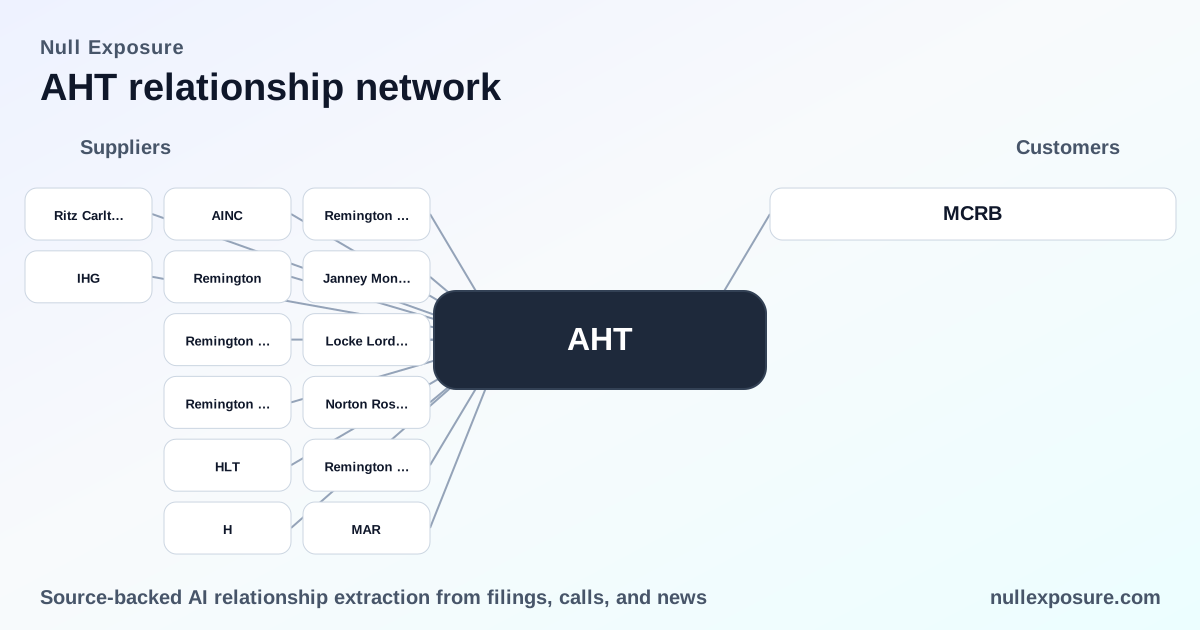
Ashford Hospitality Trust (AHT): Supplier map and what it means for investors
Thesis — Ashford Hospitality Trust is a hotel REIT that owns upscale and luxury properties but outsources virtually all operations and brand functions. The company monetizes through property-level cash flow (room, F&B, other services) while paying franchisor royalties and management fees; value to investors depends on operator execution, franchise relationships and the stability of financing arrangements. For a quick vendor-risk scan, visit https://nullexposure.com/ to see how these supplier relationships fit into broader counterparty profiles.
The operating model in plain English: outsourced operations drive both upside and risk
Ashford Trust does not operate hotels directly; it contracts third-party managers and licenses major franchisor brands, creating a business model where EBITDA is delivered through others while AHT remains responsible for asset-level leverage and capital improvements. That contracting posture produces a mix of long-term management agreements (multi-year terms with renewal options) that lock in operating relationships, usage-based licensing fees (franchisor royalties as a percent of rooms and F&B revenue), and shorter-term financing instruments for capital and mortgage needs. These characteristics create a layered risk profile: operational execution is concentrated with a small set of managers, while credit exposure sits at asset-level debt and bank counterparties.
- Contracting posture: AHT relies on long-dated management agreements while paying franchisor royalties that are usage-based, creating predictable but revenue-linked outflows.
- Concentration and criticality: A single affiliated manager group handles a majority of properties, making that relationship both material and operationally critical.
- Maturity mix: Management contracts and ground leases extend decades in some cases, whereas financing often carries shorter initial terms with extension options.
How to read the constraints investors should care about
The company disclosures show usage-based franchisor royalties (typically 3–6% of rooms revenue) and long-term management agreements that can extend beyond a decade, but also shorter dated financing tranches and variable-rate debt. Counterparty exposure includes global systemically important banks for cash/deposits and investment-grade banks as derivative counterparties. Advisory and related-party service fees are not trivial: advisory services fees rose to roughly $58.6 million in 2024, indicating meaningful spend with related advisers. These are company-level signals that shape cash flow variability and counterparty risk.
For detailed supplier screening and mapping, start here: https://nullexposure.com/.
Who AHT does business with — every relationship found in public reporting
Below is a plain‑English catalog of each counterparty referenced in the sourced materials, with a short investor takeaway and the cited source.
Remington Lodging
Remington Lodging was appointed to manage specific properties post-closing, continuing operational oversight after AHT transactions. Source: PR Newswire release on the Hilton Santa Cruz acquisition (FY2019).
Janney Montgomery Scott LLC
Janney Montgomery Scott served as the special committee’s financial advisor in a transaction review, indicating use of external investment-bank advisory capacity. Source: ConnectCRE coverage of the $275M Remington Holdings transaction (FY2019).
Locke Lord LLP
Locke Lord acted as Ashford’s tax legal advisor for the transaction, reflecting the use of specialized tax counsel on structuring matters. Source: ConnectCRE article on the Remington transaction (FY2019).
Norton Rose Fulbright US LLP
Norton Rose Fulbright served as the special committee’s corporate legal advisor, used for corporate governance and transaction oversight. Source: ConnectCRE coverage (FY2019).
Remington Holdings LP
Remington Holdings LP provides project management and capital improvement services for AHT properties, historically the internal engine for cap-ex and renovations. Source: HotelManagement.net transaction reporting (FY2018).
Marriott International
Marriott is a principal franchisor for multiple AHT assets; franchise agreements with Marriott brands determine licensing obligations and standards. Source: HotelNewsResource announcement of a franchise agreement (FY2019).
Ashford Inc.
Ashford Inc. has provided Enhanced Return Funding Program (ERFP) commitments and related-party support for certain acquisitions, signaling continued affiliated capital support. Source: HotelNewsResource transaction note (FY2019).
Remington (generic reference)
Company leadership has publicly referenced the affiliated Remington manager as a differentiator in investor calls, underlining a strategic operational link. Source: The Motley Fool earnings call transcript (FY2021).
Marriott's Autograph Collection
AHT announced conversion of the Crowne Plaza La Concha to Marriott’s Autograph Collection, positioning the asset to capture a 20–30% RevPAR premium post-conversion according to the company release. Remington Hospitality will remain manager. Source: PR Newswire update on conversion (FY2023).
Remington Hospitality
Remington Hospitality, a subsidiary of Ashford Inc., manages a large portion of AHT’s portfolio (50 of 69 properties), making it the single most operationally significant service provider. Source: company filings and the PR Newswire conversion update (FY2023 and FY2024 disclosures).
Remington Holdings (non‑LP mention)
Remington Holdings operations were described as responsible for managing and implementing capital improvements across AHT properties, confirming overlapping roles across affiliated entities. Source: HotelManagement.net (FY2018).
Marriott (brand shorthand)
Industry coverage repeatedly lists Marriott among brands in AHT’s portfolio, indicating multi-brand franchise exposure to Marriott’s systems and royalties. Source: MarketRealist commentary on AHT portfolio composition (FY2021).
Hilton
Hilton is one of the franchisor brands under which AHT operates properties, driving part of revenue through branded channel distribution and royalties. Source: MarketRealist portfolio discussion (FY2021).
Hyatt
Hyatt appears among the franchise brands in AHT’s asset mix, representing additional brand-license exposure in room distribution and standards. Source: MarketRealist (FY2021).
Courtyard
Courtyard (a Marriott brand) is listed among AHT’s franchised brands, reinforcing multi-brand licensing exposure. Source: MarketRealist (FY2021).
Sheraton
Sheraton is cited as part of the portfolio brand mix, adding to the range of franchisor relationships that AHT must maintain. Source: MarketRealist (FY2021).
Ritz Carlton
Ritz Carlton is noted in broader reporting on upscale assets; branded-luxury exposure carries higher standards and potential cap-ex obligations. Source: CBS News reporting on hotel ownership and brands (FY2020).
Crowne Plaza
Crowne Plaza was the predecessor brand for the Key West asset before conversion to Autograph; franchise conversions are used to reposition assets. Source: MarketRealist and PR Newswire conversion reporting (FY2019–FY2023).
(Multiple sources cited above include fiscal period context where available.)
Mid‑article takeaway: concentration is the headline risk
Remington Hospitality and affiliated Remington entities manage the majority of assets, and the filings explicitly call that reliance both material and critical; loss of that relationship or underperformance would be an immediate hit to cash flow. At the same time, usage‑based franchisor royalties and multi-brand licensing create ongoing revenue leakage tied to occupancy and F&B performance, so operating upside and downside flow directly to the bottom line.
Explore supplier concentration metrics and counterparty risk tools at https://nullexposure.com/ for deeper diligence.
Practical investor implications and watch list
- Operational concentration: High. Remington manages most hotels and is named explicitly as critical in disclosures. Loss or contract renegotiation risk is a top operational threat.
- Revenue linkage: Usage-based royalties (3–6% of rooms revenue) mean brand fees rise with demand but pressure margins in recovery scenarios.
- Debt and liquidity: Significant property-level indebtedness and short-term financing terms require active management; bank counterparties include G‑SIBs and investment-grade institutions.
- Spend and governance: Related-party advisory fees (~$58.6M in 2024) are material and merit governance scrutiny.
For portfolio managers and operators evaluating AHT exposures, these are the tangible vendor vectors to monitor.
Closing recommendation and next steps
Ashford’s model delivers upside through asset repositioning and brand conversions, but value realization depends on a small set of suppliers and on managing property-level leverage. Investors should track Remington’s management agreements, franchise licensing renewals, and upcoming refinancing milestones as priority monitoring items.
To continue this supplier-level due diligence and map counterparties across portfolios, visit https://nullexposure.com/ for tools and reports tailored to investor workflows.