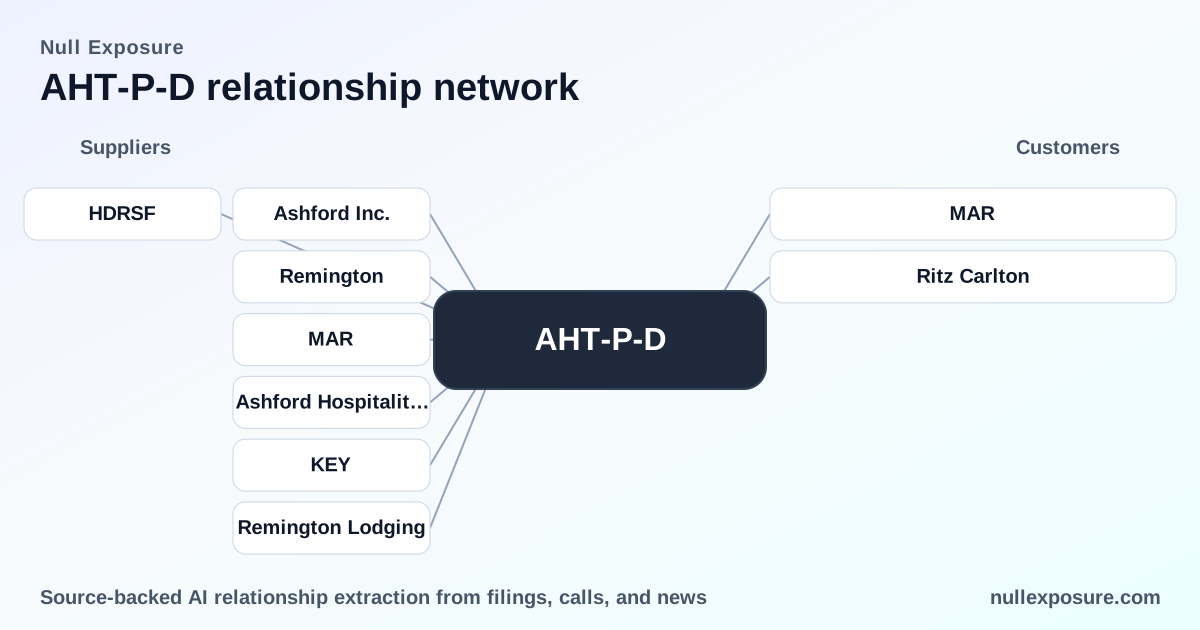
AHT-P-D: A focused income play tied to hotel operating economics and advisory partnerships
Ashford Hospitality Trust’s 8.45% Series D cumulative preferred (AHT-P-D) is a fixed-income instrument that monetizes exposure to a portfolio of U.S. hotel assets by claiming a priority dividend stream ahead of common equity while relying on the REIT’s operating cash flow and balance-sheet actions to fund distributions. Investors buy AHT-P-D for stable, contractually cumulative dividends and for downside protection relative to common equity, but the security’s practical credit profile is tied to hotel EBITDA, management and advisor relationships, and the company’s ability to refinance or extend secured hotel loans. For an ongoing, relationship-level read on counterparties that move cash flow and operational levers for Ashford, see our more extensive supplier coverage at https://nullexposure.com/.
How AHT-P-D makes money and what drives its payout
AHT-P-D does not run hotels; it collects dividends that are funded by the REIT’s operating cash flow and capital transactions. Primary monetization drivers are hotel operating performance (room rates and occupancy), cost control at managed properties, asset-light balance-sheet actions (sales and conversions), and the financing posture of the REIT. The preferred dividend is cumulative, which gives holders structural priority, but the economic reality is that cash to pay that dividend is generated at the hotel level and controlled through third-party managers and advisors.
Company-level operating signals investors should factor in
- Contracting posture: Ashford operates largely through third-party managers and an external advisor model, which implies a contracting posture that delegates day-to-day operations but centralizes strategic financial decisions.
- Concentration: Revenue and cash flow are concentrated in a portfolio of branded and independent full-service hotels; single-property performance can meaningfully swing consolidated cash flow.
- Criticality: Manager and advisor relationships are critical — cost reductions or changes in management contracts directly affect hotel-level EBITDA and preferred dividend coverage.
- Maturity and transition risk: The business is mid-to-late cycle in terms of portfolio maturation, and recent executive transitions and loan extensions indicate active balance-sheet management rather than static maturity.
If you want a concise, ongoing view of how these supplier relationships evolve for Ashford, review our supplier intelligence at https://nullexposure.com/.
What the relationship flow looks like today — a practical read for investors and operators
Below is a relationship-by-relationship review drawn from recent reporting. Each entry is kept short and factual so you can map operational levers to dividend risk.
-
Ashford Inc. (FY2025, Hotel Management) — The REIT continues to coordinate with its property managers and its advisor, Ashford Inc., as part of a “GRO AHT” strategic plan that focuses on portfolio optimization and performance initiatives. According to Hotel Management (March 2026), Ashford Inc. is actively involved in executing cost and performance programs across properties: https://www.hotelmanagement.net/operate/ashford-hospitality-reports-headcount-reductions-remington.
-
Remington (FY2025, Hotel Management) — Ashford’s largest third‑party manager, Remington, implemented property‑level headcount reductions, travel expense cuts, PTO policy changes and reductions in contracted services to lift hotel EBITDA. Hotel Management reported these actions as part of Ashford’s broader push to enhance operating margins (March 2026): https://www.hotelmanagement.net/operate/ashford-hospitality-reports-headcount-reductions-remington.
-
Marriott (FY2026, InsiderMonkey transcript) — Certain properties are being converted to Marriott brands to unlock distribution, loyalty access and higher sales channel penetration; management expects La Concha and Le Pavillon to benefit materially from Marriott’s sales and loyalty platforms. This was discussed on Ashford’s Q4 2025 earnings call in March 2026 and summarized in a transcript at InsiderMonkey: https://www.insidermonkey.com/blog/ashford-hospitality-trust-inc-nyseaht-q4-2025-earnings-call-transcript-1705138/.
-
Ashford Hospitality Advisors, LLC (FY2026, The Globe and Mail) — Ashford Hospitality Advisors, a subsidiary of Ashford Inc., provides advisory and management services to Ashford Hospitality Trust and other REITs, consolidating strategic and financial oversight across advised portfolios. The Globe and Mail noted this advisory structure as part of the company’s 2026 executive updates: https://www.theglobeandmail.com/investing/markets/stocks/AHT/pressreleases/623356/ashford-hospitality-announces-cfo-transition-and-succession-plan/.
-
Key Bank (FY2020, Bisnow) — Historical financing activity shows hotels in the Ashford portfolio obtained PPP-era loan support through Key Bank, evidencing a prior reliance on commercial banking relationships for liquidity at the property level. Bisnow’s 2020 reporting details the loan origination through Key Bank: https://www.bisnow.com/atlanta/news/hotel/ritz-carlton-hotel-indigo-among-ashford-hospitality-atlanta-hotels-to-get-ppp-loans-104108.
-
Remington Lodging (FY2015, Canal Street Beat) — When Ashford acquired Le Pavillon in 2015, Remington Lodging was the property manager, illustrating a longer-term operational partnership between Ashford and Remington-affiliated managers on specific assets. Canal Street Beat covered the acquisition and property management assignment at the time: https://canalstreetbeat.com/le-pavillon-hotel-sold-for-62-5m-to-dallas-firm/.
-
Ashford Inc. (FY2026, StockTitan/press reporting on CFO transition) — Executive-level changes are underway: Ashford Inc.’s CFO will step down from the company’s advised REITs and the company will execute a succession plan while retaining transitional support through June 2026. StockTitan summarized the transition announcement and its timetable in March 2026: https://www.stocktitan.net/news/AHT/ashford-announces-planned-retirement-of-chief-financial-officer-7ronmqqyw9lx.html.
-
Remington (FY2026, InsiderMonkey) — On the earnings call, leadership confirmed a partnership with Remington to reduce allocated corporate expenses and boost property EBITDA, reinforcing that manager negotiations are being used to lift distributable cash flow. The earnings call transcript at InsiderMonkey documents this operational collaboration (March 2026): https://www.insidermonkey.com/blog/ashford-hospitality-trust-inc-nyseaht-q4-2025-earnings-call-transcript-1705138/.
-
Highland (FY2026, GlobeNewswire) — Highland agreed to extend a mortgage loan secured by 18 hotels, indicating lender willingness to provide covenant relief or repayment flexibility on large pools of assets. GlobeNewswire reported on litigation and loan extension context in February 2026: https://www.globenewswire.com/fr/news-release/2026/02/25/3244750/0/en/AHT-Investors-Have-Opportunity-to-Join-Ashford-Hospitality-Trust-Inc-Fraud-Investigation-with-the-Schall-Law-Firm.html.
What these relationships mean for preferred holders and operators
- Operational levers are concentrated in a few managers and an external advisor. That concentration creates both upside through coordinated cost initiatives and downside if a single manager’s performance lags.
- Cost-control actions (headcount, travel, contracted services) are producing near-term EBITDA gains, which directly improve preferred coverage. These are explicit, measurable initiatives cited in management commentary.
- Brand conversions to Marriott are a strategic channel to increase ADR and occupancy; successful conversions materially change revenue per available room economics. That is a value-creation pathway that improves the security’s coverage ratio without capital injections.
- Financing flexibility from banks and mortgage counterparties is a live factor. Debt extensions, like Highland’s mortgage extension, reduce short‑term refinancing risk but concentrate exposure to specific lenders’ decisions.
If you want a periodic brief that tracks these supplier and creditor relationships and their implication for income securities like AHT-P-D, subscribe or visit our research hub at https://nullexposure.com/.
Bottom line: where to position your portfolio
AHT-P-D is a yield-oriented holding whose credit profile is driven by hotel operator performance, advisor-led restructuring, and selective lender accommodations. For investors seeking income, the cumulative dividend and priority claim provide structural protection, but active monitoring of manager performance, conversion success to national brands, and lender negotiations is essential. Operators and asset managers should treat Remington and Ashford Inc./Advisors as the key counterparties that will determine margin recovery and distributable cash flow.
For an ongoing, relationship-focused monitor and supplier intelligence tailored to REIT preferreds and hotel portfolios, return to https://nullexposure.com/ for regular updates and analyst briefings.