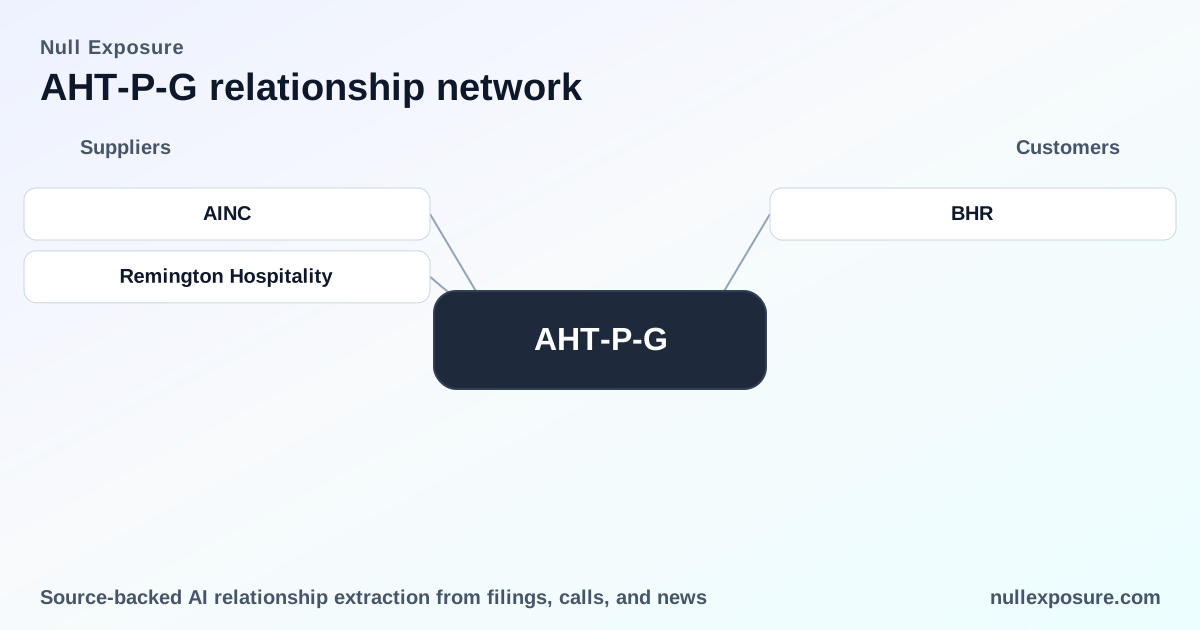
Ashford Hospitality Trust (AHT-P-G): Supplier relationships, governance links, and what investors should price in
Ashford Hospitality Trust’s 7.375% Series G cumulative preferred (AHT-P-G) is an income instrument whose value is tied to the REIT’s operating performance and its management and advisory relationships. The instrument pays a fixed coupon and is backed by a portfolio of hotels that are substantially operated or advised through entities controlled by the same parent group; investors in AHT-P-G therefore monetize yield exposure to a hospitality portfolio plus the governance and cash‑flow waterfall that sits above preferred dividends. Key investment drivers are coupon coverage, the stability of management fees and related‑party arrangements, and the concentration of operations under Ashford-affiliated managers.
If you want a focused supplier relationship view for due diligence, review the original reporting at Null Exposure: https://nullexposure.com/
How AHT-P-G’s operating model translates into cash flow for investors
AHT-P-G is a cumulative fixed-rate preferred (7.375%) whose claim on cash is senior to common equity but subordinated to secured debt and creditors. The instrument’s return to investors depends on three operational levers: hotel revenue performance, management/advisory fees paid to Ashford‑affiliated entities, and the REIT’s dividend policy. The issuer’s public summary highlights a well‑diversified hotel portfolio and an experienced management team as core supports for reliable coupon payments.
From a supplier-relations perspective, the REIT’s contracting posture is dominated by related‑party arrangements: advisory and management contracts with firms controlled by the same ultimate owner. That structure concentrates operational risk and centralizes counterparty exposure, increasing the importance of examining the specific relationships behind property management and advisory fees.
Research supplier and governance disclosures at Null Exposure for detailed document links: https://nullexposure.com/
The concrete relationships you must evaluate
Below are the relationships surfaced in the available reporting and what each means for AHT-P-G holders.
- Ashford Inc. (AINC)
- Ashford Inc. acts as an advisor to Ashford Hospitality Trust and is led by Monty Bennett, who serves as chairman of both boards, consolidating control over strategic direction and advisor engagements. According to The Real Deal coverage of the governance contest, Bennett’s dual roles are central to advisory relationships that influence REIT operations (The Real Deal, article on the proxy fight, May 16, 2024): https://therealdeal.com/texas/dallas/2024/05/16/monty-bennett-survives-proxy-fight-for-now/
- Remington Hospitality
- Remington Hospitality is an operating/management entity owned by Ashford Inc. that manages a number of the REIT’s properties and is explicitly involved in recent operational and PTO/OT changes referenced in reporting; this links property‑level operations directly to a related‑party operator (HotelInvestmentToday, coverage of Ashford Trust operational pivot, FY2025): https://www.hotelinvestmenttoday.com/Financials/REITS/Inside-Ashford-Trust-pivot-to-growing-its-portfolio
Why these relationships matter for preferred‑holders
Related‑party advisory and management agreements are the primary supplier risk for AHT-P-G. If advisory or management fees are excessive, or if related‑party operators underperform operational KPIs, the REIT’s distributable cash flow available to cover fixed preferred coupons will deteriorate faster than would be the case with arms‑length managers. Governance concentration — one executive chairing both adviser and issuer boards — increases the probability that strategic decisions prioritize the parent group’s consolidated interests. That dynamic is a structural counterparty exposure that investors must price into spread and liquidity assumptions.
Key characteristics investors should treat as inherent to the model:
- Contracting posture: Predominantly related‑party advisory/management agreements rather than purely arms‑length third‑party contracts.
- Concentration: High operational concentration under Ashford‑affiliated managers increases single‑point risk.
- Criticality: Management and advisory fee dynamics are critical to distributable cash flow and thus to coupon sustainability.
- Maturity profile: Series G is a cumulative fixed-rate preferred (7.375%); the issuer summary does not disclose a definitive redemption maturity in the provided materials, so treat the security as fixed‑coupon preferred with typical preferred‑stock maturity characteristics unless further issuer documentation states otherwise.
No supplier‑level constraints were provided in the materials reviewed; that absence is itself a company‑level signal about disclosure breadth and should prompt direct diligence on contractual terms.
Practical due‑diligence checklist for allocators
Investors and operators evaluating AHT-P-G should prioritize a small set of questions that directly map to cash‑flow and governance risk:
- Review the advisory and management agreements with Ashford Inc. and Remington Hospitality for fees, termination rights, and performance covenants.
- Quantify how much of hotel net operating income is paid to Ashford‑affiliated entities and the sensitivity of coupon coverage to a downswing in RevPAR.
- Examine board composition and related‑party voting mechanics to assess how quickly strategic changes can be implemented that affect cash distributions.
- Request historical coverage ratios and any covenant protections for Series G payment priority.
For deeper supplier‑level documents and direct links to filings and reporting, use Null Exposure as your research hub: https://nullexposure.com/
Final takeaways and investor action items
AHT-P-G offers a high fixed coupon, but that yield is conditioned on a REIT operating model with concentrated related‑party management and advisory exposure. The most material counterparty risks are Ashford Inc.’s advisory role and Remington Hospitality’s operating control of properties — both are explicitly cited in recent coverage and require direct contractual review. There are no supplier constraints disclosed in the available feed, which elevates the importance of primary‑document diligence.
If you are allocating to AHT-P-G, prioritize document review and active engagement with issuer disclosures; for a consolidated supplier and governance analysis, start your review at Null Exposure: https://nullexposure.com/
Bold, focused, and document-driven oversight of these supplier relationships will determine whether the coupon is compensation for controllable operational risk or a premium for concentrated governance exposure.