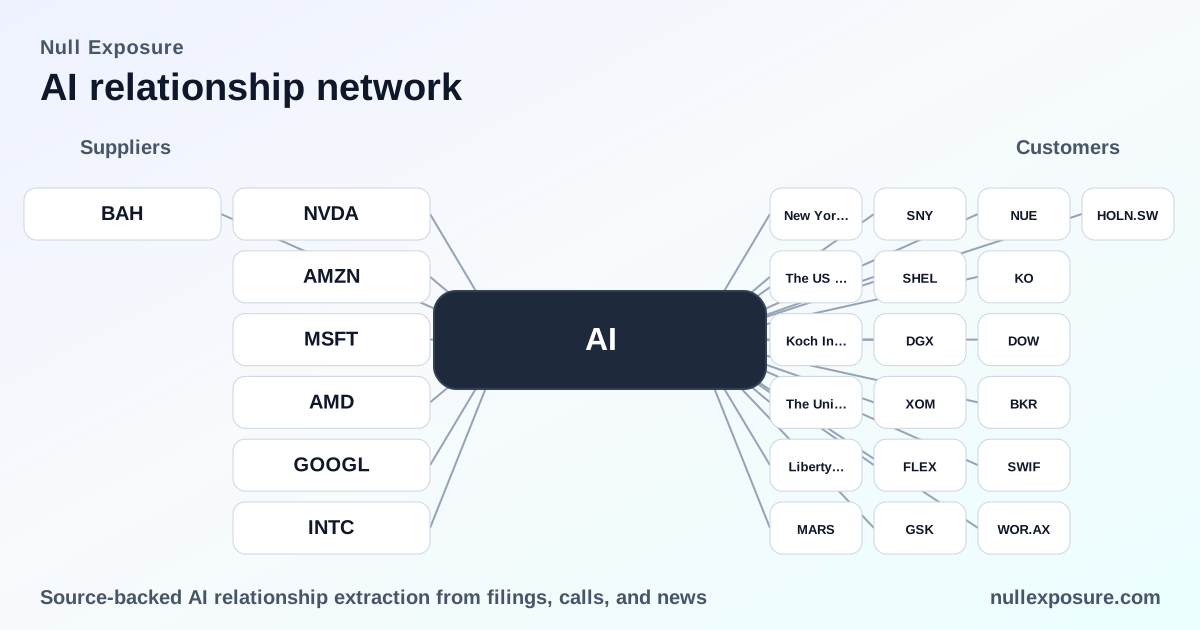
C3.ai (AI): supplier relationships that shape delivery, cost and growth
Thesis: C3.ai operates enterprise AI applications and monetizes through software subscriptions, cloud hosting and professional services, delivered globally through a mix of hyperscaler partnerships and systems integrators. Management frames its go-to-market and delivery model around long-term cloud and services commitments and strategic alliances that reduce time-to-deploy for large enterprise and federal customers. For investors, the core trade-off is clear: partner-driven scale and preferred-position wins against concentrated supplier and cloud hosting cost exposure.
If you want a concise supplier-risk briefing and strategic signals on C3.ai’s partner posture, start here: https://nullexposure.com/
What management said on the call: the partner roll call that matters
Management described a partner stack that combines silicon vendors, hyperscalers and federal systems integrators. The following are the explicit relationships disclosed on C3.ai’s 2025Q4 earnings call (first reported March 7, 2026), with plain-English takeaways and source notes.
NVIDIA / NVDA
C3.ai groups NVIDIA among its core silicon providers, indicating that GPU supply and vendor roadmap matter for model performance and hosting economics. According to the 2025Q4 earnings call, management listed NVIDIA alongside other chip suppliers as part of the underlying infrastructure. (Earnings call, 2025Q4, March 7, 2026.)
AMD / AMD
AMD is named in the same class as other processor suppliers, signaling that C3.ai runs on multiple GPU/CPU technologies rather than a single-vendor stack. Management explicitly referenced AMD as one of the silicon providers. (Earnings call, 2025Q4, March 7, 2026.)
Intel / INTC
Intel is likewise cited among the company’s silicon providers—another indicator of multi-vendor hardware dependency for compute capacity. (Earnings call, 2025Q4, March 7, 2026.)
AWS / AMZN
Management said it has formed partnerships with AWS as part of the company’s hyperscaler strategy, placing Amazon Web Services among the platforms C3.ai uses to host and distribute its applications. (Earnings call, 2025Q4, March 7, 2026.)
GCP / GOOGL
Google Cloud Platform is listed alongside AWS and Azure as a partner in the company’s multi-cloud approach, reflecting a strategy of broad hyperscaler coverage for customer deployments. (Earnings call, 2025Q4, March 7, 2026.)
Azure / MSFT
C3.ai reported a strategic partnership with Azure, with management noting that Azure recognized C3’s enterprise AI applications as preferred solutions—an explicit commercial endorsement that supports go-to-market and joint sales motion. (Earnings call, 2025Q4, March 7, 2026.)
Booz Allen / BAH
C3.ai disclosed partnership activity with Booz Allen in the federal space, highlighting an integration channel and sales conduit into government and defense-related customers. (Earnings call, 2025Q4, March 7, 2026.)
Operational constraints and what they signal about the business model
C3.ai’s filings and comments surface several structural characteristics that inform supplier and operational risk.
-
Long-term contracting posture: As of April 30, 2025, the company disclosed remaining purchase commitments of $427.5 million related to cloud hosting and associated services, and $111.5 million related to professional services due over the next one to five years. This is a company-level commitment that creates predictable delivery continuity but also fixes a material share of near-term cost base. (Company disclosure, April 30, 2025.)
-
Global delivery footprint: C3.ai serves customers from third‑party data center hosting facilities in the United States, Asia and Europe, which signals geographic diversification of hosting but also expanded compliance and operational complexity. (Company disclosure.)
-
Third‑party service provider model: The company uses third parties to deliver services and to process employee, partner and customer information—including potentially sensitive categories—making service providers a critical operational control point. (Company disclosure.)
-
Services-heavy contractual mix: The firm’s contractual obligations are dominated by non‑cancellable purchase commitments for cloud hosting and professional services, underlining that services are central to the commercial model rather than being incidental. (Company disclosure.)
Taken together, these constraints show a supplier posture that is strategic and committed: management locks in cloud and services relationships for scale and performance, accepts the fixed-cost implications, and relies on hyperscalers and systems integrators to reach enterprise and federal buyers.
If you want a deeper supplier-risk and dependency assessment tied to these signals, see our analysis hub: https://nullexposure.com/
Investment implications — what to watch next
-
Operating leverage vs. supplier concentration. Long-term hosting commitments smooth operations but raise exposure to hyperscaler pricing and silicon availability. Unexpected cost increases at major cloud partners could compress margins quickly given the size of the commitments.
-
Channel- and partner-driven revenue growth. The Azure strategic designation and Booz Allen federal channel position are positive demand signals: preferred partnerships accelerate enterprise adoption and federal procurement cycles.
-
Operational risk and compliance. Multi-region hosting plus third‑party processing increases the surface area for regulatory and security risk, which is material given enterprise and federal customers’ requirements.
-
Maturity of go-to-market. The blend of strategic hyperscaler alignment and federal systems‑integrator partnerships suggests C3.ai has moved beyond early‑stage proof-of-concept selling to scaled deployments; that improves predictability but also ties growth to the execution of partners.
Use these factors as a checklist when modeling costs, margin sensitivity and partner revenue ramp.
Practical next steps for investors and operators
- Reconcile forecasted gross margins with the disclosed $427.5M cloud and $111.5M professional‑services commitments to model downside scenarios under rising cloud costs.
- Monitor the Azure partnership for co-selling metrics, and track federal award activity with Booz Allen as a leading indicator of public-sector revenue.
- Review vendor concentration exposure to NVIDIA, AMD and Intel for compute supply risk and procurement timing.
For a supplier-focused briefing and scenario analysis tailored to AI vendors and enterprise adopters, visit our research portal: https://nullexposure.com/
Conclusion: C3.ai’s supplier footprint is explicit and strategic—hyperscalers and silicon vendors underpin delivery while system integrator partnerships unlock channels. The business benefits from preferred‑provider relationships and long-term hosting agreements, but those same arrangements concentrate operational risk and create margin sensitivity to external vendor pricing. For investors, the critical questions are whether partner-driven demand offsets supplier cost exposure and how management manages contract renewals and vendor concentration going forward.
Explore our full supplier-risk coverage and scenario models: https://nullexposure.com/