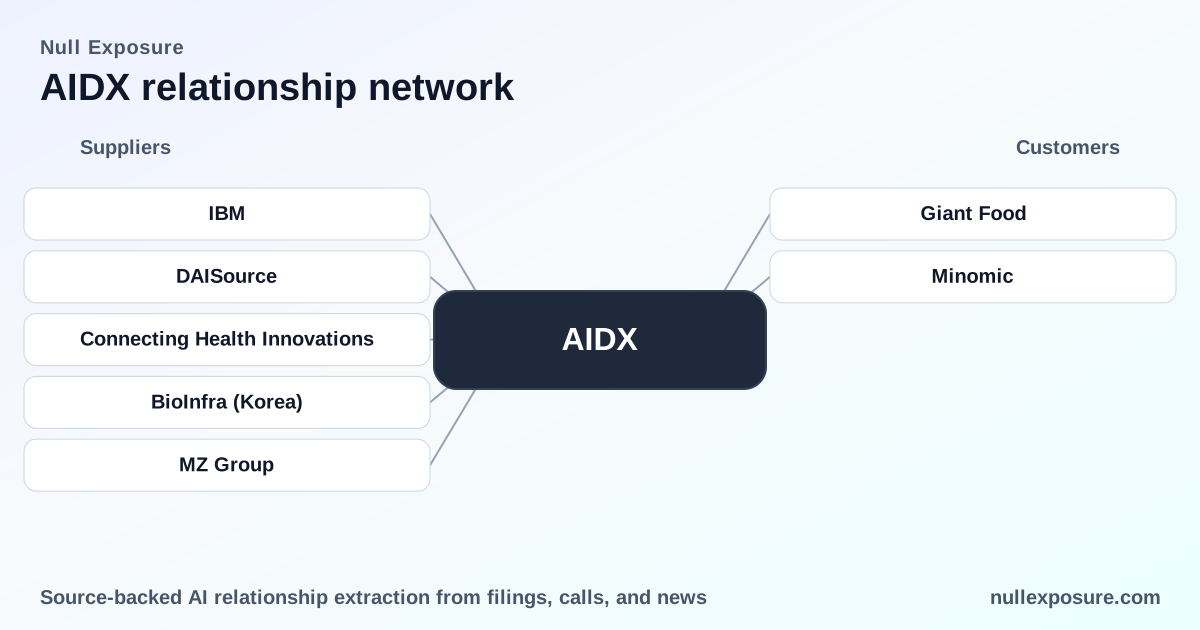
AIDX supplier map: what investors need to know about partner risk and commercial leverage
20/20 BioLabs (ticker AIDX) sells AI-enabled diagnostic and longevity testing services built by bundling laboratory panels, algorithms, and enterprise AI tooling. The company monetizes through diagnostic test sales, partnerships with retail and clinical channels, and by licensing or embedding third-party AI and analytics services into its OneTest product. Revenue upside depends on channel distribution and the commercial depth of technology partners such as IBM and regional laboratory suppliers. For deeper supplier intelligence and verification, visit https://nullexposure.com/ for primary-source consolidation and relationship tracking.
Quick take: an operational snapshot for allocators
20/20 BioLabs structures its product as a composite service: lab chemistry and panels from specialty clinical partners, algorithms and risk models sourced from third-party collaborators, and enterprise AI capacity provided by major platform vendors. This is a partner-centric operating model where vendor performance directly affects product quality and go-to-market scalability. The public footprint in FY2025–FY2026 shows multiple named collaborators but no single disclosed exclusive supplier relationship in the available disclosures, so investors should treat supplier continuity and contract terms as active monitoring items.
The supplier roster, partner-by-partner
IBM — enterprise AI backbone
20/20 BioLabs leverages IBM’s watsonx.ai as the AI engine to calculate chronic disease risk scores within its OneTest for Longevity offering; the relationship is framed as a capability integration rather than an equity tie. IBM supplies critical AI tooling that underpins the product’s analytics and clinical risk outputs. According to a GlobeNewswire press release in February 2026, the OneTest solution uses IBM watsonx.ai to analyze and present individual risk for conditions such as diabetes and cardiovascular disease.
DAISource — systems integrator for AI delivery
DAISource is cited as a partner that helped deploy enterprise-grade AI capabilities from IBM, enabling a scalable and secure solution for OneTest. DAISource functions as the implementation and deployment partner that translates platform capability into a production-grade clinical service. Company statements in a late-February 2026 release recount management commentary crediting DAISource for bringing the vision to life.
Connecting Health Innovations — wellness and guidance channel partner
Connecting Health Innovations is listed among strategic collaborators providing longevity guidance tied to the company’s diagnostics offering, positioning it as a content/clinical guidance partner that supports downstream user engagement. This partner amplifies the product’s behavioral and care-guidance layer rather than the lab analytics. A TradingView news item (FY2025 coverage) cataloged Connecting Health Innovations as a provider of DII-based longevity guidance for the business.
BioInfra (Korea) — premium panel and algorithm supplier
BioInfra (Korea) is described as a source for premium laboratory panels and algorithms, which indicates the company relies on specialized lab capabilities sourced offshore for at least a portion of its test menu. BioInfra supplies test chemistry and algorithmic inputs that feed the OneTest result set. A TradingView summary from FY2025 lists BioInfra among partners supplying premium panels and algorithms.
MZ Group — investor relations and public outreach
MZ Group appears in investor relations contact lines for press and investor briefings, serving as the retained PR/IR vendor to manage market communications. This is a non-technical but operationally important supplier that shapes investor perceptions and consistency of disclosures. A GlobeNewswire investor-webinar notice in February 2026 included an MZ Group contact for investor relations.
What these relationships collectively signal about the business model
- Contracting posture: 20/20 BioLabs operates through multiple short-to-medium term commercial partnerships rather than vertically integrated ownership of the full value chain; this amplifies speed to market but increases vendor dependency on execution quality.
- Supplier concentration: Public disclosures name multiple partners across AI, labs, and guidance, indicating diversified supplier categories, though the data does not reveal volume concentration by supplier — a key due diligence gap for investors.
- Criticality: Platform vendors like IBM are mission-critical because they supply the analytics core; lab panel suppliers are equally critical for clinical validity. Any disruption in AI tooling, algorithm licensing, or lab supply would have immediate product impact.
- Maturity and measurability: Partnerships are recent (FY2025–FY2026), framed publicly as collaborations and integrations; maturity is early, and long-term contract terms, SLAs, and exclusivity are not disclosed in the materials reviewed.
Because the constraints dataset for AIDX contains no explicit supplier contract constraints, treat these as company-level signals: public reporting emphasizes partnerships and integrations over long-term, disclosed supplier contracts. That absence is itself meaningful — it signals limited public visibility into contractual protections for continuity, pricing, and exclusivity.
Key investment implications and risk checklist
- Execution risk is concentrated in vendor delivery. IBM’s watsonx.ai and BioInfra’s panels are core inputs; investor returns depend on these vendors’ availability, performance, and commercial terms. (Source: GlobeNewswire Feb 2026; TradingView FY2025.)
- Operational leverage is partner-dependent. DAISource and Connecting Health Innovations add distribution and deployment capability, but they are service partners rather than revenue owners — a model that supports rapid scale but reduces capture of downstream margins. (Source: GlobeNewswire; TradingView.)
- Disclosure gaps create follow-up priorities. The public record shows named partners but does not disclose contract length, pricing, or exclusivity — request these in diligence. For primary-source consolidation and supplier diligence tools, visit https://nullexposure.com/ and see supplier mapping resources.
Practical next steps for investors and operators
- Request copies of master services agreements with IBM and BioInfra or at minimum confirm SLA terms and termination triggers.
- Validate the data governance and validation processes DAISource used for IBM deployment to ensure regulatory and clinical compliance.
- Confirm commercial alignment with Connecting Health Innovations for revenue sharing and retention economics.
For a consolidated supplier intelligence view, sourcing primary documents and historical press coverage in one place accelerates due diligence; find further resources at https://nullexposure.com/.
Bottom line
20/20 BioLabs sells a composite diagnostic product dependent on a small set of named partners for AI, lab panels, and clinical guidance. The partnership structure enables rapid productization but concentrates operational risk in a few critical vendors. Investors should prioritize contract-level diligence on AI platform usage rights, lab sourcing arrangements, and SLAs to convert the partnership narrative into investable, de-risked economics. For ongoing monitoring of supplier relationships and primary-source summaries, visit https://nullexposure.com/.