AIFF supplier profile: what investors need to know
AIFF commercializes an EEG/ERP analytics platform and related services (the BNA Platform) and funds operations through a mix of software/service revenue, consulting engagements, and equity-for-services arrangements. The company positions itself as a hardware-agnostic analytics provider for brain biomarker discovery and supplements product commercialization with targeted consulting and strategic credit arrangements that convert vendor services into equity. Visit the Null Exposure homepage for ongoing supplier intelligence: https://nullexposure.com/
How the business converts science into revenue
AIFF sells analytic software and professional services around the BNA Platform, which ingests EEG data from third‑party, FDA‑cleared hardware and produces analytical reports and biomarkers that can be commercialized or licensed. Monetization comes from software/reporting fees, consulting engagements, and non‑cash strategic arrangements (shares issued in exchange for service credits), creating a hybrid cash and equity-funded operating model that compresses near‑term cash needs but raises questions about dilution and supplier economics.
Key operating characteristics follow from the company disclosures:
- Contracting posture: a mix of long‑term employment arrangements and master services agreements alongside shorter consulting engagements, indicating deliberate use of both stable and flexible cost structures.
- Concentration and criticality: the platform is hardware-agnostic (AIFF does not manufacture EEG hardware), making the company dependent on third‑party hardware and compute partners for scale-out performance.
- Maturity and stage of relationships: active MSAs and employment contracts sit alongside tactical short-term consultancies, signaling a company in commercial roll‑out and capability building rather than stable, vertically integrated operations.
Explore supplier signals and relationship mapping at Null Exposure: https://nullexposure.com/
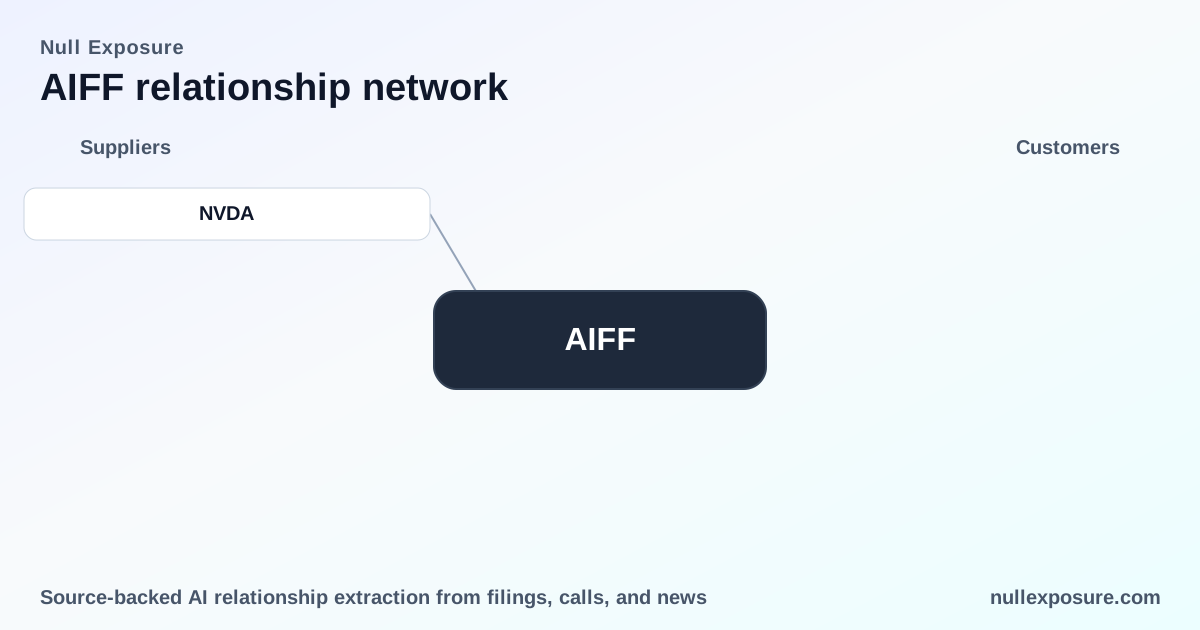
The headline supplier relationship investors should track: NVIDIA
AIFF is leveraging high‑performance GPU compute to accelerate next‑generation EEG/ERP processing and foundation‑model work. A March 4, 2026 news report quoted Firefly’s CEO describing deployment of NVIDIA L40S GPU acceleration to power EEG/ERP processing and to accelerate foundation‑model development for cognitive biomarkers. This relationship is a compute partnership: the company draws on NVIDIA’s GPU acceleration to scale model training and inference, which materially affects time‑to‑insight and cost structure. (Source: Sahm Capital news report, March 4, 2026 — https://www.sahmcapital.com/news/content/firefly-neuroscience-skyrockets-brain-scan-breakthrough-fuels-rally-2026-03-04)
Other named supplier and advisory relationships disclosed in filings
Investors should track not just raw compute but the service and advisory ecosystem that supports AIFF’s commercialization. The company’s SEC and company filings list several service providers and personnel arrangements that underpin operations:
-
Deel, Inc.: AIFF entered a master services agreement with Deel for consulting services, indicating an ongoing framework engagement rather than a one‑off contract; the MSA was disclosed in the June 27, 2024 filing. This is a framework relationship that creates a repeatable supplier channel for consulting support. (Source: Company filing, June 27, 2024)
-
ElMindA Ltd. / Stephen Purcell: AIFF previously retained ElMindA under a consulting agreement that placed Stephen Purcell as Project Coordinator and later Chief Financial Officer, showing the company uses consultant relationships for executive‑level functions. (Source: Company disclosure; appointment timeline included in filings)
-
Paul Krzywicki: A consulting agreement commencing November 13, 2023 positioned Krzywicki as controller with a short‑notice termination provision (15 days), demonstrating tactical use of short‑term consulting for finance functions. (Source: Consulting agreement excerpt, 2023 filing)
-
Employment agreements (e.g., Greg Lipschitz, Gil Issachar): The firm has written employment agreements for key executives, including a three‑year initial term for Greg Lipschitz starting January 6, 2025, with an automatic one‑year renewal unless terminated. These long‑form employment contracts anchor leadership stability during commercialization. (Source: Employment agreement excerpt, contract language in filings)
-
Strategic investment/service‑credit arrangements: AIFF executed four standalone strategic investment agreements where the company issued 433,360 shares in exchange for $2,925 in service credits to be consumed in the future, highlighting a willingness to convert equity for supplier services and to conserve cash through non‑cash consideration. (Source: Company filing disclosure on strategic investment agreements)
What these relationships mean for investors (constraints interpreted as signals)
Read the contract excerpts as behavioral signals about AIFF’s operational choices rather than isolated facts. From those excerpts, derive these company‑level operating implications:
-
Contract mix balances stability and flexibility. Long‑form employment deals for key executives provide leadership continuity, while short‑term consulting agreements enable rapid changes to expense profiles and staffing levels. The company deliberately blends fixed leadership commitments with variable cost suppliers.
-
Framework MSAs indicate scalable supplier sourcing. The Deel master services agreement suggests AIFF prefers reusable contracting vehicles for recurring advisory work, reducing negotiation friction and accelerating onboarding of external capability.
-
Equity for services reduces cash burn but increases dilution risk. Issuing shares for service credits preserves liquidity and secures supplier engagement, yet it signals reliance on equity to fund operations and could compress per‑share economics over time.
-
Hardware‑agnostic platform increases supplier dependence and optionality. AIFF’s BNA Platform does not manufacture EEG hardware, meaning integration and supplier selection for hardware and compute become critical levers for performance, cost, and time‑to‑market.
-
Active relationship posture. Multiple active consulting contracts and MSAs disclosed in 2023–2024 indicate an operational focus on execution and scale rather than sole reliance on in‑house development.
Investment implications and risk checklist
-
Upside: Access to NVIDIA L40S compute materially accelerates model development timelines and could improve product differentiation if AIFF successfully leverages GPU acceleration to create defensible biomarkers. (Source: March 2026 press coverage)
-
Downside: Equity‑for‑services and short‑term consulting create dilution and turnover risk—monitor the pace of future equity issuances and the mix of cash vs. non‑cash supplier payments. (Source: Company filing disclosures on strategic investment agreements and consulting arrangements)
-
Operational risk: Hardware‑agnostic positioning reduces capital intensity but increases dependency on external hardware and compute vendors; vendor pricing or availability changes could directly affect margins and delivery timelines.
For a deeper supplier risk scorecard and to map counterparty exposure across compute, consulting, and hardware suppliers, visit Null Exposure: https://nullexposure.com/
Final recommendation
AIFF operates as a software‑first, services‑supported commercializer of EEG analytics and is actively building its execution stack through a mix of compute partnerships (notably NVIDIA) and diversified consulting relationships. Track GPU and compute commitments, the cadence of equity‑for‑services transactions, and the renewal terms of framework MSAs as the three highest‑impact indicators for revenue scalability and shareholder dilution. For ongoing monitoring and comparative supplier analytics, explore the full supplier intelligence suite at Null Exposure: https://nullexposure.com/