AIFU supplier relationships: what investors need to know
AIFU operates as a commercial supplier that captures value through contracted services and administrative arrangements with corporate counterparties; the company monetizes via recurring service fees and transaction-related charges embedded in those contracts. For investors evaluating exposure and counterparty risk, the supplier roster and any contract-level constraints are the primary lens to judge concentration, operational criticality, and vendor leverage. For a quick dive into the live supplier signals for AIFU, see NullExposure’s homepage for ongoing coverage: https://nullexposure.com/.
A single visible counterparty — why it matters
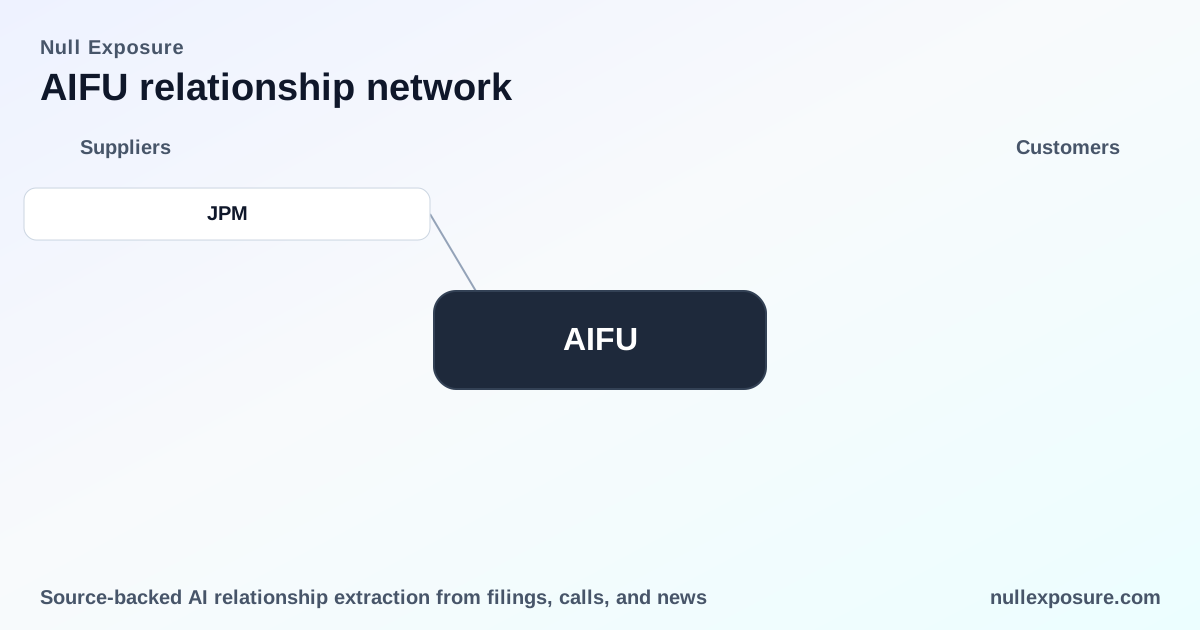
The current NullExposure results identify a single counterparty relationship for AIFU: JPMorgan Chase Bank, N.A. That relationship is limited in the public signal set but is operationally meaningful because it involves depositary services tied to an ADR/ADS program. According to a StockTitan news item in March 2026, ADS holders must act through JPMorgan Chase Bank, N.A., the depositary of Fanhua’s ADS program, to exercise their voting rights (StockTitan, March 2026: https://www.stocktitan.net/news/FANH/). Key takeaway: the relationship is administrative and legally material to ADS holders’ voting mechanics.
JPMorgan Chase Bank, N.A. — what the market signal says
JPMorgan Chase functions as the depositary for an ADS program referenced in the available signal. This creates a channel through which holders execute voting and other depositary-limited actions, making JPMorgan a gatekeeper for ADS procedural rights (StockTitan, March 2026: https://www.stocktitan.net/news/FANH/). For investors, that elevates JPMorgan from a simple supplier to a participant with procedural control over certain shareholder entitlements.
What the supplier list and constraints (or lack thereof) reveal about AIFU’s operating model
NullExposure returned no explicit constraint records tied to AIFU’s supplier relationships in the current pull. That absence is itself an informative company-level signal: it indicates there are no publicly flagged contract terms or supplier-imposed limits in the system that have been captured and tagged as constraints.
- Contracting posture: With a single public supplier linkage of administrative nature, AIFU’s contracting posture looks targeted and operational rather than broad procurement-driven. Depositary and custodial arrangements are typically standardized, favoring clear legal terms over bespoke operational risk.
- Concentration: The visible supplier footprint is concentrated: one high-capability counterparty dominates the public signal set. Concentration increases the importance of that relationship for continuity of ADS mechanics and shareholder interactions.
- Criticality: The relationship is functionally critical for ADS holders because it controls execution of voting rights through the depositary channel. That elevates operational risk if the depositary relationship encounters disruption.
- Maturity: Depositary relationships are typically mature and governed by longstanding market norms and regulatory frameworks; however, the public signal set provides no additional maturity metrics (no constraints were flagged), so investors should verify contract vintage and termination provisions in diligence.
Where to focus due diligence for investors and operators
Given the narrow supplier signal, investors and operational teams should concentrate on a few targeted areas:
- Confirm the legal status and scope of the depositary agreement: termination triggers, transferability, and processes for emergency transitions.
- Assess operational SLAs and escalation paths for shareholder services (voting, transfers, claims) and whether contingency provisions exist.
- Quantify concentration risk and scenario-plan for loss or change of the depositary relationship, including time-to-replace and costs.
- Validate document-level constraints that might not surface in high-level public signals—look for contractual indemnities, exclusivity periods, and fee adjustment mechanics.
For continuous monitoring of supplier signals and to integrate findings into investment workflows, visit: https://nullexposure.com/.
Relationship-by-relationship review (complete)
- JPMorgan Chase Bank, N.A.: The public signal identifies JPMorgan as the depositary for an ADS program, with ADS holders required to act through the bank to exercise voting rights — a procedural gatekeeper role that is operationally important for holders (StockTitan news, March 2026: https://www.stocktitan.net/news/FANH/).
Strategic implications and recommended actions
- Operationally critical supplier: Treat JPMorgan as a high-priority counterpart in vendor-management frameworks because of its role in ADS mechanics.
- Concentration-driven risk: If additional supplier relationships remain undisclosed, the current public picture underweights potential diversification — demand contract-level transparency in diligence.
- No public constraints flagged: The absence of explicit constraints in NullExposure results should not be interpreted as a full clean bill of health; it is an information signal that requires follow-up document review.
Investors and risk teams should incorporate these signals into covenant checks, governance reviews, and remediation playbooks. For a monitoring cadence that tracks changes to supplier status and constraint posture, see NullExposure’s coverage hub: https://nullexposure.com/.
Final thought
This snapshot of AIFU’s supplier footprint shows a narrow but materially scoped relationship that is operationally consequential for ADS-holder rights. The concentration around a major depositary raises straightforward questions about continuity planning and contractual protections; these are practical items for any investor or operator’s due diligence checklist. For automated monitoring and deeper relationship analytics, go to NullExposure and link this supplier view into your investment risk processes: https://nullexposure.com/.