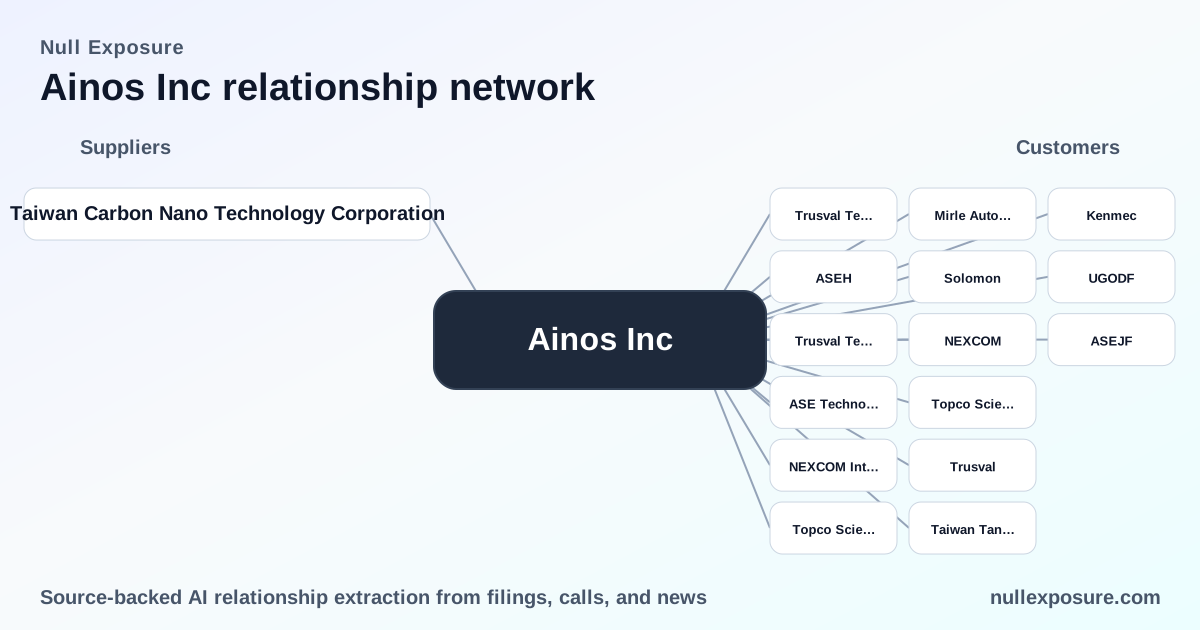
AIMD: A supplier nexus anchored in Taiwan Carbon Nano Technology
AIMD monetizes by commercializing point-of-care testing (POCT) products and AI-driven diagnostic tools while outsourcing core manufacturing and intellectual property critical to those products. The company captures margin through product sales and technology commercialization, but its operating model is tightly integrated with a single supplier-licensor that provides both manufacturing capacity and patent assets. This concentration defines AIMD’s capital efficiency and its principal operational risk profile. For a deeper supplier-risk view, visit https://nullexposure.com/.
How AIMD’s operating model actually works
AIMD operates as a thin, innovation-led commercialization platform: it develops AI Nose and POCT offerings and relies on third parties for production, regulatory-grade manufacturing processes, and foundational patents. That model preserves cash and shortens time-to-market but cedes control of key inputs—technology and manufacturing—to outside partners.
- The company exchanged equity for an exclusive patent license in 2024, converting intellectual property needs into a non-cash capital allocation that reduced near-term cash outflow.
- Manufacturing is outsourced to the same partner that controls the licensed patents, creating single-supplier concentration across IP and production.
- Reported license payments and multi-year development agreements establish multi-year commitments rather than spot contracts, so supplier relationships are strategic and durable rather than tactical.
If you evaluate supplier concentration as part of investment diligence, this relationship profile is high priority. Explore supplier exposure analytics at https://nullexposure.com/ for a compact assessment.
Relationship rundown: Taiwan Carbon Nano Technology Corporation
Taiwan Carbon Nano Technology Corporation (TCNT) is AIMD’s principal supplier and licensor. According to AIMD’s disclosures as of December 31, 2024 and supporting press coverage in early 2026, TCNT both manufactures POCT/COVID-19 antigen kits sold by AIMD and granted AIMD an exclusive, perpetual license to patents tied to gas sensors and medical devices in August 2024; the license was exchanged for 5,500,000 shares of AIMD common stock. (Company filings, year-end 2024; Quartz report March 9, 2026.)
Contract architecture and what it implies for investors
AIMD’s public disclosures and contract excerpts reveal a coherent set of commercial choices that shape both upside and downside.
- Long-term and licensing posture. AIMD entered a five-year Product Development Agreement effective August 1, 2021, and on August 6, 2024 executed a patent license agreement with TCNT that is exclusive, irrevocable, and perpetual for specified patents. These are not temporary supplier arrangements; they are structural commitments that lock in technology access and manufacturing dependencies. (Company disclosures referencing Product Development Agreement and License Agreement; August 2021 & August 2024.)
- Multi-role counterparty increases operational coupling. TCNT functions as manufacturer, licensor, and service provider—providing facilities, mass production process technology, ISO9001/ISO13485 management, and addendum-level co-development—so AIMD’s product roadmap and quality controls are tightly coupled to TCNT’s capabilities. (Addendum Agreement, January 9, 2024; manufacturing service agreement, August 28, 2023.)
- Concentration is critical. Disclosures state the company “relies on TCNT to manufacture or develop POCT products” and flag concentration risk on a sole supplier; this elevates operational and supply-chain risk in any stress scenario. (Company filing, December 31, 2024.)
- Measured cash outlay but meaningful equity transfer. AIMD paid $1,005,000 (plus indirect tax) of license fee to TCNT as of December 31, 2024 and issued 5,500,000 shares as part of the patent license exchange—illustrating a financing tradeoff that conserves cash while diluting equity. (Company disclosures, year-end 2024.)
- Geographic footprint and political-economic context. The counterparty sits in APAC and is effectively a controlling shareholder via interests in Ainos KY, which concentrates governance influence alongside manufacturing and IP control—an institutionally significant tie between corporate control and supplier role. (Company filings, December 31, 2024.)
Practical investor implications
- Operational dependency: Any disruption at TCNT would directly affect AIMD’s ability to manufacture and commercialize POCT products; contingency planning and second-source feasibility are material to valuation.
- Governance and related-party risk: TCNT’s controlling-shareholder status through Ainos KY implies related-party dynamics; investors should examine transaction terms and minority protections closely.
- Dilution vs cash preservation: The equity-for-IP exchange reduced near-term capital needs but increases share count; future returns depend on successful commercialization of the licensed patents.
- Regulatory and quality leverage: TCNT’s ISO9001/ISO13485 capabilities are a competitive advantage, but also create a dependence on that specific compliance infrastructure for regulatory filings and market acceptance.
Bright spots and value levers
AIMD’s arrangement accelerates commercialization without heavy capex. By outsourcing manufacturing and securing perpetual patent rights, AIMD runs a high-operational-leverage model where revenue growth can flow straight to the top line if market adoption accelerates. The flip side: the company’s upside is tightly correlated to supplier execution and the commercial success of the licensed technologies.
Want the supplier risk summarized for your model? See the supplier-risk dashboard at https://nullexposure.com/.
Relationship-by-relationship summary (complete list)
- Taiwan Carbon Nano Technology Corporation — TCNT manufactures AIMD’s POCT/COVID-19 antigen kits, provides mass-production capabilities and ISO-compliant management, and granted AIMD an exclusive, perpetual patent license in exchange for equity and fees; AIMD reported a $1,005,000 license payment and a multi-year product development arrangement with TCNT as of December 31, 2024. (Company filings, Dec 31, 2024; Quartz, March 9, 2026.)
What investors should ask management next
- Provide a prioritized timeline for second-source qualification and the cost to migrate manufacturing if needed.
- Clarify commercial milestones tied to the August 2024 license and the governance arrangements given TCNT’s controlling-shareholder status.
- Disclose scenario analysis quantifying revenue disruption for a 3–6 month production outage at TCNT.
Final takeaways and action checklist
- Concentration equals both cost-efficiency and single-point risk: AIMD runs a capital-light commercialization strategy that depends on TCNT for IP and manufacturing; that arrangement speeds time-to-market but concentrates operational risk.
- Equity-for-IP trade changes the capital structure: Investors must weigh diluted upside against reduced near-term cash burn.
- Active due diligence required: Focus on contingency sourcing, related-party terms, and regulatory dependencies.
For a compact supplier-risk brief you can use in model stress tests, go to https://nullexposure.com/ and request the AIMD supplier summary.