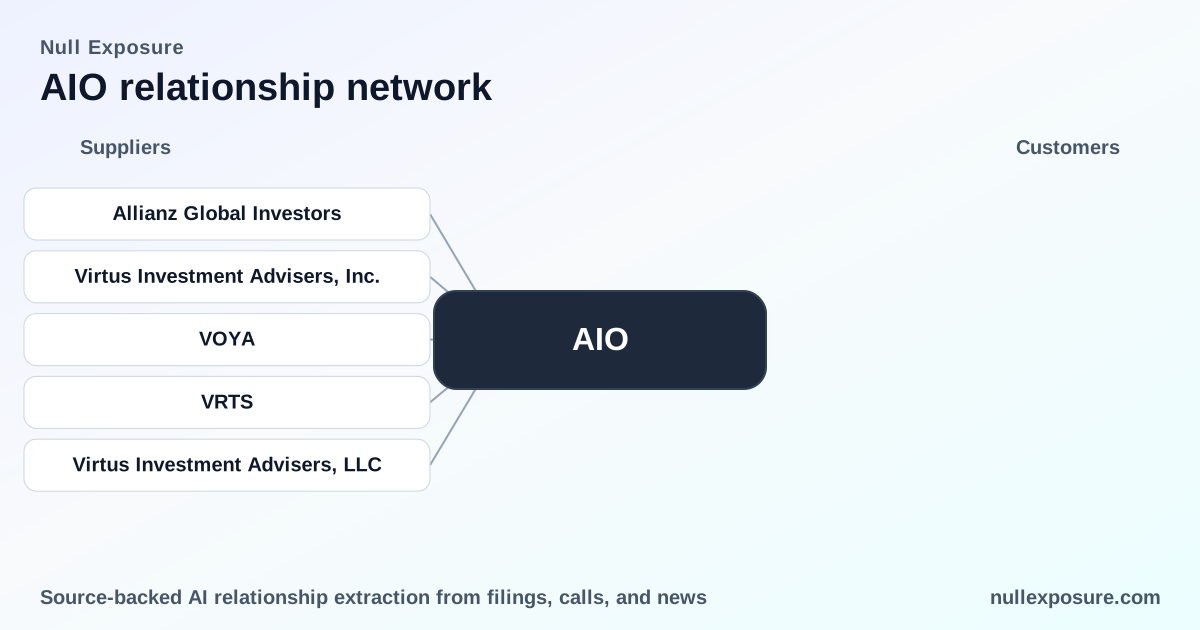
AIO supplier map: whose advisory engine runs the fund and what that means for investors
AIO operates as an investment fund that monetizes through advisory and sub‑advisory fee arrangements and distribution agreements; the economics flow from an appointed investment adviser (Virtus) and third‑party subadvisers that execute the portfolio strategy in return for management and subadvisory fees. For investors and counterparties evaluating operational risk, the supplier roster and its evolution are the primary signals of outsourcing strategy, counterparty concentration, and vendor maturity.
For a full view of supplier relationships and comparable fund supplier maps, visit the NullExposure homepage.
Why the adviser and subadviser roster matters for returns and operational risk
The adviser/subadviser model is standard for funds like AIO, but the details matter: who is appointed as the investment adviser, who is retained as subadviser, and how often those roles rotate determines fee capture, stewardship continuity, and operational resilience. The public record for AIO shows a stable investment adviser with at least one subadviser transition across filings — a structure that concentrates control with the primary adviser while outsourcing implementation to named firms. That structure delivers scale and specialization but concentrates counterparty and reputational risk around the primary adviser.
Supplier roster, relationship-by-relationship
Virtus Investment Advisers, Inc. / Virtus Investment Advisers, LLC
Virtus is documented as the fund’s appointed investment adviser across multiple filings; filings state Virtus Investment Advisers is affiliated with Virtus Investment Partners and occupies the lead advisory role. According to a PR Newswire Section 19a notice (FY2022) and subsequent filings reflected on Yahoo Finance (FY2025–FY2026), Virtus is the named investment adviser to the fund (https://www.prnewswire.com/news-releases/virtus-allianzgi-artificial-intelligence--technology-opportunities-fund-discloses-sources-of-distribution--section-19a-notice-301569952.html; https://sg.finance.yahoo.com/news/virtus-artificial-intelligence-technology-opportunities-212000207.html).
Takeaway: Virtus is the centralized control point for portfolio construction and vendor selection.
Voya Investment Management
Voya Investment Management is listed as a subadviser to the fund in multiple more recent filings (FY2023–FY2026) and press distributions, indicating it executes at least some portion of the fund’s strategy on behalf of Virtus (references include StockTitan and Yahoo Finance filings for FY2024–FY2026; see https://www.stocktitan.net/news/AIO/virtus-artificial-intelligence-amp-technology-opportunities-fund-uxr0mqgzzx1j.html and https://sg.finance.yahoo.com/news/virtus-artificial-intelligence-technology-opportunities-211000580.html).
Takeaway: Voya is a material implementation partner in the fund’s multi‑adviser construct.
Allianz Global Investors
Allianz Global Investors appears in the public record as a subadviser in earlier disclosures (FY2022), per a PR Newswire Section 19a notice that names AllianzGI as a subadviser alongside Virtus as the investment adviser (https://www.prnewswire.com/news-releases/virtus-allianzgi-artificial-intelligence--technology-opportunities-fund-discloses-sources-of-distribution--section-19a-notice-301569952.html).
Takeaway: AllianzGI provided subadvisory execution in earlier periods; later filings show a different subadviser footprint.
What the pattern of relationships signals about AIO’s operating model
-
Contracting posture: The fund uses a lead‑adviser plus subadviser model rather than running portfolio management entirely in‑house, which indicates a deliberate outsourcing posture designed to combine distribution/control (Virtus) with specialized execution (AllianzGI, Voya). This is a modular contracting approach that supports nimble subadviser changes without replacing the lead adviser.
-
Concentration and criticality: Control is concentrated with the primary adviser, Virtus, which is the critical counterparty for governance, strategy and vendor selection. Subadvisers are important for implementation but are replaceable; however, any meaningful adviser disruption at Virtus would be systemically material to the fund’s operation.
-
Maturity and lifecycle: The presence of multiple filings across FY2022–FY2026 showing subadviser names evolving from AllianzGI to Voya signals an operationally mature fund governance that rotates implementation partners by contract or performance, rather than a static single‑vendor dependency.
-
Public constraints and disclosures: The supplier data for AIO contains no recorded contractual constraints or flagged vendor conditions in the dataset provided, which is itself a company‑level signal about the absence of documented public contract frictions in these supplier relationships.
For additional supplier mapping and comparative analytics on adviser/subadviser structures, visit the NullExposure homepage.
Risks and opportunities investors should weigh
-
Counterparty concentration risk sits with Virtus as the investment adviser; investors should prioritize review of adviser governance, succession plans, and oversight of subadvisers. Performance continuity depends on Virtus’s stewardship more than on any single subadviser.
-
Vendor rotation is operationally positive when executed under disciplined governance because it allows the fund to refresh capabilities and capture specialized execution (e.g., shifting from AllianzGI to Voya). That rotation, however, increases short‑term operational change risk around transitions.
-
Fee and revenue capture flows through the adviser/subadviser agreements; investors and operators should review fee schedules and any revenue sharing or distribution arrangements disclosed in Section 19a notices and filings to understand net investor economics.
Practical next steps for investors and operators
-
Request the latest adviser/subadviser contract summaries and confirm the scope of subadvisory mandates (asset bands, discretion, termination rights). Public notices document names and roles but not full commercial terms; a targeted request is necessary.
-
Focus due diligence on Virtus’s internal controls, continuity plans, and oversight mechanisms for subadvisers since those controls are the primary risk mitigant for AIO.
-
Track future Section 19a notices and adviser filings to spot any additional subadviser changes or distribution shifts; use those filings as the leading indicator of execution risk and fee engineering.
For direct access to the supplier mapping service and to run a side‑by‑side comparison with peer funds, go to the NullExposure homepage.
Bold conclusion: AIO’s supplier architecture centralizes governance with Virtus while outsourcing execution to recognized asset managers (AllianzGI historically, Voya more recently); that structure reduces the need for in‑house execution capability but increases the imperative to scrutinize the lead adviser’s governance and transition playbook.