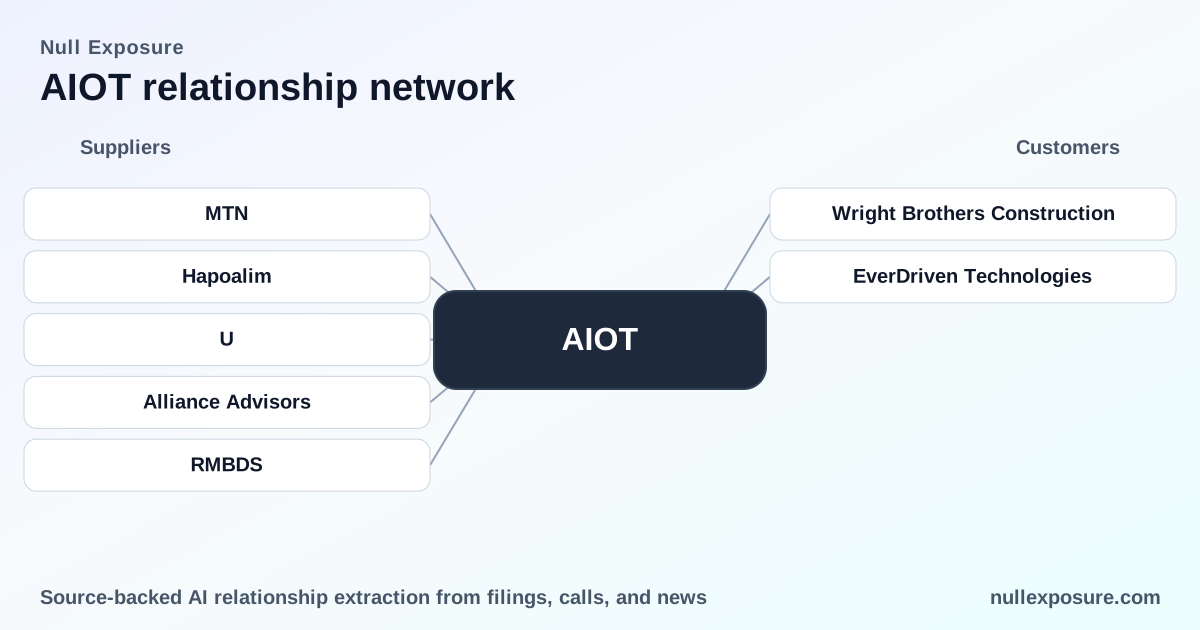
AIOT supplier report: what investors should know about counterparties, contracts and cash flow levers
AIOT operates as a supplier to the fleet-telematics and vehicle-safety ecosystem, monetizing through recurring software and service contracts, the sale of telematics hardware (outsourced to contract manufacturers), and balance-sheet management via syndicated and regional credit facilities that support subsidiaries. Its economic model is driven by subscription revenue and device attach rates, while liquidity and contract terms with network and banking partners are key levers for near-term free cash flow and downside protection.
For a direct look at document-level signals and counterparties, visit the Null Exposure homepage: https://nullexposure.com/
Why counterparties matter for valuation
AIOT’s financial profile is not just product-driven; it is counterparty-driven. Network providers, regional banks and equipment manufacturers determine gross margin and working capital dynamics. The company’s use of amended-and-restated credit agreements and new revolving facilities indicates active balance-sheet optimization, while claw-back clauses with network providers represent an operational risk that can reverse revenue recognition and cash receipts. Investors should treat support from creditors and the stability of network contracts as first-order valuation inputs.
Vendor-by-vendor run-down (concise, source-backed)
-
Mobile Telephone Networks Proprietary Limited (MTN) — Mobile network provider
MTN has contract language that entitles it to claw back payments from MiX Telematics Africa (a subsidiary referenced in the filing) if the agreement is cancelled early or base connections are not maintained, creating a contingent cash outflow risk tied to network uptime and churn. According to the FY2026 10-Q filing posted on StockTitan, this claw-back clause is explicit and contractually enforceable (FY2026, StockTitan: https://www.stocktitan.net/sec-filings/AIOT/10-q-powerfleet-inc-quarterly-earnings-report-b767ede730e0.html). -
Hapoalim — Lender (A&R Credit Agreement)
Powerfleet Israel and Pointer executed an amended and restated credit agreement with Hapoalim that refinanced prior facilities, showing active restructuring of regional debt and consolidation of covenants under a new A&R facility. The company disclosed this refinancing in its FY2026 10-Q (FY2026, StockTitan: https://www.stocktitan.net/sec-filings/AIOT/10-q-powerfleet-inc-quarterly-earnings-report-b767ede730e0.html). -
Unity — Technology integration partner (video/safety intelligence)
AIOT’s automated AI risk intervention module is integrated on Unity’s Data Highway to provide a unified command center for video-based safety intelligence, demonstrating a strategic product partnership that enhances the company’s value proposition for video telemetry and driver safety solutions. This integration was announced in a FY2025 PR Newswire release (FY2025, PR Newswire: https://www.prnewswire.com/news-releases/powerfleet-launches-automated-ai-risk-intervention-module-for-driver-safety-302502822.html). -
Alliance Advisors — Investor relations / IR contact
Alliance Advisors is listed as the investor relations contact for Powerfleet, indicating the company’s outsourced IR support and a formal channel for investor communications. The IR contact details were published in a company investor event notice in FY2025 (FY2025, StockTitan news: https://www.stocktitan.net/news/AIOT/powerfleet-to-attend-december-investor-h7rkjxqxkc1k.html). -
RMB — Lender (New Facilities Agreement)
RMB agreed to provide two revolving credit facilities — a $10 million facility (New RMB Facility A) and a 180,000,000 South African rand facility (New RMB Facility B) — to the company and MiX Telematics, expanding the company’s regional liquidity and signaling reliance on revolving credit to fund operations in South Africa. The New Facilities Agreement was disclosed in the FY2026 10-Q (FY2026, StockTitan: https://www.stocktitan.net/sec-filings/AIOT/10-q-powerfleet-inc-quarterly-earnings-report-b767ede730e0.html).
Operating-model constraints and what they imply
Company-level signals extracted from public filings reveal two structural characteristics:
-
AIOT operates with a service-provider posture: independent audit commentary and formal compliance statements indicate the company engages external professional services and adheres to regulated reporting standards; this confirms typical public-company governance around third-party service providers and audit oversight.
-
AIOT outsources hardware manufacturing to contract manufacturers: the company explicitly delegates its electronics manufacturing to third parties to avoid capital-intensive buildout and to focus on design and software. This lowers fixed-capex but increases operational dependency on contract partners and supply-chain resilience.
These are company-level signals, not statements about any specific counterparty unless explicitly named in the excerpt.
Strategic implications for investors
-
Liquidity and covenant risk are active: the A&R agreement with Hapoalim and the New RMB Facilities indicate management is leaning on credit markets to manage working capital across geographies. For investors, that translates into monitoring covenant schedules and drawdown patterns as early-warning indicators of stress.
-
Network-contract contingent liabilities are material: the MTN claw-back clause creates reverse cash-flow exposure if base connections decline or contracts terminate early. That is a direct operational risk that can compress margins and increase churn-related cash volatility.
-
Product differentiation is anchored by partnerships: the Unity integration strengthens AIOT’s competitive moat in video-based safety analytics, potentially improving device attach rates and average revenue per user if adoption scales.
-
Outsourced manufacturing shapes margin and supply risk: outsourcing reduces capital intensity but increases exposure to supplier lead times, price pass-throughs and quality control. This structure supports flexible gross-margin management but transfers operational risk externally.
Key takeaways: monitor covenant compliance, network contract terms, and hardware supplier performance as the primary drivers of upside and downside in near-term cash flow.
Practical next steps for evaluation
- Review the FY2026 10-Q for covenant language, amortization schedules and any cross-default triggers related to the RMB and Hapoalim facilities (documents referenced above provide a starting point).
- Request a vendor-risk summary from management focusing on contract termination mechanics with MTN-equivalent providers and supplier concentration metrics.
- Assess revenue mix sensitivity to video-based offerings tied to the Unity integration—growth there reduces unit economics dependency on hardware margins.
Bottom line
AIOT’s business is a hybrid of subscription software and outsourced hardware, with financing relationships actively managing regional liquidity and network contracts creating tangible contingent exposures. Investor focus should be on creditor covenants, network claw-back mechanics, and supplier concentration — those three elements will determine near-term free cash flow and the reliability of recurring revenue. For a deeper dossier and tracked document alerts, visit Null Exposure: https://nullexposure.com/