AAR Corp (AIR) — Supplier Relationships That Reprice the MRO Playbook
AAR Corp operates as a specialist parts distributor and maintenance, repair and overhaul (MRO) services provider for commercial and business aviation, monetizing through exclusive OEM distribution agreements, MRO contracts (including power-by-the-hour arrangements), and parts sales tied to high-utilization fleets. Recent disclosures and press activity show a deliberate pivot toward exclusive distribution deals, selective divestitures, and digital partnerships designed to compress lead times and lift margins on higher-value skews.
If you track supplier and partner durability as an investment signal, this update materially changes how to size counterparty and contractual risk for operators and asset managers. For operational counterparties and strategic diligence, see more at https://nullexposure.com/ for a broader supplier-risk view.
What the recent moves signal about strategy and margins
AAR is packaging three levers: (1) capture aftermarket margin via exclusive OEM distribution, (2) outsource and scale component repair selectively to protect PBH economics, and (3) reduce corporate drag through targeted disposals. These initiatives increase margin leverage over time while also concentrating commercial exposure into a smaller set of supplier agreements.
- Distribution and OEM exclusives: The company announced renewals and new exclusive agreements with OEMs and specialized vendors that convert AAR from generalist reseller to preferred channel for certain high-value parts. That structure supports higher gross yields but increases dependency on fewer counterparties.
- Outsourcing of repairs: AAR continues to lean on third-party repair providers to deliver on PBH commitments, which lowers fixed-cost intensity but creates operational dependency on service partners.
- Purchase obligations and capital cadence: Company disclosures record material purchase obligations in FY2026 (aggregate $657.1 million due in 2026), reflecting committed working-capital and supplier funding that will shape near-term cash flow and counterparty exposure.
These are company-level constraints drawn from AAR’s filings and announcements; they are not assigned to any single supplier unless the filing explicitly names that counterparty.
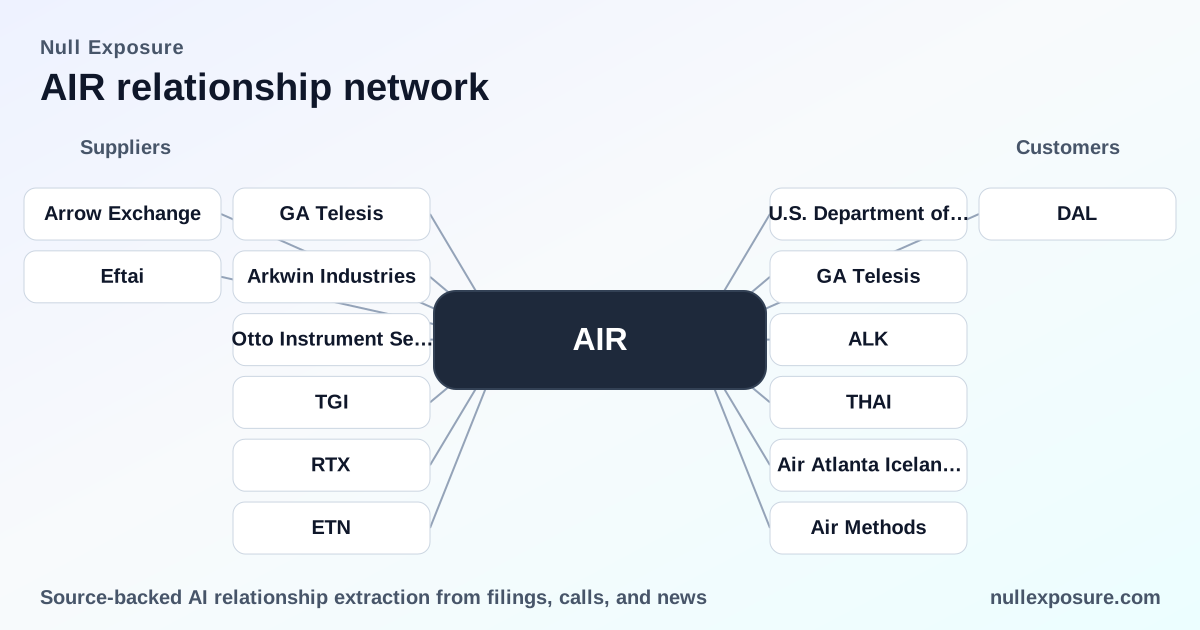
Line‑by‑line: the supplier and partner roster investors must model
Below are the relationships disclosed in the recent filings and press coverage, with a concise plain‑English summary and the cited source for each.
GA Telesis
AAR agreed to divest its Landing Gear Overhaul business to GA Telesis for $51 million, subject to normal post‑closing working capital, cash, and debt adjustments, completing a targeted business simplification step. Source: AAR FY2025 10‑K filing (air‑2025‑05‑31).
Arkwin Industries (unit of TransDigm)
AAR renewed an exclusive contract with Arkwin Industries, reinforcing its position as a preferred commercial channel for certain transducer/nacelle-related OEM product lines. Source: Q2 FY2026 earnings call transcript coverage (InsiderMonkey, March 2026).
Arkwin Industries (JV/distribution mention)
The company publicized joint ventures and distribution agreements that reference Arkwin Industries alongside other OEMs, evidencing multi‑channel OEM partnerships across product categories. Source: StockTitan coverage of AAR announcements (March 2026).
Otto Instrument Service
AAR entered a new distribution and support agreement to sell and support the LASEREF IV inertial reference system for business aircraft, expanding its avionics portfolio in business aviation. Source: AviTrader (Feb 27, 2026).
Otto Instrument Service (additional reporting)
Multiple market outlets reiterated the Otto Instrument Service agreement to emphasize the strategic depth it adds to AAR’s business‑aviation avionics aftermarket. Source: SahmCapital / SimplyWallSt coverage (March 2026).
TRIUMPH (TGI)
AAR began executing an exclusive commercial distribution agreement with TRIUMPH, effective January 5, 2026, to handle actuation parts—an arrangement that channels critical components through AAR’s distribution network. Source: StockTitan announcement (March 2026).
TRIUMPH (actuation parts emphasis)
Press coverage frames the TRIUMPH arrangement as exclusive for actuation parts, reinforcing AAR’s pivot into higher‑value, concentrated OEM distribution deals. Source: StockTitan (March 2026).
Collins Aerospace (RTX)
AAR renewed an exclusive contract with Collins Aerospace, signaling continued reliance on large OEM partnerships to secure parts flow and aftermarket share. Source: Q2 FY2026 earnings call transcript coverage (InsiderMonkey, March 2026).
Collins Aerospace (joint venture reference)
Public disclosures also tie AAR’s joint ventures—such as xCelle Asia for nacelle overhaul services—into its broader business model with OEMs like Collins for integrated MRO and distribution solutions. Source: StockTitan (March 2026).
Eaton (ETN)
Eaton named AAR’s Amsterdam facility as an authorized service center to support Eaton hydraulic components across Europe, the Middle East and Africa, expanding AAR’s service footprint for hydraulic systems. Source: Q2 FY2026 earnings call transcript coverage (InsiderMonkey, March 2026).
Arrow Exchange
AAR announced a partnership with Arrow Exchange to enhance digital supply‑chain capabilities and accelerate secure, commercial aviation supply‑chain connectivity. Source: Q2 FY2026 earnings call transcript coverage (InsiderMonkey, March 2026).
Eftai
AAR referenced a major partner, Eftai, in the context of aero derivative offerings for the CFM56 engine family—an important aftermarket product line for mid‑cycle airframes. Source: Q2 FY2026 earnings call transcript coverage (InsiderMonkey, March 2026).
How these relationships change the operating model and where risk concentrates
AAR’s relationship map shows higher counterparty concentration and greater contractual commitment. Company disclosures explicitly state that AAR maintains formal distribution relationships with OEM suppliers and that it outsources portions of component repair to third‑party facilities to support PBH contracts. Those statements are company‑level signals that underline two structural traits:
- Contracting posture: Shift to exclusive distribution agreements makes AAR more of a strategic channel partner to OEMs rather than a broad-market parts broker. That improves margin potential but increases supplier dependence.
- Operational criticality: Outsourcing repair work reduces fixed cost but elevates service‑provider risk where uptime, lead time and quality of repairs are outsourced to partners.
- Financial maturity of commitments: The disclosed purchase‑obligation schedule shows $657.1 million due in 2026, implying a near‑term liquidity and supplier‑funding cadence that investors should model into working capital and covenant stress tests.
For a consolidated read on supplier concentration and counterparty diligence, visit https://nullexposure.com/.
Investment and operator action items
- For investors: stress‑test earnings against scenarios where one or two OEM exclusives lapse or where a major repair partner underperforms; exclusive deals lift upside but amplify downside if a supplier relationship deteriorates.
- For operators and procurement teams: audit SLAs and ramp plans with AAR’s authorized service centers (for example, Eaton’s Amsterdam center) to confirm EMEA coverage and lead‑time assurances.
- For diligence teams: verify post‑closing adjustments and integration plans for the GA Telesis LGO disposal to understand one‑time cash and operational impacts.
If you want a detailed supplier‑risk memo tied to AAR’s disclosures and coverage, start your research at https://nullexposure.com/ and request the AAR supplier dossier.
Bottom line
AAR is intentionally concentrating its supplier base into exclusive OEM distribution lanes and selective MRO partnerships, improving margin profile while raising single‑counterparty exposure and working‑capital commitments. Investors should price the tradeoff: higher recurring aftermarket yield balanced against increased counterparty risk and a front‑loaded purchase‑obligation profile. Operators should treat these relationships as strategic suppliers whose service reliability directly influences PBH economics and aircraft availability.
For continuity-risk scoring or to commission a bespoke supplier analysis tied to AAR’s filings and public coverage, visit https://nullexposure.com/ and engage our supplier‑risk team.